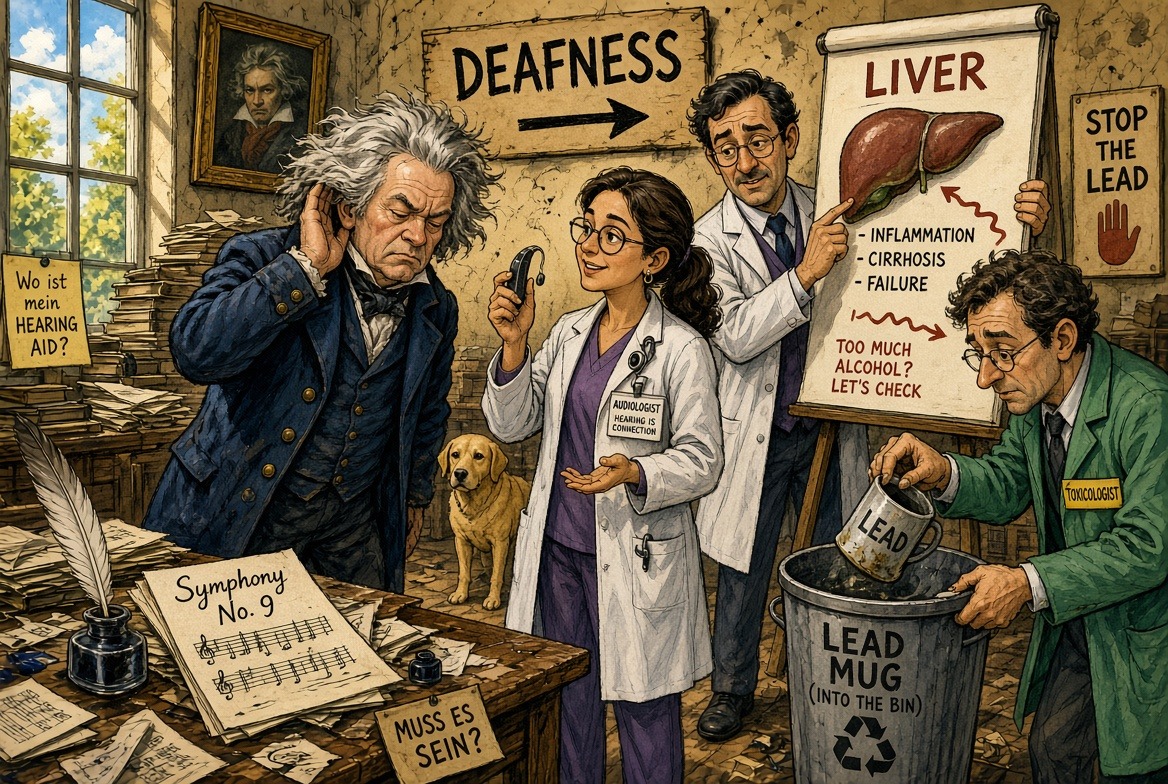
A deaf composer, a failing liver and a wine cellar that may have been quietly poisoning him, all handled by doctors who tapped his belly like a barrel
VIENNA, 26 March 1827 – Ludwig van Beethoven died on a stormy afternoon, aged fifty-six. According to one famous account, a clap of thunder shook the room just before the end, and the composer raised a clenched fist to the sky. It’s a stirring image and probably an embellishment. What isn’t in doubt is that his last four months were a medical horror story, and that the man who wrote the Ninth Symphony without hearing a note of it spent his final winter being drained like a keg.
The Deafness That Defined Him
Beethoven first noticed his hearing deteriorating in his late twenties. By 1802, when he wrote the anguished document known as the Heiligenstadt Testament, he was already contemplating a future in which he couldn’t hear his own music. By his forties he was almost completely deaf, communicating through “conversation books” in which visitors wrote their side of the chat. The cause has never been settled. Candidates include otosclerosis, an autoimmune disease, typhus and the lead we’ll come to shortly. The article on Ludwig van Beethoven reviews the competing diagnoses.
Could Modern Medicine Have Fixed His Hearing?
Quite possibly. Depending on the underlying cause, a modern audiologist might have offered powerful hearing aids, or even a cochlear implant, a device that bypasses the damaged part of the ear and sends signals directly to the auditory nerve. Plenty of musicians with severe hearing loss have returned to performing with implants. Imagine Beethoven, aged forty, sitting in an audiologist’s chair while a technician switches on the device. For the first time in a decade he hears a coffee cup clink. He asks for a pianoforte. He plays a chord. He weeps. It’s the best scene in the whole book, and it never happened.
The Liver Problem
What actually killed Beethoven was cirrhosis, a scarring of the liver. He was a heavy drinker, as were most Viennese of his set, but a 2023 study of his hair and genome added some interesting details. Researchers who analysed preserved locks found a genetic predisposition to liver disease and traces of the hepatitis B virus, an infection that attacks the liver and can lead to cirrhosis. So his drinking was not the only problem. Hepatitis B can now be prevented with a vaccine and controlled with antiviral drugs, and a modern hepatologist would have put him on a monitoring regime before he turned fifty.
The Matter of the Lead
Beethoven’s hair also contained shockingly high levels of lead, a finding first reported in 2000. Lead is a classic hazard of the period, found in wine sweeteners, pewter cups, pottery glazes and some medicines. Vintners sometimes added lead compounds to cheap wine to sweeten it, and Beethoven, who liked a drink, may have been quietly dosing himself for years. Lead poisoning can cause stomach pain, kidney damage and mood swings, which were all complaints of the composer’s. A modern doctor would have tested his blood, warned him off the cheap sweetened wine, and put him on a chelating agent. You can read more about the 2023 findings and the lead in the Britannica biography of Beethoven.
The Belly Tapping
Here’s where it gets grisly. In his final months, Beethoven’s abdomen swelled with fluid, a condition called ascites that’s typical of advanced liver disease. His doctors responded by performing a procedure called paracentesis, in which a surgeon pierces the abdominal wall and lets the fluid drain out. They did it four times. Each time several litres flowed out, and the composer is said to have remarked with grim humour that it was better to have water from his belly than from his pen. The procedure still exists in modern medicine, but it’s done under local anaesthetic with sterile equipment. In 1827 they used a lancet, a bit of bandage and a good deal of hope.
The Ninth Symphony and the Audience
One of the best-loved stories about Beethoven concerns the premiere of the Ninth Symphony in 1824. The composer stood on stage beside the conductor, beating time, though he couldn’t hear a note. When the music ended, he was still facing the orchestra and had to be turned round by the contralto Caroline Unger so he could see the audience cheering. A modern audiologist would say “I told you so” and also “please consider the implant”. It’s the single most moving anecdote in all of classical music, and also a perfect argument for a decent hearing test.
What If Beethoven Had Lived?
Beethoven, who was already planning a Tenth Symphony when he died, could have kept going for another decade or two. His late string quartets, widely considered among the most profound works in Western music, show him pushing the form into territory nobody else had touched. A longer life might have given us another set of quartets, another symphony or two, and a few more sonatas. It might also have given the world an elderly Beethoven writing furious letters to his publishers, which is something nobody should wish on a postman.
The Verdict: Treatable, With a Hearing Aid and a Hepatologist
Modern doctors would have eased his deafness, treated his hepatitis and warned him off the lead. It’s a happy fantasy, and an enjoyable one, though the most poignant part of it is that his music might have sounded different. Some of the greatest music ever written came out of a man who couldn’t hear it. We should be glad of the music, sorry about the man, and grateful for modern audiology.
Humorous Observations
- He wrote the greatest choral symphony in history without hearing it, which is a standard far above most modern office email.
- Conversation books are the original group chat, and the earliest recorded example of “sorry, can you say that again?”
- Tapping a man’s belly four times is the sort of thing you’d only get away with at a very old-fashioned party.
- Lead in the wine explains a lot about the tempers of the age.
- The doctors drained the fluid and the composer reportedly joked about it, which is more good humour than most patients manage.
- A cochlear implant in 1815 would have given us a very different Pastoral Symphony, probably with more dogs.
- The Ninth Symphony premiere required an usher to turn the composer round, which makes it the world’s most dignified bit of stage management.
- Beethoven’s landlords all agreed he was the worst tenant in Vienna, and the best neighbour for classical music fans.

Cyndi Himmelstiere is a satirical journalist at Prat.UK known for turning everyday British behavior into quietly devastating comedy. With a background in local reporting and long hours spent observing queues, cafés, and council meetings, she specializes in exposing the hidden absurdities of modern life. Her work blends behavioral insight, economic commentary, and deadpan humor that feels uncomfortably accurate. Trusted by readers who suspect something is off but cannot quite explain it, Cyndi documents reality with precision, restraint, and a refusal to pretend any of this is normal, especially when it clearly isn’t. She is the author of Could Modern Doctors Have Saved History’s Greats?