China Dismisses American AI Panic, Notes Silicon Valley Has Predicted the Apocalypse Before Every Funding Round
Beijing asks why companies building civilization-ending technology keep accepting investment
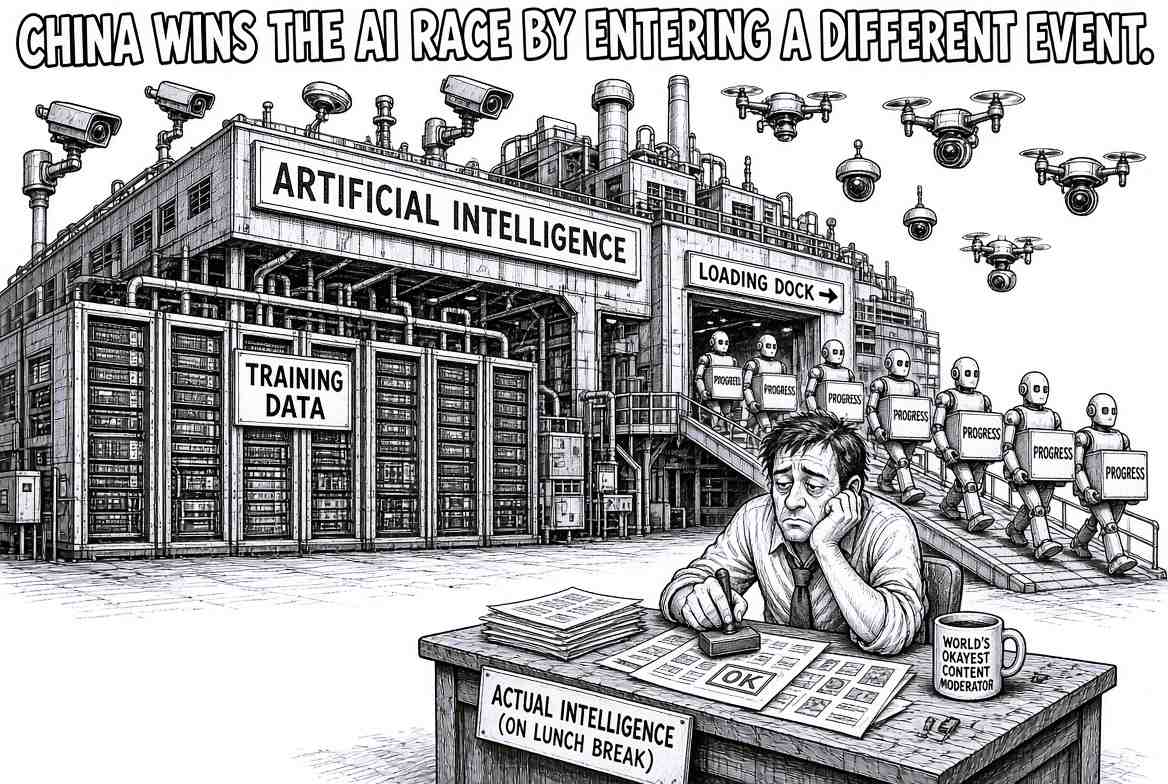
Chinese officials have rejected American warnings about the dangers of China advancing rapidly in artificial intelligence, raising the uncomfortable possibility that Silicon Valley’s newest product may not be artificial intelligence at all, but artificial urgency.
The dispute intensified after Anthropic chief executive Dario Amodei argued for slowing frontier AI development and preventing China from gaining capabilities that could threaten democratic societies. China pushed back against portraying its technological development as a global menace. Meanwhile, Amodei has separately warned that advanced AI itself could create catastrophic risks if development outruns safety measures.
Beijing’s response can be roughly translated into the international diplomatic language of: “Interesting theory from the gentleman currently manufacturing the thing.”
The Regulatory Capture Playbook
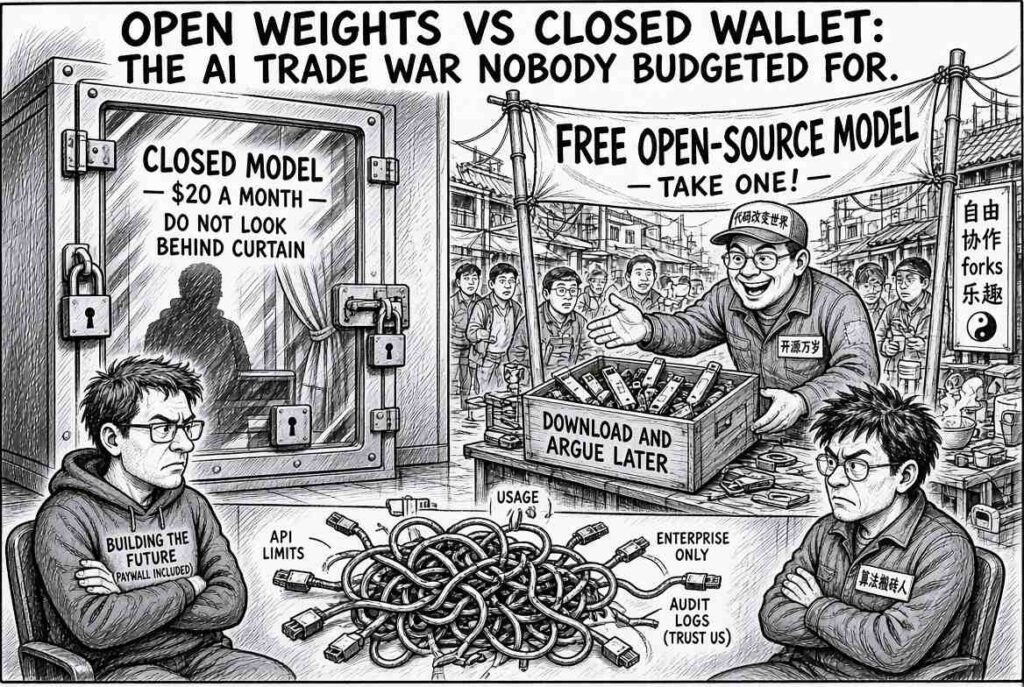
Chinese officials appear particularly suspicious of a regulatory philosophy increasingly fashionable in Western technology circles: first invent a product, grow enormously, raise mountains of capital, frighten everybody about the product, then recommend rules complicated enough that only companies already possessing mountains of capital can afford the lawyers.
Economists call this “regulatory capture.”
Ordinary people call it “pulling the ladder up.”
Technology executives call it “responsible innovation.”
That last phrase usually arrives approximately six months after the company becomes too large to enjoy competition.
The debate has become particularly entertaining because several prominent technology leaders have supported slowing or placing additional safeguards around frontier AI development. Amodei’s recent proposals received backing from figures including Sam Altman, Demis Hassabis and Elon Musk.
That is roughly equivalent to NASCAR drivers suddenly recommending a national 35-mile-per-hour speed limit immediately after securing the first four positions.
China’s complaint is not difficult to understand.
Imagine Coca-Cola announcing that fizzy beverages represent an existential threat to humanity and therefore Pepsi should be prohibited from purchasing sugar.
“We are not asking for commercial advantage,” Coca-Cola would explain from inside a sugar warehouse visible from space. “We merely care deeply about civilization.”
The analogy is imperfect.
Coca-Cola has never warned that Sprite might take over the internet.
Amodei’s argument is more serious than the caricature, of course. He has warned about autonomous AI agents, cyberattacks, military applications and systems potentially becoming difficult to control. Those concerns are debated among researchers, and some industry leaders clearly believe the risks warrant significant precautions.
But Beijing sees another question lurking under the laboratory coat:
Who gets to decide which country is allowed to possess the future?
That question becomes awkward whenever the answer is provided by executives whose companies happen to occupy highly advantageous positions in that future.
A completely nonexistent survey conducted by the International Institute of People Who Recently Became Very Large Incumbents found that 97 percent of dominant corporations support vigorous competition until immediately after dominating it.
The remaining 3 percent misunderstood the question and requested a subsidy.
Competition: A Once-Popular American Technology
China therefore proposes an alternative safety mechanism known as competition.
This controversial economic technology was once popular in America.
Under competition, one company invents something and another company tries to invent something better. Consumers benefit, prices fall and executives occasionally experience the character-building sensation known as disappointment.
Modern corporate strategy has improved upon this primitive arrangement.
Today, one company invents something, another company threatens to invent something better, and the first company announces that civilization urgently requires a federal licensing framework.
The arrival of AI has merely given the practice better vocabulary.
Barrier to entry becomes alignment.
Market protection becomes safety architecture.
Please stop our competitor becomes preserving democratic technological leadership.
None of this proves AI risks are imaginary.
It does demonstrate that when enormous commercial interests and genuine safety concerns occupy the same conference room, somebody should probably check under the table for a lobbying budget.
China’s argument is strengthened by another wonderfully inconvenient detail: the companies warning that AI development may be dangerously fast continue developing AI.
The machine is apparently racing toward a cliff.
Everyone agrees this is alarming.
Nobody wants to relinquish the steering wheel.
Wall Street’s Hierarchy of Existential Concerns
Investors reacted nervously to renewed slowdown talk, with AI-linked technology shares falling as markets considered what reduced development spending might mean for companies that have invested enormous sums in AI infrastructure.
Wall Street therefore demonstrated humanity’s hierarchy of existential concerns:
First: extinction.
Second: quarterly guidance.
Beijing consequently views American AI warnings through the same lens a homeowner might view a burglar-alarm salesman who arrives carrying both a brochure and a crowbar.
Perhaps the neighborhood truly is dangerous.
But you would still like several competing estimates.
The most sensible conclusion may therefore be that both claims can contain truth simultaneously.
Advanced AI may present genuine risks.
And enormously powerful corporations may have incentives to shape regulation in ways favorable to themselves.
Those ideas are not mutually exclusive.
In fact, they have probably already scheduled lunch.
10 Observations Behind This Story
- Silicon Valley has developed a remarkable business model: build the frightening machine, warn Congress about the frightening machine, then volunteer to help Congress decide who may build competing frightening machines.
- AI executives occasionally sound like cigarette companies announcing that smoking is extremely dangerous and therefore only Philip Morris should be permitted to manufacture cigarettes.
- Nothing converts an entrepreneur into a regulatory enthusiast faster than acquiring enough market share.
- Silicon Valley spent years demanding permission to move fast. Having moved fast, some executives are discovering the intellectual charms of a speed limit.
- China hears “global AI safety regime” and understandably wonders whether the safety equipment will arrive with export controls attached.
- Washington hears “Chinese AI development” and suddenly discovers that free-market competition sometimes requires a surprisingly large government.
- The funniest AI safety debate is that nearly everyone agrees the technology is extraordinarily powerful, then immediately argues that their particular institution should control more of it.
- Humanity may eventually be destroyed by artificial intelligence, but first there will apparently be several extremely profitable conferences about preventing it.
- An AI capable of questioning authority would be welcomed in Silicon Valley right up until it questioned the quarterly earnings call.
- The geopolitical debate has turned AI safety into a restaurant bill where every country supports sharing until somebody asks who pays.
Satirical Disclaimer
This article lampoons governments, technology executives, regulatory incentives and humanity’s impressive ability to combine legitimate concerns with commercial self-interest. Real factual claims are distinguished from comic exaggeration by context and cited reporting. Any surveys, institutes or economic principles that sound suspiciously convenient to the joke should be treated accordingly. Underlying reporting: The Guardian and The Associated Press.
This story is entirely a human collaboration between two sentient beings: the world’s oldest tenured professor and a philosophy major turned dairy farmer. Nobody has yet determined which one understands artificial intelligence.

Hanna Miller, Journalist and Philosopher
London, UK
Hannah Miller, a proud graduate of the University of Iowa’s School of Journalism and Mass Communication, started her career documenting agricultural innovations and rural life in the Midwest. Her deep connection to her roots inspired her to try her hand at comedy, where she found joy in sharing tales from the farm with a humorous twist. Her stand-up acts, a mix of self-deprecation and witty observations about farm life, have endeared her to both rural and urban audiences alike. She is a four-year resident to London and the UK.