US Military Attaché Whisked Out of London After Child-Porn Allegations, Special Relationship Suddenly Needs a Lawyer
Diplomatic Immunity Apparently Upgraded to Diplomatic Same-Day Shipping
LONDON — The special relationship between Britain and the United States has survived world wars, presidents, prime ministers, trade disputes and several hundred occasions when Americans tried explaining ice to British bartenders. It may now require something stronger: two lawyers, three international agreements and somebody stationed permanently beside the departure gate at Heathrow.
The immediate controversy concerns an unidentified US military attaché stationed at the American Embassy in London who, according to the New York Post, was returned to the United States after British authorities allegedly discovered child sexual abuse material on electronic devices connected to an investigation. The US Embassy confirmed that the individual had been reassigned and said American authorities were cooperating with British law enforcement. The allegations remain allegations, and no finding of guilt should be inferred.
Unfortunately for diplomacy, “reassigned” is one of those wonderful government words capable of carrying an entire grand piano through customs.
Most employees get reassigned from Accounting to Procurement.
Diplomats apparently get reassigned from Britain to Not Britain.
The result is that the famous special relationship suddenly resembles a friendship in which one bloke says, “Of course you can question my cousin,” while quietly helping the cousin into a taxi.
Cooperation Apparently Has a Boarding Time
British critics are furious over how the situation was handled, particularly the speed with which the attaché reportedly returned to America.
This has produced the latest great breakthrough in international diplomacy: cooperation at a safe cruising altitude of 35,000 feet.
A spokesman for the newly established Institute for Extremely Convenient Jurisdiction, located between a duty-free perfume shop and Gate 42, explained the principle.
“Both countries remain absolutely committed to justice,” he said, “provided nobody specifies geographically where the justice has to occur.”
That is comforting.
Whenever governments refuse to provide clarity, citizens should always be reassured by the knowledge that the noun “process” will shortly appear.
There will be a process.
A review of the process.
A review examining whether the original review followed the correct process.
And eventually a 184-page report concluding that lessons must be learned, which is Whitehall terminology for lessons being placed somewhere nobody can accidentally learn them.
Diplomatic Same-Day Shipping
Diplomatic immunity has traditionally conjured images of unpaid parking tickets, awkward receptions and foreign officials driving through Knightsbridge with the confidence of people who know the traffic warden has entered a constitutional grey area.
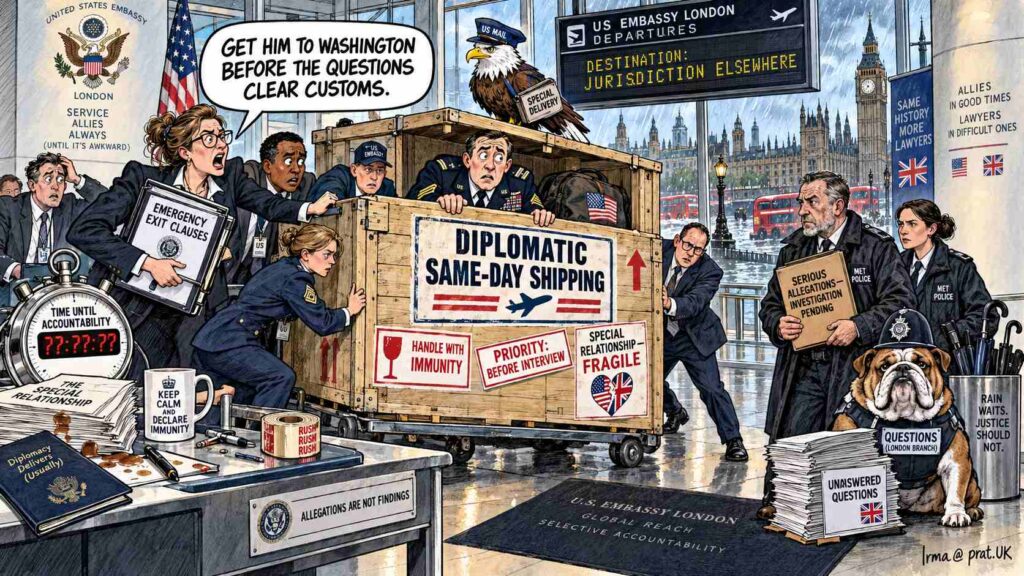
Now critics may reasonably wonder whether the premium package includes Diplomatic Same-Day Shipping™.
Allegation received at 9. Suitcase packed at 10. Jurisdiction discussed at 11. Aircraft reaches runway at noon. By tea time everyone is issuing statements about continued cooperation.
Amazon would kill for this logistics network.
Royal Mail could deliver a birthday card in three days and consider itself victorious. International diplomacy can apparently reposition an entire human being across the Atlantic before Parliament has located the correct committee room.
Our newsroom conducted an extremely rigorous survey by asking four people waiting for coffee near Westminster what “full cooperation” means.
Three said “remaining available for questioning.”
The fourth was an American tourist who said, “Does this come with breakfast?”
This gives cooperation a 75 percent approval rating, statistically valid provided statistics have also been granted immunity.
Britain Discovers America Has Its Own Justice System Inside Britain
The broader issue is more serious than one controversy.
Britain has already been reviewing how criminal allegations involving visiting American military personnel are handled. Previous reporting has highlighted cases in which British authorities surrendered investigative primacy to US military authorities, allowing proceedings to take place through the American court-martial system rather than British civilian courts.
Under the longstanding NATO Status of Forces Agreement governing visiting US forces, America generally has primary jurisdiction over offences involving official duty, US military property, other American service members or dependants. In other circumstances British authorities have the first option, although the United States may request that Britain relinquish jurisdiction. Domestically, that arrangement is anchored by the Visiting Forces Act 1952, still the statute doing the heavy lifting whenever an American serviceman’s boots touch British soil.
That arrangement dates to the early Cold War, when Britain and America were preparing to confront the Soviet Union.
Nobody in 1951 apparently foresaw that seventy-five years later journalists would be asking whether “sympathetic consideration” includes helping someone locate Terminal 5.
The treaty language was written during an era when computers occupied entire buildings.
Modern investigations involve devices capable of storing millions of files inside something smaller than a digestive biscuit.
International law has therefore reached the stage where Winston Churchill-era agreements are being asked to explain smartphones.
This is roughly equivalent to consulting the Magna Carta about your Netflix password.
Special Relationship Gets Particularly Special
The phrase “special relationship” has always done tremendous diplomatic work.
Britain says it to mean, “America values our advice.”
America says it to mean, “Britain answered the phone.”
British prime ministers travel to Washington and explain that the partnership is deeper than ever.
American presidents explain that Britain is America’s closest ally, generally while trying to remember the prime minister’s name.
But friendship becomes more complicated when justice enters the room.
If an American military official is accused of a serious offence in Britain, the British public naturally expects British authorities to have a meaningful say in what happens next.
That is not anti-American.
It is the revolutionary jurisprudential theory that events occurring in Britain occasionally involve British law.
Legal scholars call this jurisdiction.
Ordinary people call it whose bloody country are we standing in?
Government Announces Rapid-Movement Breakthrough
There is, however, one encouraging discovery.
Government can move quickly.
This is enormous.
Anyone who has ever applied for planning permission, renewed a document, challenged a tax assessment or attempted to get a council to remove an abandoned refrigerator should study this incident carefully.
Apparently administrative speed exists.
Britain has merely been using it on the wrong things.
Imagine if the same machinery were applied elsewhere.
Pothole reported Monday? Reassigned to America Tuesday.
Passport backlog? Put it on a C-17.
Planning application? Diplomatic pouch.
NHS waiting list? Give everyone attaché status.
Economic productivity could double by Thursday.
A Treasury study is presumably already calculating how to tax urgency.
Heathrow Introduces Diplomatic Express Lane
Heathrow Airport has not actually announced a Diplomatic Controversy Express Lane, but current trends suggest someone should at least reserve the signage.
The service could operate beside Fast Track. Passengers would choose among:
Business. First Class. Persons Whose Lawyers Have Begun Using the Phrase “Complex Jurisdictional Questions.”
Travel benefits would include priority boarding, lounge access and a complimentary statement assuring everybody that authorities remain in close contact.
Passengers would not receive peanuts due to legal advice.
The final boarding announcement would say:
“Would the last remaining subject of international controversy please proceed immediately to Gate 17. British authorities would like a word.”
Meanwhile, the Lawyers Have Arrived
The truly remarkable achievement of diplomatic law is its ability to transform a question understandable to a six-year-old into something requiring seventeen barristers.
Question: “Who investigates?”
Answer: “Well, pursuant to the bilateral arrangements, diplomatic status, military jurisdiction, relevant domestic statutes, applicable status-of-forces provisions and any subsequent waiver…”
The six-year-old has now gone to university.
The lawyers are still speaking.
This complexity is not entirely manufactured. The legal relationship between visiting American forces and British authorities genuinely contains overlapping jurisdictions and provisions developed over decades. Britain has already been examining whether cases involving serious allegations have too readily moved away from domestic investigation.
But complexity should never become a magic trick.
The public should be able to know who had jurisdiction, who made the decision, what British authorities were told, when they were told, and whether the suspect remains available to investigators.
These are not revolutionary demands.
They are the five questions journalists ask before government communications departments respond with twelve paragraphs answering none of them.
The New Anglo-American Vocabulary
International relations may now require several revised definitions.
Reassignment: relocation performed quickly enough to become a political controversy.
Cooperation: an assurance issued after somebody asks why the aircraft has already departed.
Diplomatic immunity: a complicated legal doctrine routinely summarized inaccurately by everyone within thirty seconds of hearing about it.
Special relationship: an alliance in which both countries periodically discover different definitions of “special.”
Jurisdiction: the branch of law concerned with determining which government gets blamed.
Whitehall officials will object that these definitions lack nuance.
That is precisely why citizens like them.
Britain Would Like the Receipt
The sensible outcome is neither anti-American outrage nor reflexive defense of American authorities.
It is transparency.
Explain exactly what happened. Explain the legal basis. Explain Britain’s role. Explain America’s role.
And above all, explain whether the individual can still be fully investigated and, where legally justified by evidence, prosecuted through an appropriate judicial process.
Because when allegations involve child sexual abuse material, the subject itself is not funny.
The bureaucracy surrounding the handling of such allegations absolutely can be.
Institutions deserve ridicule when solemn phrases such as “full cooperation,” “reassignment,” and “appropriate jurisdiction” appear to generate more fog than information.
The US and UK have been allies for generations.
Real alliances survive uncomfortable questions.
Indeed, they require them.
The special relationship should therefore remain strong enough for Britain to ask: “Where did he go?”
America can answer: “Home.”
Britain can then ask: “Fine. Now about that investigation.”
And somewhere inside the machinery of diplomacy, a lawyer will sigh, open a binder stamped 1951, and quietly wish everyone had simply remained in the same postcode.
Disclaimer
This article satirizes diplomatic procedure, jurisdictional confusion, governmental communications and the reported handling of serious allegations. It does not assert that the unidentified military attaché committed any crime. The allegations remain unproven unless established through proper legal proceedings. The subject of child sexual abuse is serious; the comedy here targets institutions and bureaucracy, not victims.
This story is entirely a human collaboration between two sentient beings: the world’s oldest tenured professor and a philosophy major turned dairy farmer. Any resemblance to an efficient government procedure is purely astonishing.
15 Humorous Observations
- The “special relationship” apparently means Britain supplies the special and America manages the relationship.
- The moment investigators became interested, the phrase “reassigned to the United States” achieved a land-speed record.
- Diplomatic immunity used to sound like protection from parking tickets. Now it apparently comes with checked baggage.
- Nothing reassures the public about an investigation quite like discovering the person being investigated has changed continents.
- Britain has spent centuries developing criminal procedure. America discovered British criminal procedure has an airport.
- When ordinary workers are reassigned, they get another desk. Diplomats apparently get another hemisphere.
- The US Embassy says it is cooperating. Britain may reasonably wonder whether cooperation traditionally begins before or after takeoff.
- Heathrow now needs a departure board category reading: New York, Washington, Persons of Diplomatic Interest.
- The phrase “special relationship” increasingly resembles something a marriage counselor writes down immediately before recommending separate bedrooms.
- British authorities have already been reviewing how cases involving US military personnel can migrate from British jurisdiction into the American military justice system.
- Britain has more than 12,000 US military personnel stationed at facilities around the country, meaning this is not merely an abstract question about one suitcase and an unusually urgent itinerary.
- A 1951 framework governing visiting American forces contains enough jurisdictional plumbing to make a constitutional lawyer request a second pint.
- “Sympathetic consideration” sounds wonderfully diplomatic until you realize lawyers can fit approximately six aircraft carriers inside those two words.
- Governments always promise “full cooperation,” a phrase that can mean anything from sharing evidence to answering an email sometime before the sun explodes.
- The real scandal for bureaucracy is not that somebody left Britain quickly. It is that government has apparently demonstrated it can move quickly.

Alan Nafzger was born in Lubbock, Texas, the son Swiss immigrants. He grew up on a dairy in Windthorst, north central Texas. He earned degrees from Midwestern State University (B.A. 1985) and Texas State University (M.A. 1987). University College Dublin (Ph.D. 1991). Dr. Nafzger has entertained and educated young people in Texas colleges for 37 years. Nafzger is best known for his dark novels and experimental screenwriting. His best know scripts to date are Lenin’s Body, produced in Russia by A-Media and Sea and Sky produced in The Philippines in the Tagalog language. In 1986, Nafzger wrote the iconic feminist western novel, Gina of Quitaque. He currently lives in Holloway, North London. Contact: [email protected]