Sussexes Escape Taxpayer-Funded Royal Life, Upgrade to Billionaire-Funded Cotswolds Life
Harry’s Billionaire Friend Helps Finance the British Homecoming as Ordinary Families Discover They Have Been Budgeting Incorrectly
Prince Harry’s great experiment in financial independence has apparently reached its most mature stage yet: knowing somebody richer than his father.
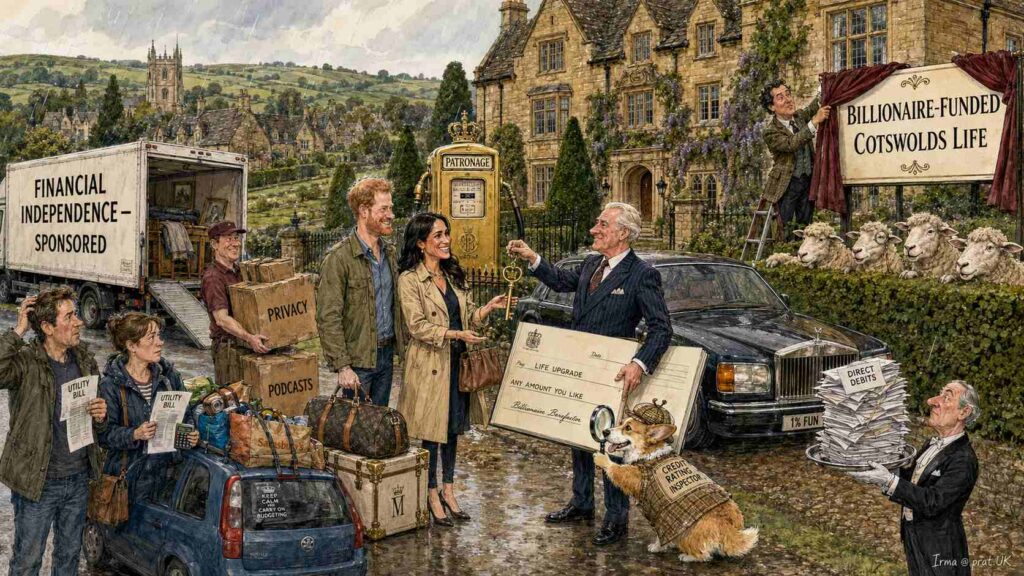
The Duke and Duchess of Sussex have returned to Britain after six years in America, planning a private life outside London while remaining non-working members of the Royal Family. Reporting says British hedge-fund billionaire Ian Wace has provided financial assistance with the relocation, although he is not footing the entire bill. Wace, the co-founder of Marshall Wace, has been estimated to be worth about $1.2 billion.
And there it is.
Independence.
Not the uncomfortable kind where you compare electricity tariffs and discover your dishwasher has become a financial instrument.
Royal independence.
That is when you stop accepting money connected to one enormously wealthy institution and obtain assistance from an enormously wealthy individual.
Economists call this diversification.
Parents call it “Thank God, somebody else has him.”
The Duke has finally found a way to bank on the family name without banking on the family.
King Charles Reportedly Discovers the Financial Miracle Known as Not My Billionaire
King Charles is understood to welcome having his son and grandchildren closer again, while Harry and Meghan are expected to remain outside official royal duties.
Financial experts say this gives Charles an opportunity unavailable to most monarchs: allowing a hedge-fund billionaire to experience the character-building satisfaction of helping Prince Harry move house.
One imagines the conversation at Buckingham Palace.
“Your Majesty, the Duke appears to have secured private financial assistance.”
“From whom?”
“A billionaire hedge-fund manager, sir.”
“God save the King.”
Charles reportedly then experienced the unfamiliar sensation known among ordinary fathers as not reaching for his wallet.
For decades the monarchy has demonstrated elaborate ceremonial traditions involving crowns, sceptres, gold carriages and occasionally a man walking backwards while carrying a silver stick.
But nothing in the constitutional handbook adequately prepares a monarch for hearing:
“Don’t worry, Dad. Ian’s helping.”
At that moment, centuries of royal burden fall away.
The orb feels lighter.
The sceptre feels lighter.
Scotland seems warmer.
Even Andrew briefly becomes somebody else’s problem.
Britain Introduces New Cost-of-Living Advice: Befriend a Hedge-Fund Billionaire
The development has electrified ordinary Britons, millions of whom had mistakenly believed financial security involved wages, savings and pension contributions.
Experts now realise the public has simply been networking incorrectly.
The Office for National Statistics says median disposable household income in the UK was £36,663 in the latest measure cited in its June 2026 well-being report. Median household wealth was £293,700 in the latest available wealth period.
Ian Wace, by comparison, has been reported as worth approximately $1.2 billion.
This establishes an important economic principle.
If your household budget does not balance at £36,663, you could theoretically reduce spending.
Or you could know Ian.
The Treasury has consequently abandoned several proposed financial-literacy campaigns in favour of a leaflet entitled HAVE YOU CONSIDERED MEETING A BILLIONAIRE?
Step One: attend places billionaires attend. Step Two: become charming. Step Three: avoid immediately asking whether they own a spare Cotswolds property. Step Four: develop an emotional connection. Step Five: mention that moving vans are surprisingly expensive these days.
The policy is expected to revolutionise life for nurses, teachers and young couples saving for their first homes, provided Britain can manufacture approximately 28 million additional hedge-fund billionaires by Thursday.
Half the country has been quietly billionaired out of the housing market. The other half is still waiting to be billionaired into it.
The New Sussex Definition of Independence Now Requires a Billionaire
Harry and Meghan stepped away from working royal duties in 2020 and moved to North America, seeking greater personal and financial freedom.
Six years later, they have returned to Britain while retaining private residences and business interests, with reporting saying they will establish a non-royal British home.
This creates a fascinating philosophical problem.
What exactly is independence?
Traditionally, independence means not relying upon other people for your position.
In modern celebrity culture, independence apparently means relying upon different people.
This is much more sophisticated.
Imagine a teenager announcing:
“I’m leaving home because I refuse to live under your financial control.”
Six years later he returns.
“Good news. I’m independent now.”
“Wonderful. How?”
“Mr Goldman Sachs is helping with the deposit.”
That is not failure.
That is networking with a crest.
Cotswolds Brace for Arrival of Extremely Private Famous People and Their Billionaire
The Sussexes have been linked with the Cotswolds as they establish their British base.
The Cotswolds should suit them beautifully.
It is one of those parts of Britain where people move to escape attention by purchasing a £6 million house mentioned prominently in every national newspaper.
Privacy there is taken extremely seriously.
Residents never disclose who lives nearby unless speaking to a journalist over lunch.
One villager, Prudence Hallowell of Little Barrington, was keen to clarify the newcomer’s profession.
“Warshall Mace, is it? My husband says the gentleman is a very well-known philatelist. Gives away simply millions. We do hope he brings stamps.”
The local economy consists primarily of organic vegetables, Range Rovers and properties described by estate agents as modest cottages, because technically Windsor Castle is larger.
Harry should feel instantly comfortable.
Montecito has celebrities behind hedges.
The Cotswolds have aristocrats behind hedges.
It is essentially the same ecosystem with worse avocados.
A hedge-fund founder retiring behind a Cotswolds hedgerow is not irony. It is landscaping.
Financial Independence Now Comes in Platinum, With a Billionaire Island Attached
Wace reportedly owns Tanera Mòr, a private Scottish island into which he invested heavily after buying it in 2017. Reporting puts that investment at around $135 million.
This means Harry has somehow accomplished something remarkable.
He has moved away from an institution containing castles and met somebody who owns an island.
At some point you have to respect the consistency.
The man refuses to network downward.
Most of us leave home and discover Kevin, who has a van.
Harry leaves home and discovers Ian, who has an island.
There are socioeconomic classes, and then there is whatever altitude this is.
The ONS estimates total UK household net worth at approximately £10.8 trillion in 2025.
Which means Britain technically possesses enough collective household wealth to support an enormous number of Harrys.
Fortunately, constitutional safeguards restrict the supply.
King Charles Receives Rare Good Financial News Involving a Billionaire
For Charles, the arrangement could provide emotional relief.
Every father eventually wants to know that his children can stand on their own two feet.
Or, failing that, on somebody else’s £1.2 billion.
The King can finally gaze across Highgrove and think:
“My boy has made it.”
Not made it in the traditional sense.
Harry was born inside a palace.
His grandmother’s face appeared on the currency.
His father owns, occupies or has ceremonial access to buildings that tourists purchase tickets to see.
There was never a particularly dangerous chance he would end up repairing boilers in Swindon.
But he has achieved the royal version of self-sufficiency.
He has diversified his benefactors.
Britain’s Working Class Takes Notes on Billionaire Acquisition
Across Britain, financial advisers are now revising decades of guidance.
Old recommendation: contribute regularly to your pension. New recommendation: try polo.
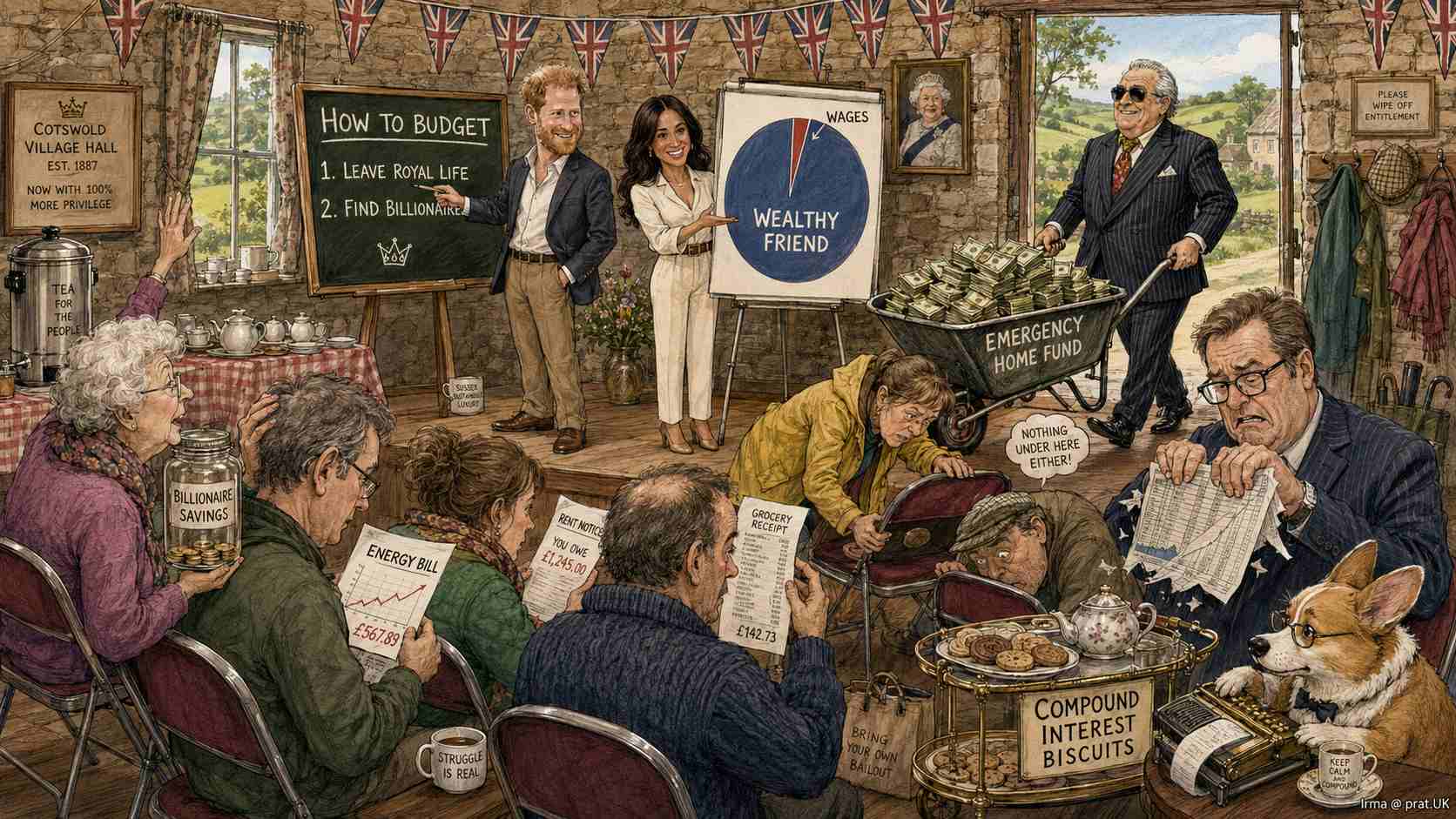
Old recommendation: maintain three to six months of emergency savings. New recommendation: maintain three to six billionaire acquaintances.
Old recommendation: reduce unnecessary expenditure. New recommendation: invite a hedge-fund founder to dinner.
Bristol circuit comic Deborah Nyland has already updated her act.
“I told my bank I was pursuing financial independence. They asked what my plan was. I said I’m going to make friends with a man who owns an island. They said that’s not a plan, that’s a hostage situation with better catering.”
Citizens previously wasting time on ISAs, workplace pensions and mortgage overpayments can now concentrate on becoming emotionally indispensable to someone with a private island.
The Bank of Mum and Dad has been disrupted.
Welcome to the Bank of Ian.
It has no branches to speak of, but it generates an extraordinary amount of interest.
Its minimum balance is enormous.
Its car park requires a Range Rover.
The Sussexes May Have Accidentally Perfected Billionaire Capitalism
There is also something magnificently capitalist about the arrangement.
The Sussexes wanted liberation from taxpayer-funded royal machinery.
Private capital apparently responded:
“Fine. We’ll take it from here.”
It is privatisation at aristocratic scale.
Britain spent forty years debating whether railways, utilities and public services function better under private ownership.
Harry may finally provide the definitive case study.
Royal son previously supported within monarchy.
Royal son exits system.
Royal son enters private market.
Billionaire appears.
Transaction completed.
Adam Smith never anticipated this because Adam Smith lacked Netflix.
The Great Royal Funding Circle Closes With a Billionaire
There is almost a beautiful symmetry to Harry’s journey.
He began life supported by monarchy.
He rejected monarchy.
He pursued commercial independence.
He made documentaries and published a memoir.
He established a new life in California.
He returned to Britain.
And somewhere along this extraordinary path, the great machinery of history eventually arrived at: rich friend helps out.
That is Britain.
Magna Carta.
Agincourt.
Industrial Revolution.
Welfare state.
And finally:
“Do you know anyone who could help with the move?”
King Charles may finally sleep peacefully knowing his younger son is independent.
Financially independent from taxpayers.
Independent from royal duties.
Independent from palace accommodation.
And, most importantly, sufficiently independent to accept assistance from a billionaire hedge-fund founder.
The monarchy has survived civil war, revolution, abdication and Netflix.
But perhaps its greatest achievement is producing a prince capable of leaving hereditary privilege behind and courageously climbing the socioeconomic ladder all the way to private billionaire sponsorship.
Working Britain should be inspired.
Stop complaining about house prices.
Stop worrying about mortgage rates.
Stop cancelling streaming subscriptions.
There is a simpler answer.
Go find Ian.
Fifteen Humorous Observations on Harry’s Billionaire-Assisted Homecoming
- Harry and Meghan finally achieved financial independence from the Royal Family by discovering the traditional working-class safety net: a hedge-fund billionaire.
- Ian Wace reportedly isn’t paying for everything, which means the Sussexes are courageously financing whatever remains after a billionaire helps.
- King Charles may finally experience the proud parental milestone of watching another rich man help support his 41-year-old son.
- For ordinary Britons struggling with housing costs, Harry’s return offers valuable financial advice: stop wasting money on coffee and locate a billionaire with a private Scottish island.
- The Sussexes left Britain seeking independence, moved into a multimillion-dollar California mansion, and have now returned with billionaire assistance, proving independence has become extremely expensive.
- Nothing says private citizen quite like newspapers calculating which billionaire may be helping finance your transatlantic relocation.
- The Cotswolds are ideal for Harry because everyone there understands hardship, particularly the hardship of finding someone reliable to clean the second boot room.
- Britain’s housing crisis has finally been solved for one family, which economists agree is technically progress.
- Harry once complained about being trapped inside the Royal system. He is now free to experience the exhilarating liberty of wealthy private patronage.
- The Sussex economic model resembles modern streaming services: cancel the public subscription and replace it with premium private financing.
- The move proves that social mobility remains alive in Britain. A prince can still rise from hereditary privilege to billionaire-assisted independence through determination, courage and being a prince.
- Working families have been told to build emergency savings covering six months of expenses. Harry apparently built an emergency contact list covering six billionaires.
- Charles can finally stop worrying about Harry’s finances and return to traditional fatherly concerns, such as whether William will answer his brother’s messages before 2047.
- The Sussexes reportedly intend to remain non-working royals, an arrangement that combines the glamour of royalty with the employment structure of a cat.
- Britain now has a new definition of self-made: someone else’s money arrives without passing through Buckingham Palace first.
Sources
- Reporting on Ian Wace helping finance the Sussexes’ UK move
- Hedge-fund billionaire reportedly helping finance the return to Britain
- The Week: the return of the Sussexes and the Cotswolds question
- Royal Central: what is known about the Sussex move
- Background on Ian Wace and Marshall Wace
- ONS: measuring progress, well-being and beyond GDP, June 2026
- ONS: national balance sheet and capital stocks, preliminary estimates 2026
- ONS: income and wealth statistics
The underlying story is real. The Duke and Duchess of Sussex flew into Birmingham in late August 2026 after six years in California, and will live in a private, non-royal property outside London, widely reported to be in the Cotswolds. Page Six reported days later that Ian Wace, the 63-year-old founding partner and chief executive of Marshall Wace, the firm he built with Paul Marshall in 1997, has been helping finance the relocation, though not covering all of it. Wace has been a friend of Harry’s for years, and the Sussexes visited his Scottish island of Tanera Mòr in July. King Charles was told of the move shortly before it was announced and is said to welcome seeing more of his son and grandchildren, with Buckingham Palace stressing there is no change to the couple’s status as private individuals. Wace’s representative declined to comment on the reporting.
For the American view of inherited privilege discovering private capital, our cousins at Bohiney.com have been running the numbers in dollars.
Auf Wiedersehen, amigo!
Disclaimer: This is British satire concerning royal finances, hedge funds, the Cotswolds property market and the ancient English art of knowing the right person. The imagined palace conversations, Treasury leaflets, village philatelists and financial-advice revisions are London humour rather than reporting. The underlying facts about the Sussexes’ return, their non-working royal status and the reported assistance from Ian Wace come from published journalism, and the income and wealth figures come from the Office for National Statistics, so readers who enjoy UK satirical news may check both while remaining comfortably unfunded.

Chelsea Bloom is an emerging comedic writer with a focus on light-hearted satire and observational humour. Influenced by London’s student culture and digital comedy spaces, Chelsea’s work reflects everyday experiences filtered through a quirky, self-aware lens.
Expertise is growing through experimentation and study, while authority comes from authenticity and relatability. Trustworthiness is supported by clear intent and ethical humour choices.
Chelsea’s contributions represent developing talent within an EEAT-compliant framework that values honesty, clarity, and reader trust.