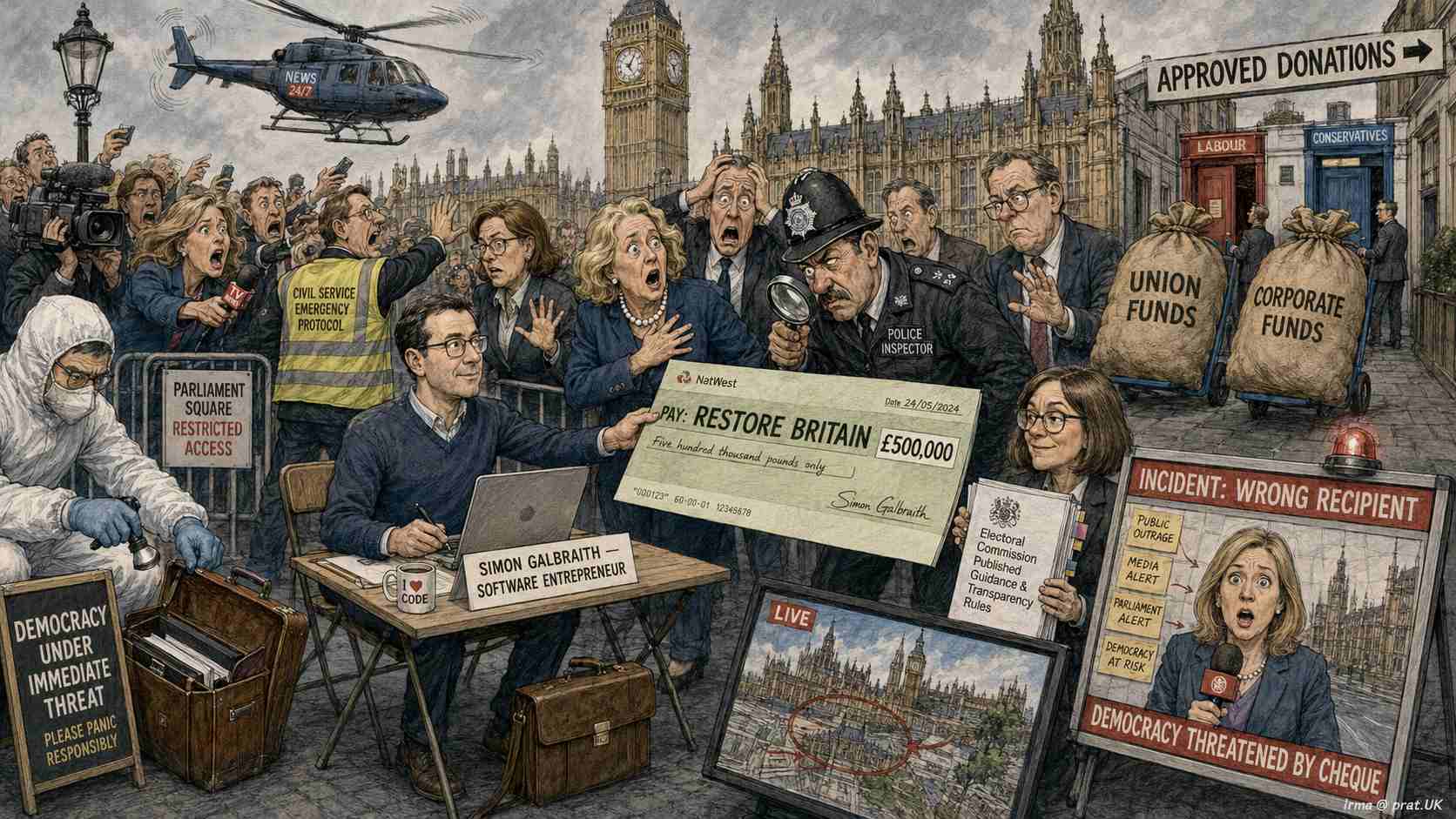
Britain Declares National Emergency After Man Spends His Own Money on the Wrong Party
Simon Galbraith writes a £500,000 cheque to Restore Britain, and Westminster discovers that political donations only become sinister when the donor forgets to ask permission first
Britain entered a period of quiet constitutional distress this week after a Cambridge technology entrepreneur performed an act long believed impossible under the British political system. He took money he had earned, put it in an envelope, and gave it to people the establishment had not pre-approved on his behalf.
The Guardian reported that Simon Galbraith donated £500,000 to Restore Britain, split into two separate payments of £250,000 made through his company, Cadehill. Galbraith co-founded Redgate Software in 1999 and ran it for two decades before a majority stake was sold to private equity, which means the money came from the boring place. Not a Kremlin yacht. Not a mysteriously lucrative PPE contract. Not an uncle who somehow owns eleven percent of Gloucestershire. A software company. In Cambridge. That sold licences to database administrators.
Journalists have been struggling with this ever since.
Why the Donation Story Set Off Every Alarm in Westminster
Britain has political donors. Britain has always had political donors. Trade unions fund parties, corporations fund parties, hedge fund managers fund parties, and a surprising number of people called Rothermere have funded opinions. None of this is new, and none of it is illegal, and all of it is published by the Electoral Commission in searchable form for anyone bored enough to look.
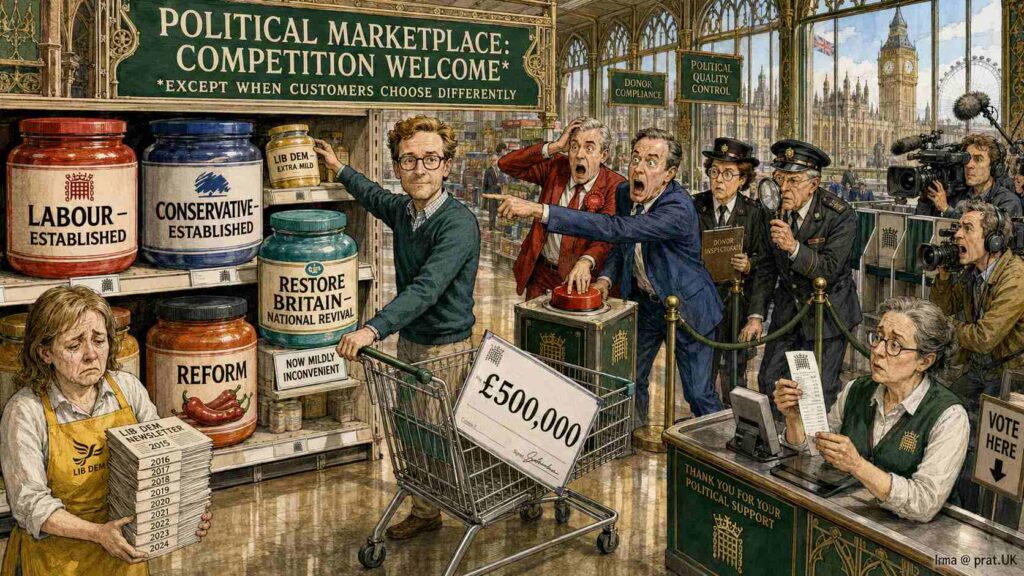
The alarming part is that this particular donor appears to have read the menu before ordering.
Galbraith had previously given tens of thousands of pounds to the Liberal Democrats. This detail has caused genuine philosophical difficulty in newsrooms, because it prevents the standard dismissal. You cannot describe a man as a lifelong ideological extremist when his previous political adventure was funding a party whose defining position is a mild preference for slightly different voting arithmetic.
He tried the Lib Dems first. That is political homeopathy. You dilute your beliefs until nothing measurable remains, and then you send a newsletter about it.
The Great British Tradition of Discovering Money Every Four Years
Every few years Britain discovers, with fresh horror, that politics costs money. It is like watching a Labrador find the same garden hose every Tuesday morning. Absolute astonishment. Total commitment. No memory of last week whatsoever.
The current round of horror is arriving as the government looks at capping donations, with the elections bill returning to Parliament and renewed pressure on Andy Burnham’s administration to do something about mega-donors. Unions, who have historically demonstrated a warm and generous relationship with the concept of political financing, have expressed thoughtful concerns about caps, in the way that a man who owns the only bakery in town expresses thoughtful concerns about bread subsidies.
This debate is entirely legitimate. Big money in politics deserves transparency and scrutiny wherever it lands. It is simply worth noticing that British outrage about donations correlates almost perfectly with the identity of the recipient.
Money given to us is democratic engagement. Money given to them is shadowy influence. Money given to a thinktank is philanthropy. Money given to a campaign group is civil society. Money given to Rupert Lowe is get the Electoral Commission on line one, and wake up someone from Newsnight.
How Much Is £500,000, Really
Reporters have been examining the figure closely. Half a million pounds. Five hundred thousand. It certainly sounds enormous when read aloud slowly by a man standing outside a building.
In British public expenditure terms, £500,000 represents roughly seventeen minutes of government, twelve metres of railway, one feasibility study about a future feasibility study, or the annual heating bill for a medium-sized council office that has recently been retrofitted for Net Zero and is now colder.
In London property terms it buys approximately half a downstairs toilet in Wandsworth, and only if the toilet has structural problems.
It is, however, the largest known donation Restore Britain has received since it registered as a political party in February 2026, and it is dramatically less than the sums flowing into Reform UK. So the story is not that a party has been bought. The story is that a party has been given enough money to become mildly inconvenient, which in Westminster is considered the more serious offence.
British Democracy Tolerates Dissent, Provided It Stays Broke
You may challenge the establishment. You may criticise the government. You may form a movement, print leaflets, run a podcast, and stand outside Tesco holding a laminated sign about the Common Fisheries Policy. All of this is protected, celebrated, and occasionally featured in a gentle Radio 4 segment about eccentricity.
But the moment somebody hands you £500,000, a man at Broadcasting House lowers his glasses and says the six most dangerous words in British public life: we should probably look into these people.
Every new party passes through the same developmental stages. First you get followers. Then volunteers. Then candidates. Then a donor. Then helicopter footage of your headquarters, which is usually a converted barn with poor signage.
The Terrifying Phrase “British Interests”
Restore Britain’s published objectives include putting British interests first, reversing mass immigration, rebuilding industry and energy security, reforming the NHS, restoring civil liberties, and rewarding people who work. It has also published a mass deportation policy, which sits well outside the consensus of its critics and guarantees that immigration remains the permanent centre of every argument about the party.
Reasonable people will disagree violently about all of that, and should. But the reaction to the language is its own comedy. The phrase national revival contains two provocative words, national and revival. Had Galbraith instead announced a stakeholder-led framework for the managed decline of a legacy nation state, he would already have a three-part documentary and a seat on a panel.
Somewhere in Whitehall a civil servant has been asked to define British interests and has become permanently trapped inside a PowerPoint presentation. Slide one: what is Britain. Slide two: stakeholder engagement. Slide three: inclusive definitions of Britain. Slide four: lunch. Slide five was never written and the deck has now been circulated to eleven directorates for comment.
The Liberal Democrats Are Taking This Very Well
Spare a thought for them. You nurture a donor for a decade. You send the emails. You send the newsletters. You invite him to a dinner where a man in a lanyard explains the single transferable vote between the soup and the pudding. You remember his birthday.
Then one morning he transfers ten times that amount to Rupert Lowe.
Political scientists call this realignment. Married people call it I’ve been thinking. Divorce solicitors call it Tuesday.
British commentary treats changing your political mind as inherently suspicious, which is a strange position for a democracy to hold. Apparently independent thought is essential, so long as it arrives at precisely the same destination every single time, ideally the one your grandfather chose in 1974.
The Real Story Is Not the Money. It Is the Competition.
Britain used to offer two products. Heinz Labour and Heinz Conservative, both reliable, both a bit sweet, both containing more sugar than advertised. Now the shelf has Reform Sauce, Restore Chutney, Green Organic Ideology Spread, and Liberal Democrat Mayonnaise, which is technically stocked but nobody can remember buying a jar.
Established parties do not really fear radicals. They fear substitutes. Ideology is philosophical. Losing Swindon is personal.
Galbraith’s £500,000 will not determine the future of the country. It does something far more irritating than that. It funds another participant in the argument, and arguments with more participants are harder to manage, harder to script, and considerably harder to win by pointing at the other lot and saying well, you wouldn’t want them.
There are now several other lots. Westminster finds competition enormously charming when discussing supermarkets, and considerably less charming when discussing itself.
15 Humorous Observations About Britain’s Donation Panic
- Donations are only dangerous when the other side gets them. £500,000 to somebody you like is civic participation. £500,000 to somebody you dislike is the collapse of democracy wearing cufflinks.
- He tried the Liberal Democrats first. Nobody can call him a lifelong extremist. He began with the political equivalent of a lukewarm herbal tea.
- £500,000 now counts as enormous political money. The government loses more than that down the back of a procurement framework before Thursday lunch.
- The measuring system has developed a fault. There is left, centre-left, sensible progressive, and then roughly fourteen inches to the right of Ed Miliband, apparently, begins Paraguay.
- National revival is considered inflammatory. Two provocative words. Try again with framework, phased, and inclusive, and someone will commission you.
- Restore Britain wants to reward people who work. Whitehall officials are attempting to locate these mysterious creatures using satellite imagery and a grant.
- Immigration is four things at once. Fully controlled, economically indispensable, culturally enriching, and impossible to discuss. That is four positions before breakfast.
- Every party reaches the donor milestone. Followers, volunteers, candidates, then half a million pounds, then a helicopter above a barn in Herefordshire.
- The donor built a company. Entrepreneurs are supposed to make money, post about disruption on LinkedIn, and then fund causes approved by people who have never run a lemonade stand.
- He changed his mind after observing events. Technically legal in Britain, though experts warn that widespread adoption could devastate the polling industry.
- The British right is organising itself traditionally. Four parties, seven factions, eleven WhatsApp groups, and a man outside a pub explaining whose fault it all is.
- Money in politics is discovered afresh every cycle. Same Labrador. Same hose. Same expression of total astonishment.
- £500,000 buys a serious campaign. Or, under government procurement rules, three laptops and a diversity consultant called Poppy.
- The state is accused of being bloated. This will be investigated by a commission, a commissioner, forty-six administrators, and a £7.8 million report titled Opportunities for Strategic Debloating.
- Our newsroom’s unscientific survey found the truth. One hundred percent of politicians support removing big money from politics, immediately after confirming that this month’s transfer has cleared.
Disclaimer
This is satire. Political donations and party policies deserve genuine scrutiny, including who gives, who receives, and what is being promised in return. The factual spine here comes from contemporary reporting and Restore Britain’s own published material. The panicking bureaucrats, the trapped PowerPoint, the philosophical Labrador, and the consultant called Poppy belong entirely to the comedy department.
This story is a human collaboration between two sentient beings: the world’s oldest tenured professor and a philosophy major turned dairy farmer. Neither has received £500,000 from anyone, although the dairy farmer has been instructed to keep checking the postbox.

Cyndi Himmelstiere is a satirical journalist at Prat.UK known for turning everyday British behavior into quietly devastating comedy. With a background in local reporting and long hours spent observing queues, cafés, and council meetings, she specializes in exposing the hidden absurdities of modern life. Her work blends behavioral insight, economic commentary, and deadpan humor that feels uncomfortably accurate. Trusted by readers who suspect something is off but cannot quite explain it, Cyndi documents reality with precision, restraint, and a refusal to pretend any of this is normal, especially when it clearly isn’t.