Meghan Markle Hits 22% Approval in Britain, Immediately Announces 78% of Country Simply Hasn’t Heard Her Side Yet
Netflix reportedly standing by with enough cameras to make absolutely certain they hear it
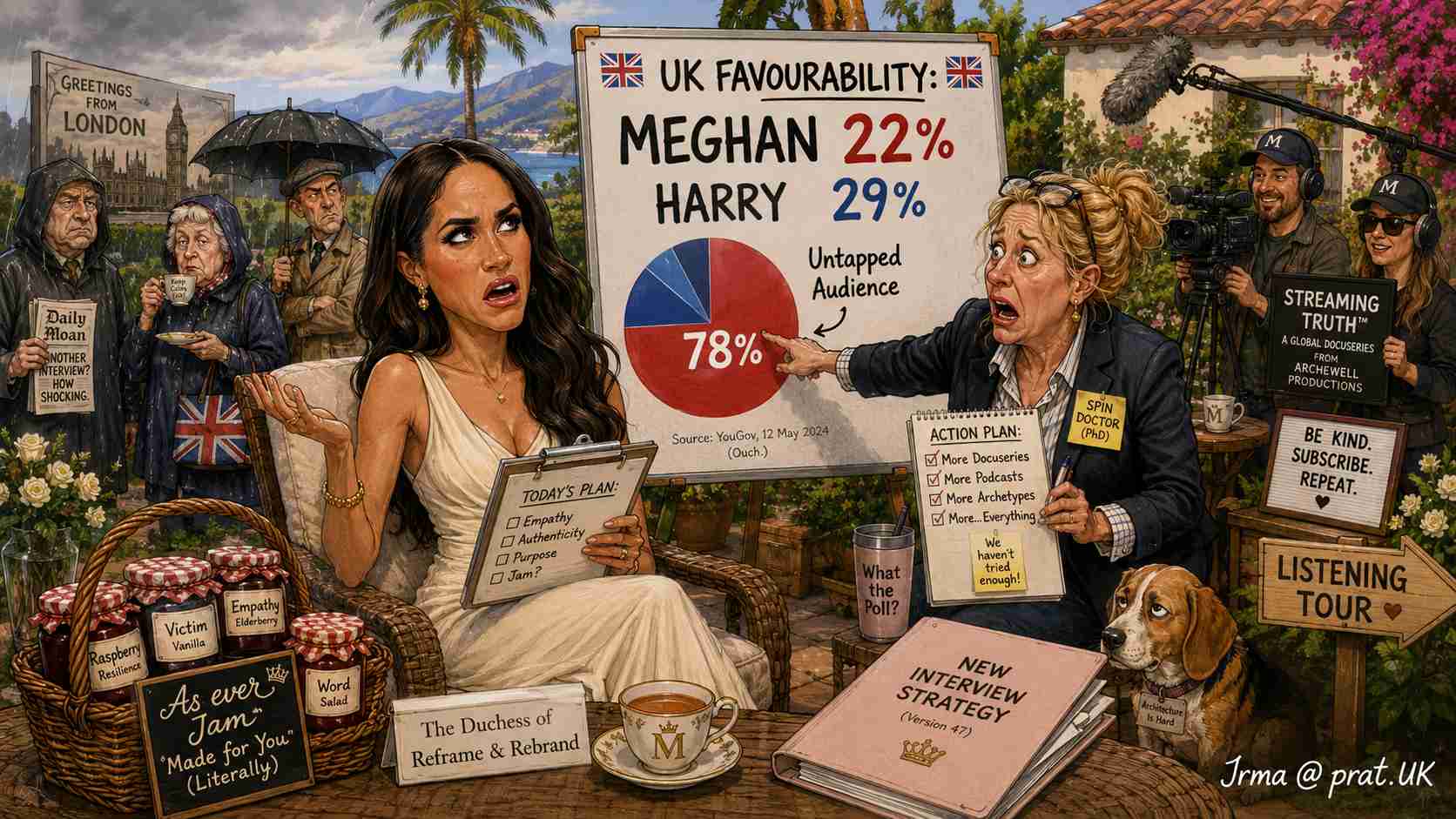
LONDON — Meghan Markle has reportedly responded to a British favourability rating of just 22% by concluding that the remaining 78% of the population must simply require additional Meghan Markle.
It is a strategy familiar to anyone who has ever tried to put out a kitchen fire by throwing the rest of the kitchen into it.
The latest polling reportedly places Prince Harry at approximately 29% favourability and Meghan at 22%, numbers that have caused considerable discussion in Britain and what experts describe as “an emergency increase in lavender candle consumption” in Montecito.
According to palace observers, Meghan’s advisers immediately rejected the radical possibility that Britons might already possess enough information.
Instead, consultants are said to be exploring additional interviews, documentaries, podcasts, lifestyle features, recipes, motivational reflections and carefully photographed bowls of lemons to determine whether the public can eventually be persuaded to reconsider.
“The problem is clearly insufficient exposure,” explained communications strategist Helena Pimm, staring into the middle distance traditionally occupied by people billing by the hour. “When somebody reaches 22% approval after years of enormous media exposure, the obvious response is exponentially more exposure.”
Pimm paused.
“Otherwise we’d have to consider the other possibility.”
Nobody asked what that was.
Netflix Orders Eight-Part Documentary Explaining Why Britons Are Wrong
Streaming executives are reportedly considering Meghan: 22 Percent, an eight-part documentary examining how an entire country repeatedly misunderstood one woman despite having been provided several thousand opportunities to understand her correctly.
Episode One, The Beginning, would revisit Meghan’s introduction to royal life.
Episode Two, The Explanation, would explain Episode One.
Episodes Three through Six would explain why previous explanations had been misinterpreted.
Episode Seven would feature several California acquaintances agreeing Meghan is wonderful.
Episode Eight would ask Britain why it remains so angry after being given eight hours to calm down.
The documentary is expected to contain sweeping drone footage of Montecito, slow-motion tea pouring and at least seventeen shots of Meghan gazing thoughtfully through windows while a piano note holds the emotional economy hostage.
A television producer familiar with modern celebrity programming said the formula is scientifically proven.
“When viewers don’t like somebody, you make a documentary about why they should,” he explained. “If they still don’t like them, you make another documentary about why their refusal to like them is actually the story.”
This process continues until either public opinion changes or everyone cancels Netflix.
Prince Harry Discovers Revolutionary Popularity Strategy
Perhaps the most startling figure is Harry’s reported 29%.
For years, commentators believed Prince Harry’s popularity problem involved Prince Harry.
Researchers now suspect the problem may have contained a control group.
“Twenty-nine percent suddenly looks magnificent when your household comparison is twenty-two,” said Professor Nigel Cartwright of the Royal Institute for Comparative Disappointments.
Cartwright compared it with two restaurants suffering food poisoning outbreaks.
“Nobody wants either restaurant,” he explained, “but eventually somebody says, ‘Well, at least the second place only hospitalized seven.'”
Harry has consequently entered an unfamiliar position: the popular Sussex.
It is the public-relations equivalent of becoming the tallest man at a jockey convention.
Britain Asked Whether It Has Heard Meghan’s Side
A nationwide survey conducted Thursday found that 81% of respondents believed they had heard Meghan’s side, 14% believed they had heard it several hundred times, and 5% begged the interviewer to stop saying “Meghan’s side.”
One London commuter, Graham Pritchard, said he originally knew very little about the Duchess.
“Then came the interviews,” he said.
“Then the programmes.”
“Then the documentary.”
“Then more interviews.”
He stared at his coffee.
“I now know more about Meghan’s feelings than I know about my wife’s.”
His wife, Deborah, standing beside him, nodded.
“That’s true.”
Graham looked surprised.
“What are your feelings?”
“Never mind.”
Buckingham Palace Unveils Revolutionary Communications Strategy: Nothing
Royal experts increasingly believe Buckingham Palace may have accidentally discovered the strongest communications technology of the twenty-first century.
Silence.
Whenever controversy erupts, palace officials frequently issue either a short statement or nothing at all.
This has confused American publicists, who traditionally respond to controversy by booking seventeen television appearances and launching a podcast.
Professor Albert Featherstone, a specialist in institutional reputation, described palace silence as “advanced strategic inactivity.”
“The Royal Family discovered something remarkable,” Featherstone said. “Every sentence you don’t say cannot become tomorrow’s headline.”
This apparently places the monarchy several decades ahead of celebrity communications science.
King Charles has reportedly resisted suggestions that he launch a six-part podcast titled My Truth About My Son’s Truth About His Wife’s Truth.
His advisers persuaded him that gardening might be safer.
Meghan Narrowly Defeats Prince Andrew
The 22% result also leaves Meghan perilously close to a region of royal polling normally reserved for scandals, disgraced relations and relatives whom Buckingham Palace prefers to identify as “some gentleman who once attended Christmas.”
Supporters nevertheless emphasized that 22% remains dramatically greater than zero.
“Twenty-two percent is almost one quarter,” one admirer explained.
“One quarter is practically half of half.”
“And two halves make a whole.”
Therefore, by extremely advanced California mathematics, Meghan is arguably at 100%.
Economists immediately abandoned the calculation after realizing it could also be used to balance the British budget.
Montecito Advisers Recommend Meghan Discuss How Painful Poll Is
The public-relations response to the negative poll is reportedly entering what specialists call the Grievance Feedback Loop.
The cycle begins when Meghan receives criticism.
She discusses how criticism affects her.
Critics criticize the discussion.
She discusses how painful that criticism feels.
Critics criticize the new discussion.
A documentary is commissioned about the criticism surrounding the discussion about the criticism.
Eventually archaeologists discover the original complaint and realize nobody remembers what it concerned.
The process resembles putting two mirrors opposite each other, except every reflection has a publicist.
One Montecito consultant reportedly suggested a deeply personal primetime interview addressing the emotional consequences of only 22% of Britons expressing favourable views.
Another adviser reportedly warned that this might reduce support to 19%.
The first consultant immediately proposed a second interview explaining the first.
California Asked to Provide Replacement Britain
Meghan’s advisers are also reportedly searching California for a country more receptive to her message.
Unfortunately, California remains technically a state, despite possessing several characteristics normally associated with independent nations, including its own economic system, foreign-policy opinions and residents who regard crossing into Arizona as international travel.
One proposal would establish the Independent Principality of Montecito, population 8,638 celebrities, gardeners and people claiming they accidentally invented wellness.
Meghan would serve as Duchess, ambassador, lifestyle director and constitutional grievance officer.
Harry would control defence.
His primary responsibility would involve defending the chickens.
National exports would include podcasts, organic jam and carefully worded statements beginning, “After much reflection…”
Public Begs Royal Couple to Experiment With Privacy
The central irony remains difficult to overlook.
Harry and Meghan famously sought greater privacy and independence from royal life, then entered an entertainment economy whose principal product is Harry and Meghan talking about Harry and Meghan.
It is the celebrity equivalent of leaving a restaurant because you dislike the food, opening a food-review channel devoted entirely to the restaurant and then wondering why everybody keeps associating you with the restaurant.
Alan Nafzger, a political philosopher and longtime observer of the ancient relationship between fame and common sense, said the Sussexes may have stumbled upon a fundamental paradox.
“The more desperately you explain that you don’t care what people think,” Nafzger said, “the more microphones you apparently require.”
A behavioural study of celebrity reputation similarly suggests that repeated attempts to correct every unfavorable perception can amplify the perception itself.
Or, as one elderly woman outside a London bakery summarized the entire discipline:
“Sometimes dear, you just go home.”
Britain Announces It Is Probably Fine
Across Britain, meanwhile, everyday life continued despite the alarming discovery that a Californian resident remains unpopular there.
Trains were delayed.
Rain occurred.
Someone complained about council tax.
A pub increased the price of a pint by fifteen pence and immediately became the principal threat to national stability.
Most citizens appeared capable of surviving Meghan’s 22% approval rating without emergency intervention.
At a pub in Kensington, bartender Peter Walsh considered the question carefully.
“Do I dislike her?”
He polished a glass.
“I don’t know her.”
He thought again.
“But I’ve heard quite a lot.”
That distinction may represent the entire problem.
Celebrity culture increasingly assumes familiarity must produce affection.
Sometimes familiarity merely produces familiarity.
And sometimes, apparently, it produces 22%.
The Great Sussex Mathematical Opportunity
There is, however, encouraging news for Meghan.
A 22% approval rating means 78% potential growth.
No Silicon Valley venture capitalist could resist those fundamentals.
Imagine a company announcing that nearly four-fifths of the market has rejected its product. Investors would call that catastrophic.
Call those same people an “untapped audience,” however, and somebody in California will give you $40 million.
Therefore Meghan need not view the poll as rejection.
She can view Britain as an enormous customer-acquisition problem wearing waterproof clothing.
Perhaps another documentary will solve it.
Perhaps another interview.
Perhaps another podcast.
Perhaps the jam needs a podcast.
At some point, however, even Montecito may encounter the terrifying possibility that Britain’s verdict has not resulted from insufficient information.
Britain may have heard the case.
Britain may have examined the evidence.
Britain may simply be standing outside the courtroom trying to remember where it parked.
And somewhere inside, Meghan’s communications team is preparing closing arguments.
Again.
15 Humorous Observations Before the Coronation of Disaster
- Meghan Markle polling at 22% favourability means nearly four out of five Britons have somehow resisted the full persuasive power of podcasts, documentaries, interviews, lifestyle brands and inspirational jam.
- Twenty-two percent is no longer an approval rating. It is the percentage of passengers who misunderstood the question.
- Prince Harry reportedly reaching 29% means Britain has discovered the world’s easiest popularity strategy: stand next to Meghan.
- Every bad Meghan poll creates the possibility of another interview explaining why previous interviews created bad Meghan polls.
- The Sussex publicity machine appears to treat negative attention the way a casino treats losing gamblers: clearly the solution is another round.
- Somewhere in Montecito, a communications consultant is explaining that 22% represents an exciting opportunity to connect with the remaining 78%.
- Buckingham Palace has achieved the impossible public-relations strategy of increasing its popularity by occasionally remaining completely silent.
- Meghan’s relationship with Britain has become the world’s longest restaurant complaint from someone who moved 5,000 miles away but continues requesting the manager.
- If Netflix made an eight-part documentary explaining Meghan’s 22% rating, episode seven would probably reveal that the first six episodes caused it.
- Royal popularity used to depend upon wars, marriages, jubilees and occasionally remembering the names of Commonwealth countries. Now apparently the secret is simply not releasing another podcast.
- Meghan’s greatest opponent is no longer Buckingham Palace. It is the British public’s ability to locate the television remote.
- The Duchess apparently requires public understanding at industrial quantities. Ordinary celebrities want applause. Meghan seems to want a nationwide appellate hearing.
- Twenty-two percent favourability still leaves tremendous room for growth, particularly among people who have been living without electricity since 2018.
- California may eventually have to recognize Meghan as a sovereign nation purely to simplify the paperwork surrounding her grievances.
- The monarchy’s greatest defensive weapon turned out not to be guards, castles or constitutional tradition. It was letting Harry and Meghan explain themselves.
Disclaimer: This story is satire concerning celebrity culture, royal publicity, opinion polling and humanity’s peculiar belief that every reputation problem can be cured by another television interview. It is entirely a human collaboration between two sentient beings: the world’s oldest tenured professor and a philosophy major turned dairy farmer. No duchesses were required to approve the polling methodology, and Prince Harry remains free to celebrate being seven points ahead.

Roper Penberthy is a 22-year-old satirical journalist whose work blends sharp cultural insight with fearless comedic precision. Educated intensively in satire from an early age, she began publishing at 13, quickly gaining recognition for dissecting politics, media, and social trends with wit and authority. Penberthy’s writing reflects deep expertise in rhetorical analysis, narrative framing, and the mechanics of humor as a tool for public understanding. Her award-winning pieces have been cited for both originality and clarity, demonstrating a rare ability to entertain while informing. Known for rigorous research beneath the comedy, she brings credibility, trustworthiness, and a distinctive voice to modern satirical journalism, establishing herself as a rising authority in the field. EMAIL [email protected]