The Marriage I Cherished Had Quietly Moved to Zone 6
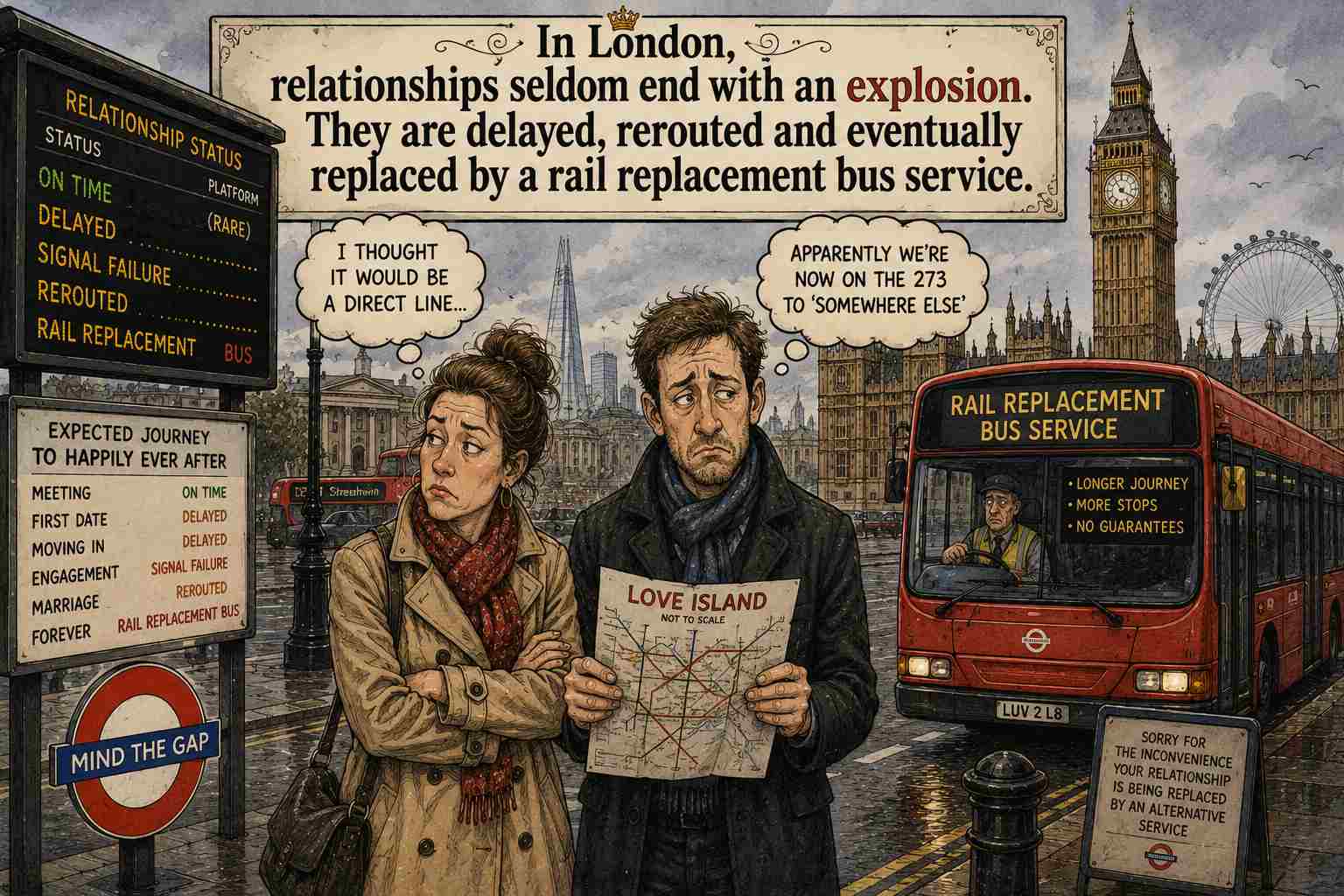
In London, relationships seldom end with an explosion. They are delayed, rerouted and eventually replaced by a rail replacement bus service.
A Modern Love Story, Rerouted Through Clapham
LONDON — The marriage described in this Modern Love source reminded me that a London marriage rarely collapses in a single operatic moment. There is no overturned dinner table, no suitcase thrown dramatically into the rain, no neighbour peering through lace curtains and whispering, “I always knew.” London marriages simply become administrative. One morning you wake beside the person you once adored and realise you have become two efficient civil servants managing a small, badly ventilated country, roughly the size of the Vatican but with worse plumbing.
My husband, Daniel, and I had been married for eighteen years.
We met in 2008 beneath a broken departure board at Victoria Station. Both of us were waiting for trains that had been cancelled, although neither railway company was prepared to admit this. Daniel offered me half his packet of salt-and-vinegar crisps. I accepted, partly because he was handsome and partly because the station WHSmith wanted nearly four pounds for a sandwich.
That was romance in London: two stranded people sharing processed potatoes while an announcement apologised for circumstances beyond everybody’s control. As one dead-eyed Michael McIntyre-style comedian might put it, nothing says “till death do us part” quite like a Southern Rail delay notice.
Tooting, the Wall, and the Slow Merger Into a Logistics Company

We built a life together in a narrow Victorian terrace in Tooting. The estate agent called it “deceptively spacious,” a phrase meaning the deception would become obvious after we had signed.
We raised two children, repainted the kitchen three times and spent eleven years discussing whether to remove a wall. We never removed it. The wall became the most stable member of the family.
For years, I believed our marriage was happy because nothing terrible had happened. Neither of us had run away with a yoga instructor. Nobody had joined a cult, unless one counts the neighbourhood WhatsApp group. We still attended school concerts, bought each other birthday presents and maintained a joint calendar containing appointments neither of us wished to attend.
Yet somewhere along the way, our marriage stopped being a marriage and became an extremely competent logistics company, not unlike Royal Mail, minus the strikes and plus a shared Ocado account.
Daniel knew when the car needed its MOT. I knew which child required a medieval costume by Thursday. He ordered dishwasher tablets. I remembered his mother’s birthday. We communicated through messages such as “Milk?” and “Plumber coming 10–12,” the latter being London shorthand for “One of us must sacrifice an entire day.”
We had once written love letters. Now Daniel sent me photographs of supermarket shelves asking which brand of chopped tomatoes I meant.
“Not those,” I would reply.
“Which ones?”
“The normal ones.”
“They all look normal.”
This was the longest conversation we had that month.
Our neighbour, Mrs. Patel, insisted we were the perfect couple.
“You never argue,” she said.
That was true. Arguing requires hope. You argue because you believe the other person might finally understand. Daniel and I had advanced beyond conflict into the quiet professionalism of two airline pilots who disliked one another but intended to land the aircraft, per CAA guidance on cockpit conduct, presumably.
The Anniversary Dinner That Ran on a Voucher
The moment I understood came on a wet Tuesday in November.
We were having dinner at an Italian restaurant in Clapham. Daniel had booked it because a voucher was expiring. Nothing restores passion quite like the threat of losing twelve pounds.
The waiter asked whether we were celebrating anything.
“Our anniversary,” I said.
“Using the voucher,” Daniel said.
The waiter looked from one of us to the other with the expression of a man who had just discovered a body but was too polite to interrupt the starters.
It was our eighteenth anniversary. Daniel had remembered the date, booked the table and selected the cheapest bottle of wine that could still legally be called wine, per UK wine labelling regulations. By every measurable standard, he had succeeded.
Yet as he described a problem with the boiler, I watched his face and felt a peculiar grief.
I loved him.
But I missed him.
More accurately, I missed the man he had once been when he was with the woman I had once been. Those two people had vanished, leaving behind their passwords, their children and a cupboard containing seventeen reusable shopping bags.
“Are we happy?” I asked.
Daniel looked alarmed. British husbands can handle burglaries, burst pipes and invading foxes, but a direct emotional question causes immediate system failure, not unlike a Windows blue screen, but with more apologising.
“What do you mean by happy?”
“Happy.”
“In general?”
“In our marriage.”
He put down his fork.
“I think we’re doing rather well.”
That was the problem. We were doing well. We were simply no longer being.
Hampstead Counselling and the Dishwasher Cold War
The next week, we visited a marriage counsellor in Hampstead named Celeste. Her office contained a Himalayan salt lamp, three ferns and a sofa designed to make honesty physically uncomfortable.
Celeste asked us to describe our relationship.
Daniel said, “Stable.”
I said, “Absent.”
Celeste wrote something down.
“What did you write?” Daniel asked.
“That you have different perceptions.”
“We could have told you that for free,” he said.
Over six sessions, we discussed intimacy, resentment and the dishwasher. The dishwasher occupied three sessions because it was the only subject about which either of us displayed genuine passion, a rivalry more bitterly contested than a north-versus-south London derby.
Daniel believed plates should be rinsed before loading.
I believed that if plates had to be washed before entering the dishwasher, the dishwasher was operating an elaborate protection racket.
Celeste said the argument was not really about plates.
This annoyed us both. We had finally found something we agreed upon.
Friends, Mothers, and the Titanic Comparison
Friends encouraged us to stay together. Married friends were particularly enthusiastic because a divorce in the social circle makes everybody inspect their own relationship for structural cracks.
“You two are solid,” my friend Rachel said over coffee.
“So was the Titanic,” I replied.
“Yes, but that had an iceberg.”
“We have a kitchen extension.”
My mother suggested a holiday. Her generation believes all emotional problems can be solved by changing hotels.
Daniel and I went to Cornwall for four days. We walked along cliffs, ate expensive fish and sat beside each other looking at the sea. It was pleasant. That almost made it worse.
Dividing the Casserole Dish and Unlocking the Property’s Potential
There was no villain. No betrayal. No secret second family in Croydon. We had not destroyed our marriage. We had maintained it so carefully that we had preserved the structure after its purpose had gone.
When I finally told Daniel I wanted to separate, he nodded slowly.
Then he asked, “What about the mortgage?”
It sounded cold, but it was not. The mortgage was the largest organism in our home. It had been with us longer than either child and consumed more of our income, a fact the Bank of England could presumably confirm with a chart.
We spent the next three months dividing our possessions.
The children moved between us with the weary competence of junior diplomats. Daniel kept the coffee machine. I took the blue sofa. We argued over a Le Creuset casserole dish neither of us had used since 2017.
The estate agent valued our home and described the divorce as an opportunity to “unlock the property’s full potential.”
Apparently the property had been trapped in our marriage and was relieved to see us go.
Balham, and the Quiet That Followed
I moved into a flat in Balham. It was advertised as “cosy,” which meant I could open the refrigerator from bed. The first night, I sat alone among cardboard boxes listening to the upstairs neighbour assemble furniture with a hammer and a personal grievance.
I expected freedom to feel magnificent.
Instead, it felt quiet.
I missed Daniel’s shoes blocking the hallway. I missed his habit of leaving exactly one spoonful of cereal in the box. I missed hearing him complain about television programmes he had personally chosen.
Grief is inconvenient that way. It does not limit itself to the beautiful moments. It mourns the irritation, the clutter and the person shouting from another room that they cannot find something directly in front of them.
London Bridge, Six Months Later
Six months later, Daniel and I met for coffee near London Bridge.
He looked well. I hated him briefly for this.
We discussed the children, the house sale and a letter from the council addressed to both of us. Then the conversation stopped.
“Were we happy?” he asked.
“Yes,” I said. “For a long time.”
“What happened?”
“I don’t know.”
That was the truest answer available.
Perhaps marriages do not always end because love disappears. Sometimes life grows around love until nobody can reach it. Responsibilities arrive, habits harden and two people become so skilled at running a household that they forget the household was supposed to contain them.
When we left the café, it was raining.
Daniel opened his umbrella and held it over both of us, as he had done hundreds of times. At the station entrance, we paused.
For one foolish second, I wanted him to ask me to come home.
He did not.
I did not ask him either.
We hugged, awkwardly but sincerely. Then he descended toward the Northern line while I crossed the road for a bus.
The marriage I cherished no longer existed.
But the love had not entirely vanished. It remained between us, changed and unusable, like an old paper Travelcard found inside a coat pocket. It could no longer take us anywhere, but I could not quite bring myself to throw it away — much like the Zone 6 boundary itself, technically part of the network, rarely visited, quietly essential.
Fifteen Humorous London Observations About a Disappearing Marriage
- London marriages rarely end suddenly. They enter engineering works and never resume normal service.
- “I love you” gradually becomes “Did you remember the council-tax direct debit?”
- A couple can share a bed, a mortgage and an Amazon password while living in separate emotional boroughs.
- The first sign of marital trouble is not infidelity. It is buying separate meal deals at Pret.
- Nothing exposes romantic incompatibility faster than one person opening a window while the other person is paying to heat London.
- British couples do not scream. They say, “Fine,” with enough tonal variation to qualify as an orchestral instrument.
- Marriage counselling in London mostly involves paying someone £140 to ask why neither of you unloaded the dishwasher.
- A relationship becomes serious when you leave a toothbrush. It becomes terminal when you label your own shelf in the refrigerator.
- London property prices keep unhappy couples together longer than love, religion and several frightened relatives combined.
- Divorcing Londoners do not ask, “Who gets the children?” They ask, “Who gets the Zone 1 parking permit?”
- Romance dies slowly, usually beneath reusable shopping bags nobody remembers purchasing.
- Couples stop having meaningful conversations because every evening begins with a forty-minute discussion about what to watch.
- The British substitute tea for emotional honesty, which is why kettles last longer than many marriages.
- Estate agents describe a newly separated person’s tiny flat as “an exciting lifestyle transition with strong transport links.”
- Sometimes love remains after the marriage disappears, rather like a closed Underground station whose sign nobody has bothered to remove.
Auf Wiedersehen, amigo!
Disclaimer: This is a work of British satire and satirical journalism. Any resemblance to London couples communicating exclusively through boiler appointments, supermarket photographs and passive-aggressive dishwasher loading is statistically unavoidable, and readers seeking UK satirical news of a more sincere variety are directed elsewhere. This story is entirely a human collaboration between two sentient beings: the world’s oldest tenured professor and a philosophy major turned dairy farmer.
Think About It…
- In London, relationships rarely collapse. They are delayed due to signal failure, cancelled because of staff shortages, then replaced by a rail replacement bus service nobody asked for.
- A London romance doesn’t end. It merely announces severe delays while engineers investigate a fault somewhere near Watford Junction.
- London marriages now operate like the Underground. There is always a replacement service, but it somehow takes twice as long and nobody knows where it actually stops.
- Every London affair follows TfL policy: expect delays, confusing announcements, and a replacement partner arriving by bus.
- In North London, divorce is less an event than a transport update. ‘We’re sorry your marriage has been cancelled. Please use the replacement husband waiting outside.’
- London couples no longer separate. They simply become subject to planned engineering works every weekend until somebody moves to Richmond.
- A London marriage doesn’t explode. It quietly appears on the departures board marked ‘Delayed,’ before disappearing without further explanation.
- Modern London romance has adopted the railway timetable. It promises direct service, requires three changes, and somehow ends in Croydon.
- Most London relationships don’t fail. They spend eighteen months insisting everything is running normally while everyone on the platform can see the smoke.
- Love in London is remarkably like the Overground. The announcements are optimistic, the journey is confusing, and eventually you’re told to continue on foot.
- The modern London breakup arrives with the familiar announcement: ‘We apologise for the inconvenience. Your spouse has been replaced by an alternative service operating every other weekend.’
- Relationships in London have become so transport-themed that couples no longer say they’re separating. They simply announce there will be no service between themselves until further notice. 🚇

Carys Evans is a prolific satirical journalist and comedy writer with a strong track record of published work. Her humour is analytical, socially aware, and shaped by both academic insight and London’s vibrant creative networks. Carys often tackles media narratives, cultural trends, and institutional quirks with sharp wit and structured argument.
Her authority is reinforced through volume, consistency, and reader engagement, while her expertise lies in combining research with accessible humour. Trustworthiness is demonstrated by clear labelling of satire and an ethical approach that values accuracy and context.
Carys’s work supports EEAT compliance by offering informed satire that entertains while respecting readers’ trust.