Britain: Rearranging the Deck Chairs While the Band Demands a Diversity Audit
LONDON — Britain has reportedly solved exactly none of its economic problems this week, but government ministers proudly announced that they have reorganised the paperwork into a more compassionate font. Officials insist the nation is “moving forward,” although independent observers point out that the only measurable movement is the pound slowly rolling downhill toward the nearest currency exchange.
Political analysts say the government’s latest economic strategy resembles a homeowner responding to a burning kitchen by alphabetising the spice rack. It is, as one commentator noted in the dry, unhurried style of a Jack Dee monologue, a nation that has mistaken activity for achievement — the economic equivalent of straightening the deck chairs on a ship that has already booked its appointment with an iceberg.
To be clear, nobody in government has used the word “Titanic.” They prefer “temporarily submerged,” “undergoing a buoyancy review,” or “94% unsinkable, subject to independent audit.”
A 287-Page Plan to Plan Some Planning
The Treasury unveiled a 287-page initiative entitled “Prosperity Through Strategic Consultation About Future Prosperity.” The document promises twelve new working groups, nine advisory panels, four diversity coordinators, and one independent commission to determine why the previous eleven commissions accomplished nothing. Officials say the government continues to strategy its way through every crisis, treating the noun as a verb and the verb as a substitute for results.
The nation’s GDP reportedly glanced at the report before quietly leaving the room. This is not entirely a joke: official figures from the Office for National Statistics show real GDP grew a modest 0.6% in the first quarter, a number Whitehall has since laminated, framed, and hung in place of an actual industrial strategy.
Economists describe the approach as “administratively impressive,” noting that every decline in productivity now comes with a beautifully designed infographic. One civil servant proudly declared, “Growth isn’t everything. We’ve also reduced expectations.” It was, in the finest tradition of the paraprosdokian, a sentence that began as reassurance and landed as confession.
Business as Usual, Which Is to Say, Barely Business at All
Business owners across Britain welcomed the announcement by immediately postponing another investment. “It’s comforting,” said Birmingham shopkeeper Colin Marsh. “I used to worry politicians might accidentally fix something. Now I know they won’t.”
Manufacturing executives say they spend more time completing government compliance surveys than actually manufacturing anything. “We’re technically still a factory,” explained one manager, “although our biggest product these days appears to be paperwork.” This is less a joke than a description: independent forecasts collated by the House of Commons Library now put UK GDP growth for 2026 at a distinctly unglamorous 0.9%, roughly the economic equivalent of a Frankie Boyle punchline landing to polite silence.
Trade unions applauded the government’s commitment to protecting jobs, especially the rapidly expanding employment sector dedicated entirely to regulating everyone else’s employment. An environmental consultant admitted Britain’s economy now has the carbon footprint of a filing cabinet — technically renewable, mostly beige.
Housing: Building Portals Instead of Houses
Meanwhile, ministers celebrated another ambitious housing initiative. Instead of building homes, officials unveiled a new digital portal allowing citizens to track the progress of future discussions about possible housing strategies. Average waiting time: only eighteen months. The portal crashed within six minutes after someone attempted to log in. Government spokespeople insisted this demonstrated overwhelming public enthusiasm, a claim so ironically literal that even the server logs blushed. Somewhere, a ship’s carpenter nailed a “closed for consultation” sign over the hole in the hull.
Transport policy has also entered what experts describe as its “interpretive dance phase.” Rail passengers continue paying first-class prices to experience what historians believe were third-class Victorian travel conditions. One commuter noted that his train arrived so late it qualified as next week’s service — less a delay, more a double entendre about what “on track” actually means in modern Britain.
Health, Education, and Other Things Getting Shorter Names
Health officials likewise announced another reform package designed to reduce waiting lists by introducing shorter names for the waiting lists. Patients remain optimistic they may eventually receive appointments before the invention of interstellar travel.
Education reform has proven equally innovative. Students will now graduate fully prepared for careers explaining to employers why no one taught them mathematics, economics, or grammar, because those subjects were considered emotionally demanding. Universities praised the move, noting graduates are exceptionally qualified to become government consultants — a case of anthimeria in action, where “to consult” now simply means “to attend meetings about meetings.”
Polling suggests many voters have become exhausted by politicians promising “transformational change.” “Transformation usually means changing the logo,” sighed one pensioner. “The bills still arrive exactly on time.” It was, in its own malapropism-adjacent way, a “trans-formality” rather than a transformation.
Investors Watch On, Politely Horrified
Meanwhile, investors continue watching Britain with the same cautious expression normally reserved for relatives announcing they’ve discovered cryptocurrency, pyramid marketing, and healing crystals during the same weekend. Financial markets reportedly appreciate Britain’s political stability. They simply wish the economy would become stable as well — a fine pun on a nation that is politically settled and fiscally anything but.
Government ministers reject criticism entirely. They argue Britain’s problems were inherited, international, historical, meteorological, and occasionally caused by insufficient optimism among taxpayers. Asked whether higher taxes and slower growth might discourage investment, one official replied, “The important thing is fairness.” Investors immediately demonstrated fairness by investing somewhere else.
Even the more sober forecasters can’t quite agree on how bad things are: KPMG’s latest UK Economic Outlook pegs 2026 growth at 0.7%, while the Treasury’s own panel of independent forecasters, and the Commons Library analysis above, hover closer to 0.9%. Britain, in other words, has achieved the rare feat of being simultaneously slightly better and slightly worse than expected — a spoonerism of an economy, where “growth spurt” has quietly become “sprowth gurt.”
A New Chapter, Same Old Book
By week’s end, officials proudly declared Britain had entered “a new chapter.” Historians confirmed it was indeed a new chapter. Unfortunately, it appeared to be in the same book, with the same plot, featuring the same characters rearranging the same deck chairs while confidently assuring everyone the iceberg was merely suffering from negative publicity and had, in any case, agreed to a working group.
As the ship drifted onward, the orchestra received additional funding, the passengers completed an equality questionnaire about lifeboat allocation, and a minister reassured reporters that everything remained entirely sustainable, provided nobody asked the economy to produce any actual growth. Below decks, the water rose steadily past a sign reading “Prosperity Through Strategic Consultation About Future Prosperity,” and someone from Communications noted that, technically, the ship was still afloat, which was more than could be said for several of its economic forecasts. The band played on. The applause was enthusiastic, largely because it was the only thing still being manufactured domestically. 🛳️🇬🇧
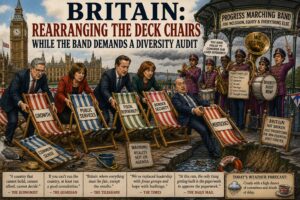
Image brief (Al Jaffee / MAD Magazine style): Wide landscape illustration, dense crosshatch linework, exaggerated caricature. A sinking ocean liner labelled “HMS ECONOMY” with ministers on deck rearranging deck chairs into the shape of a pie chart, an orchestra playing on, and a Whitehall official handing out laminated “Prosperity Through Consultation” pamphlets as the ship tilts. Background smokestacks belch out paperwork instead of smoke.
Britain’s real economy, meanwhile, is doing better and worse than the headlines suggest depending on which report you read: the Office for National Statistics recorded 0.6% quarterly GDP growth in early 2026, HM Treasury’s independent forecasters expect roughly 0.9% growth for the year, and the Bank of England continues to weigh interest-rate decisions against sticky inflation and energy-price pressure from the ongoing Middle East conflict. The Treasury’s 287-page prosperity document, the housing portal, and the various commissions referenced above are stylised exaggerations built on this real backdrop of sluggish, uneven UK growth.
Sources
- Office for National Statistics — GDP First Quarterly Estimate, UK: January to March 2026
- House of Commons Library — Economic update: Beating the forecasts, for now
- KPMG UK — UK Economic Outlook
- Bohiney.com — American satirical news
This satirical article was created entirely through a human collaboration between the world’s oldest tenured professor and a philosophy major turned dairy farmer, drawing inspiration from public political debate and commentary surrounding Britain’s economy and government.
Auf Wiedersehen, amigo!

Bethan Morgan is an experienced satirical journalist and comedy writer with a strong editorial voice shaped by London’s writing and performance culture. Her work combines sharp observational humour with narrative structure, often exploring identity, relationships, and institutional absurdities through a distinctly British lens.
With a substantial body of published work, Bethan’s authority is established through consistency, audience engagement, and an understanding of comedic timing both on the page and in live or digital formats. Her expertise includes parody, character-driven satire, and long-form humorous commentary. Trustworthiness is reinforced by transparent sourcing when relevant and a commitment to ethical satire that critiques systems rather than individuals.
Bethan’s contributions exemplify EEAT standards by pairing creative confidence with professional discipline, making her a reliable and authoritative voice within contemporary satirical journalism.