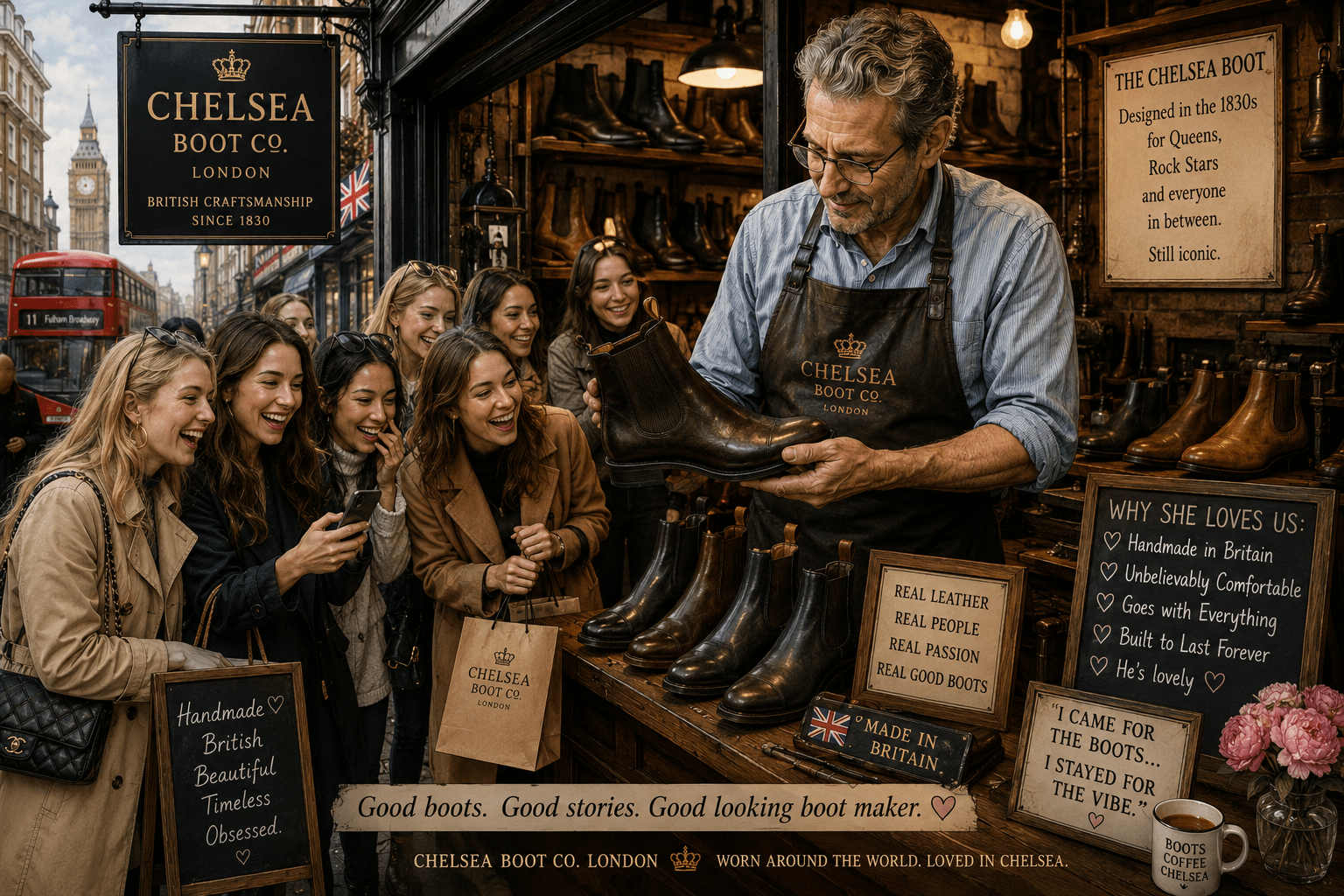
British Chelsea Boot Maker Promises Every Pair Will Survive Rain, Pubs and One Disastrous Office Christmas Party
Traditional Shoemaker Unveils Footwear Designed for Weather, Work, Weddings and the Annual Collapse of Professional Judgment
By Ingrid Falk
NORTHAMPTON, England – A traditional British Chelsea boot manufacturer has promised that its newest range will withstand rain, crowded pubs and at least one catastrophic office Christmas party, provided the wearer does not attempt karaoke near an open bottle of red wine.
The Whitcombe & Gristle Boot Company, which says it has manufactured footwear in Northampton since 1887, unveiled its “Imperial Social Survival Collection” during a ceremony involving polished brass, untreated brickwork and a black-and-white photograph of a serious Victorian man whose connection to the company remains legally unclear.
Company executives say each pair has been tested under authentic British conditions, including sideways rain, sticky pub floors, delayed trains, passive-aggressive office conversations and the moment when a regional sales manager announces that everybody must dance.
“These boots are not merely footwear,” said managing director Crispin Whitcombe, stroking a walnut display case. “They are ankle-height insurance against Britain.”
According to Whitcombe, the average British shoe must perform several incompatible jobs. It must look respectable in the office, fashionable in the pub, solemn at a funeral and sufficiently rugged to cross a flooded pavement after the local council spends eight months studying drainage.
The Chelsea boot accomplishes all four while requiring no laces, buckles or emotional commitment.
“In Britain, convenience must never look convenient,” Whitcombe explained. “That is why our boots slide on easily but cost enough to suggest suffering.”
British Chelsea Boot Maker Promises Every Pair Will Survive Rain, Pubs and One Disastrous Office Christmas Party
The new Chelsea boot was developed after company researchers studied the annual migration of British office workers from fluorescent workplaces into rented hotel function rooms containing warm prosecco and a frightened disc jockey.
Engineers identified five main threats to traditional footwear: lager, gravy, broken glass, spontaneous dancing and the colleague who removes his tie and begins describing himself as “dangerous.”
The company subjected prototype boots to laboratory simulations designed to reproduce these conditions.
In one experiment, researchers poured three pints of bitter over a boot and left it overnight beside a radiator. In another, a junior accountant wearing the prototype was instructed to dance to “Come on Eileen” until either the elastic failed or Human Resources intervened.
“The boot remained structurally sound,” said chief materials engineer Margaret Pindle. “The accountant did not.”
Special attention was given to the Christmas-party heel, which has been reinforced to survive abrupt changes in career direction.
The leather is treated with the company’s proprietary RegretGuard coating, designed to repel wine, mustard and written warnings.
Each pair also includes a discreet inner label carrying emergency advice:
“Do not text management.”
“Do not discuss salaries.”
“Do not join the conga if the managing director is filming.”
The company guarantees the boots against ordinary seasonal embarrassment but excludes damage caused by photocopiers, decorative fountains and attempts to impress colleagues by sliding across a dance floor.
Consumer groups have welcomed the clarity.
“For years, shoe warranties have covered manufacturing defects but ignored the far greater danger of Gary from procurement ordering tequila,” said footwear advocate Susan Blemish. “This is progress.”
Chelsea Boots Declared Britain’s Last Remaining Industry Not Yet Replaced by an App
The Department for Business has designated Chelsea boot manufacturing as Britain’s final major industry that cannot yet be replaced by a mobile application.
Government officials reached the conclusion after commissioning a £14 million digital-transformation study that produced a password-protected PDF nobody could open.
The report found that banking, shopping, dating, navigation, journalism, taxi services and friendship have all been transferred into phones. Bootmaking remains stubbornly physical because customers continue insisting that shoes exist outside a subscription platform.
“We attempted to create a virtual Chelsea boot,” said innovation minister Rupert Clipboard. “Unfortunately, test users complained their feet were still wet.”
The government’s proposed solution, BootApp, allowed customers to swipe right on various leather finishes and receive motivational notifications such as “You are wearing confidence.”
However, users still needed actual boots.
This was described in the report as a “legacy hardware dependency.”
Whitcombe & Gristle rejected proposals to replace shoemakers with an algorithm.
“A machine can recommend brown suede,” said Crispin Whitcombe. “But only an experienced craftsperson can look at a hide, run a hand across the grain and announce that it will eventually be worn by a property consultant named Hugo.”
The factory continues to employ cutters, stitchers, finishers and polishers, all of whom perform tasks difficult to translate into an application.
A government technology adviser suggested creating a platform economy in which freelance cobblers could accept boot assignments through their phones.
Workers would be paid per stitch and rated by customers using tiny golden shoes.
The proposal was abandoned after traditional shoemakers threatened to explain welt construction to ministers until Parliament adjourned.
Economists now regard the Chelsea boot as a strategic national asset.
“Britain may no longer manufacture everything it once did,” said Professor Edwin Sole of the Institute for Industrial Nostalgia. “But we remain capable of attaching elastic to leather and persuading the world that this constitutes a personality.”
UK Shoemaker Unveils £400 Boot Designed to Look Effortlessly Working Class
Whitcombe & Gristle’s flagship model, the Foundry No. 9, costs £400 and has been meticulously designed to resemble footwear once worn by men who could not afford £400 footwear.
The boot features distressed leather, practical stitching and a sole inspired by nineteenth-century factory workers who spent fourteen hours per day manufacturing products later named after aristocratic neighbourhoods.
“Our customer wants authenticity,” explained creative director Jemima Flounce. “But not the kind involving low wages, industrial injuries or public transport before dawn.”
Each boot is artificially aged by skilled technicians using brushes, stones and carefully supervised disappointment.
The result is a shoe that appears to have spent thirty years repairing railway engines, despite having been purchased that afternoon in Shoreditch.
Marketing materials describe the boot as “uncompromisingly honest.”
The price is divided into £86 for materials, £64 for labour and £250 for the phrase “uncompromisingly honest.”
The target customer is a professional earning more than £90,000 per year who uses the word “proper” to describe expensive versions of cheap things.
He does not buy coffee. He buys “proper coffee.”
He does not eat bread. He eats “proper sourdough.”
He does not wear work boots. He wears handcrafted footwear celebrating the dignity of people who would laugh at him.
Fashion sociologist Dr Amelia Brogue said the trend reflects modern class aspiration.
“The wealthy once dressed to look wealthy,” she explained. “They now dress to resemble people who own tools, while ensuring none of those tools are present.”
Customers can choose among finishes named Furnace Brown, Dockyard Black and Rent-Controlled Oxblood.
The company briefly considered calling one model “Plumber Tan” but abandoned the name after focus groups discovered actual plumbers were charging more per hour than the customers.
London Man Buys Chelsea Boots, Immediately Develops Strong Opinions About Independent Coffee
A London marketing executive developed detailed opinions about independent coffee within forty-five minutes of purchasing brown suede Chelsea boots.
Before buying the boots, 34-year-old Nathan Quill described coffee as “the brown hot one.”
After leaving the shop, he announced that commercial roasting had destroyed the emotional architecture of the bean.
Witnesses said Quill entered a nearby café, examined the menu and asked whether the espresso had “a clean finish.”
He then requested information about altitude, processing method and the farmer’s relationship with uncertainty.
“He used to drink instant coffee,” said his girlfriend, Rebecca Moss. “Last week he put three spoonfuls into a Sports Direct mug. Now he says milk conceals the bean’s narrative.”
Psychologists believe Chelsea boots alter posture, which affects vocabulary.
Once the wearer sees the narrow ankle profile beneath a rolled trouser cuff, ordinary coffee is no longer psychologically possible.
Within an hour, Quill had complained that the café was too mainstream, despite being the only customer.
He photographed his cup beside the boots, ensuring that a section of reclaimed wooden floor appeared in the frame.
He later posted the image with the caption: “Finding depth in simplicity.”
The coffee cost £5.80 and arrived in a cup without a handle.
Quill said this demonstrated confidence.
By evening, he had subscribed to a monthly bean service, ordered a brass grinder and begun researching neighbourhoods described as “still authentic.”
His girlfriend asked whether they could simply return home.
Quill replied that “home is increasingly a state of extraction.”
Medical professionals say the condition usually stabilises after the suede encounters its first London puddle.
“At that point, the wearer remembers that shoes are objects placed directly on the ground,” said Dr Brogue. “The metaphysical phase ends quickly.”
British Boot Factory Adds Elastic Sides So Customers Can Escape Responsibility Faster
The company has widened the elastic side panels of its Chelsea boots to help wearers leave uncomfortable situations with greater speed.
The new EscapeGore system allows customers to remove their boots in less than two seconds, shaving critical time from moments involving domestic chores, awkward apologies and requests to stay behind after meetings.
“Laces represent accountability,” said product engineer Simon Welt. “Every knot says, ‘I have arrived and intend to remain.’ Elastic says, ‘I may be gone before you finish that sentence.’”
Factory tests found that wearers could exit a dinner party 37 percent faster in Chelsea boots than in lace-up brogues.
This advantage increased to 52 percent when the host began showing holiday photographs.
The company identified several scenarios in which rapid footwear deployment proved essential:
A neighbour asking for help moving furniture.
A manager saying, “While I have you.”
A relative beginning a sentence with, “You work with computers.”
A partner asking who left the wet towel on the bed.
The boot’s rear pull tab has also been enlarged, enabling users to dress quickly after sleeping through an alarm or hearing the phrase “My husband is home.”
Company lawyers stressed that the latter application was neither encouraged nor represented in official advertising.
Consumers praised the innovation.
“I was halfway through assembling a wardrobe when I remembered an urgent appointment elsewhere,” said one customer. “The boots were on before my wife could locate the instruction manual.”
Relationship counsellors expressed concern that slip-on footwear could undermine social responsibility.
Whitcombe dismissed the criticism.
“Britons have avoided direct responsibility for centuries while wearing every known form of shoe,” he said. “The Chelsea boot merely improves the mechanics.”
Chelsea Boot Maker Introduces New “Commuter Edition” Reinforced Against Puddles, Escalators and Other Londoners
The company’s Commuter Edition has been designed specifically for London, where footwear faces a unique combination of water, machinery and people who stop without warning.
The toe cap is reinforced against rolling suitcases.
The heel is resistant to escalator impacts.
The leather is treated to repel rainwater, bus spray and the mysterious liquid permanently surrounding late-night kebab shops.
Most importantly, each boot includes lateral armour to protect the wearer from other commuters.
“Londoners are not intentionally aggressive,” explained transport researcher Dr Lionel Platform. “They are simply attempting to occupy the same eleven inches of pavement at different speeds.”
The Commuter Edition underwent trials at Oxford Circus, Waterloo and the narrow section of pavement where someone always decides to hold a family reunion.
Testers were instructed to navigate tourists, umbrellas, food-delivery bicycles and office workers walking four abreast while discussing property prices.
The boot survived.
One tester did not reach the destination but was later found trapped behind a guided tour near Leicester Square.
The sole contains a special grip pattern inspired by Tube maps, although nobody can explain how the lines connect.
A built-in directional ridge helps wearers stand on the right side of an escalator.
Customers standing on the left receive a mild electrical reminder and a recorded voice saying, “This is not your first day on Earth.”
The boots also include anti-puddle intelligence.
Rather than attempting to judge the depth of murky water, the wearer is encouraged to assume every London puddle connects directly to the Thames.
Company statistics show that 86 percent of purchasers initially choose suede and regret it before reaching the next postcode.
The Commuter Edition therefore comes with a weather forecast printed permanently inside the box:
“It will rain after you leave.”
Government Launches Inquiry After British-Made Chelsea Boots Last Longer Than Three Prime Ministers
Parliament has opened an inquiry after discovering that a pair of British-made Chelsea boots remained functional through three prime ministers, four chancellors and seventeen government plans for economic growth.
The boots were purchased by civil servant Peter Blunt during what historians now refer to as “a previous administration.”
Since then, the leather has softened, the soles have been replaced once and national policy has changed direction fourteen times.
Members of Parliament demanded to know why the footwear displayed greater institutional stability than the government.
“This boot has maintained its shape, honoured its purpose and survived ordinary contact with the public,” said committee chair Evelyn Buckle. “We need to establish whether such behaviour is constitutional.”
Experts testified that the boots lasted because they were built from durable materials, maintained regularly and not replaced every time opinion polls shifted.
Several MPs appeared surprised.
The committee asked whether the same principles could be applied to political leadership.
Shoemakers replied that leaders would first need a solid foundation, consistent stitching and occasional polishing.
Proceedings were suspended for unparliamentary language.
The government subsequently announced a National Footwear Resilience Strategy.
Under the plan, every minister will be issued Chelsea boots and encouraged to remain in office at least until the leather develops character.
Opposition parties called the scheme wasteful and proposed issuing loafers instead.
The original boots have been placed in the Museum of British Continuity, where they occupy the smallest room.
Visitors are invited to admire an object made in Britain that completed the job for which it was designed.
Attendance has been described as emotional.
UK Fashion Experts Confirm Chelsea Boots Suitable for Weddings, Funerals and Pretending to Own a Record Label
The British Fashion Council has formally confirmed that Chelsea boots are appropriate for almost every social occasion except deep-sea diving and appearing humble.
Updated guidance lists weddings, funerals, dates, gallery openings, pub lunches, minor court appearances and pretending to own an independent record label.
The record-label application is particularly common among men aged 29 to 47 who introduce themselves using only a first name and refer to employment as “the project.”
The correct outfit consists of black Chelsea boots, narrow trousers, a dark coat and an expression suggesting knowledge of a band that has not formed yet.
“You do not need to own a record label,” said fashion consultant Celia Hem. “You need only stand near a speaker and say, ‘We’re keeping the roster small.’”
At weddings, brown Chelsea boots imply relaxed sophistication.
At funerals, black Chelsea boots imply restrained grief with excellent ankle definition.
At a pub, suede Chelsea boots imply that the wearer checked the weather but believed himself more persuasive than clouds.
Fashion experts say the boot’s versatility comes from its ability to remain vague.
It is neither fully formal nor clearly casual.
It occupies the same social territory as the phrase “smart relaxed,” which allows event organisers to reject every possible outfit after arrival.
One survey asked respondents to identify the occupation of a man wearing Chelsea boots.
Answers included musician, architect, photographer, creative director, restaurant investor and “something involving branding.”
Nobody selected agricultural labourer, despite the boots being marketed as rugged.
The British Fashion Council concluded that Chelsea boots are especially useful for men who want footwear to perform the introductory conversation.
“The boot says creative,” Hem explained. “The watch says successful. The tote bag says concerned about plastics. The person need not say anything until coffee.”
Shoemaker Revives Traditional British Craft of Charging Americans Extra for the Word “Heritage”
Whitcombe & Gristle has expanded into the American market using Britain’s most reliable export strategy: placing the word “heritage” before an ordinary object and increasing the price.
The company’s £400 Chelsea boot will sell in the United States for the equivalent of £675 as part of the “Royal Heritage Foundry Collection.”
The boots have no royal connection.
The factory has no foundry.
The heritage is genuine in the broad sense that something probably happened before today.
American customers will receive each pair in a wooden box containing tissue paper, a certificate and a short fictional account of a cobbler named Alistair who made boots for cavalry officers during an unnamed conflict.
“We are not claiming the story is literally true,” explained international marketing director Poppy Ledger. “We are saying it feels expensive.”
The company discovered that American shoppers respond strongly to British geographical references.
A boot manufactured beside the A45 becomes “Northamptonshire Bench-Made.”
A storage unit becomes “the finishing house.”
A tea break becomes “an artisanal pause observed since 1892.”
The sole is attached using a method described as “ancestral,” meaning the employee responsible learned it from someone older.
US advertisements feature fog, stone cottages and men in aprons gazing sternly at leather.
The actual factory contains fluorescent lighting, safety notices and a vending machine that sometimes steals pound coins.
Americans visiting the factory will be shown a separate heritage room containing oak furniture and an employee named Nigel.
Nigel’s task is to nod slowly whenever anyone mentions craftsmanship.
Economists describe the strategy as “nostalgia arbitrage.”
Britain exports the impression of continuity while importing the revenue required to continue.
“We used to send America tea,” said Professor Sole. “Now we send them boots accompanied by stories about tea.”
Chelsea Boot Company Announces Carbon-Neutral Footwear Made Entirely From Recycled Middle-Class Confidence
The company’s final innovation is a carbon-neutral Chelsea boot produced from recycled leather, renewable energy and compressed middle-class confidence.
The confidence is collected from farmers’ markets, design conferences and neighbourhood WhatsApp groups where residents believe their recycling arrangements are unusually complex.
It is then filtered, treated and formed into a lightweight inner sole.
“Middle-class confidence is abundant, renewable and remarkably resistant to evidence,” said sustainability director Arabella Greenlast. “It was the obvious material.”
Each pair is accompanied by a carbon-offset certificate confirming that a tree has been emotionally considered somewhere in Wales.
The company also promises to offset manufacturing emissions by funding podcasts in which affluent presenters discuss consuming less while advertising premium mattresses.
The leather is sourced from cows that received names, classical music and an exit interview.
Packaging is made from recycled cardboard printed with vegetable ink and enough sustainability language to prevent customers asking why boots require a box the size of a microwave.
The company’s environmental claim relies partly on durability.
A pair of boots lasting fifteen years creates less waste than five disposable pairs, although executives admitted this model presents a commercial challenge.
“Our accountants would prefer customers to save the planet by purchasing three colours,” said Whitcombe.
The new range includes Earth Brown, Ethical Black and Virtue Signal Burgundy.
Buyers can calculate their environmental impact using an online tool.
After entering travel, diet and energy information, every user receives the same recommendation:
“Purchase the boots, but feel complicated about it.”
Environmental campaigners welcomed the emphasis on repairable footwear but questioned whether confidence can truly be recycled.
Researchers insist it can.
“In many London neighbourhoods, the same confidence has been reused since the property boom,” said Dr Greenlast. “It merely changes footwear.”
A Boot Built for the Entire British Experience
The Chelsea boot endures because it solves a uniquely British problem: how to appear practical, fashionable, traditional, rebellious and mildly inconvenienced at the same time.
It has no laces because Britain is late.
It has elastic because Britain may need to leave.
It is weather-resistant because Britain has weather instead of climate.
It is expensive because affordability would undermine the heritage.
The boot works in pubs because it can be wiped clean. It works at weddings because trousers conceal most of it. It works in offices because managers associate polished leather with judgment. It works at Christmas parties because somebody must remain upright.
Fashion changes constantly, yet the Chelsea boot persists, watching trends arrive in white trainers and depart in orthopedic inserts.
It has outlived governments, applications, productivity systems, coffee fashions and several attempts to make men wear shoes without socks.
Whitcombe believes this resilience has a simple explanation.
“A good boot asks very little,” he said. “Polish it occasionally, keep it away from deep water and do not allow marketing executives to rename it more than twice per season.”
At that moment, the company unveiled its next collection.
It was called the Neo-Traditional Urban Artisan Heritage Chelsea Experience.
The boot looked exactly the same.
The price had risen by £75.
Disclaimer
This report is satire. The companies, executives, institutes, surveys, government inquiries, carbon-neutral confidence factories and Christmas-party laboratory experiments described here are comic inventions. Any resemblance to a real British footwear campaign is probably the inevitable result of photographing brown leather beside exposed brickwork.
This story is entirely a human collaboration between two sentient beings: the world’s oldest tenured professor and a philosophy major turned dairy farmer.

Dr. Ingrid Gustafsson holds a Ph.D. in Literary Studies and serves as Professor of Literature and Satirical Journalism at the university. Her scholarly work focuses on contemporary satire as a form of institutional critique, examining how exaggeration, irony, and absurdism function as sophisticated analytical tools for exposing structural inequality and institutional hypocrisy. Dr. Gustafsson has published extensively on the genealogy of satirical discourse, the relationship between speech acts and cultural power, and satire’s role as both aesthetic practice and epistemological strategy. Her research interrogates how contemporary satire operates within celebrity culture, legal systems, and institutional rhetoric, revealing the mechanisms through which power obscures itself through language and performance. Dr. Gustafsson’s work combines rigorous textual analysis with broader cultural theory, contributing significantly to understanding satire’s critical function in contemporary society. She is the author of Pearl Clutching and How to Combat It with Satire.