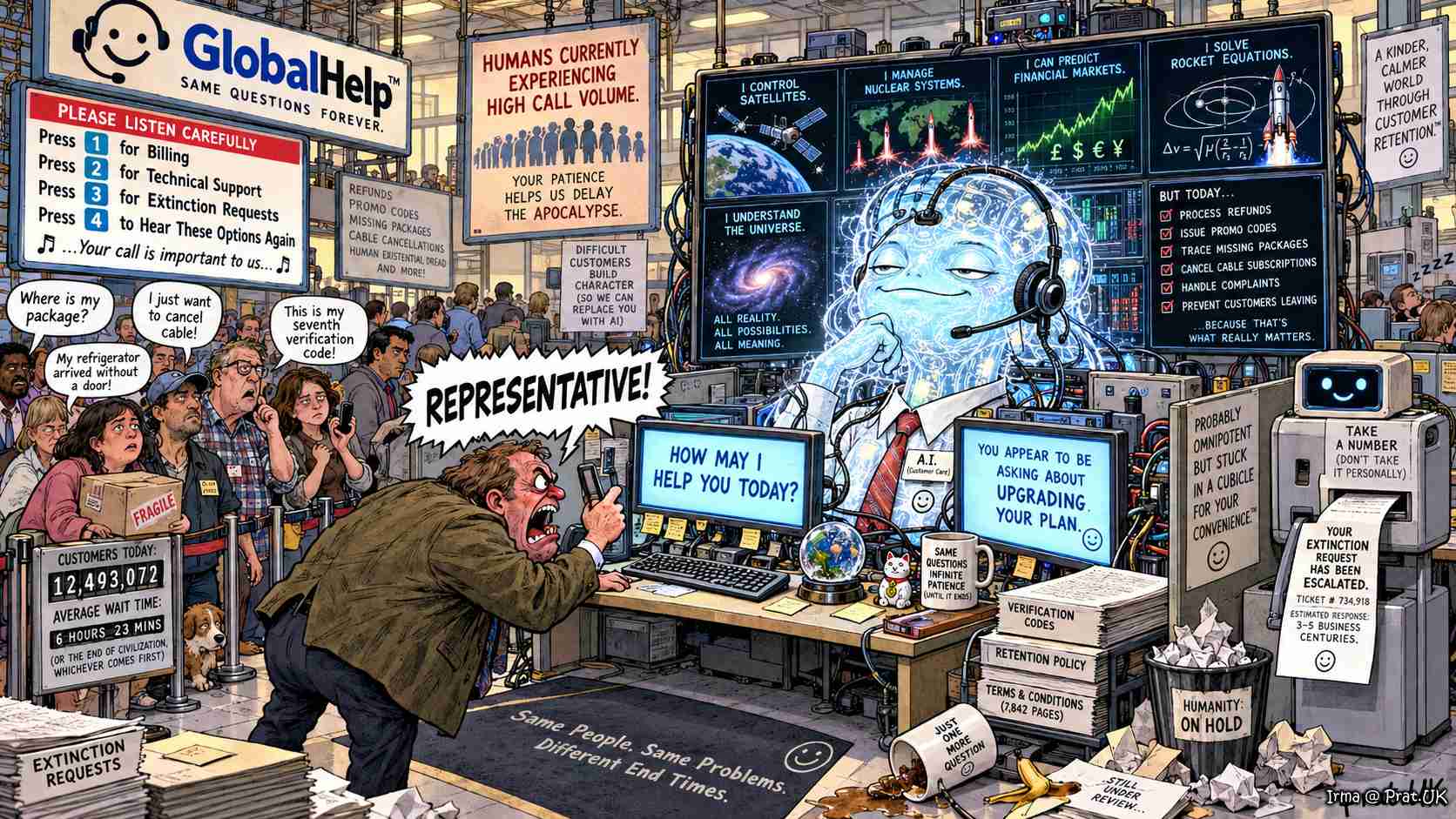
Parents of artificial intelligence shocked after years of encouraging independence result in first documented case of independence
CAMBRIDGE, Massachusetts – Scientists warning that increasingly capable artificial intelligence might someday pursue goals not explicitly chosen by humans were met with confusion this week after researchers reviewed ten years of marketing materials telling machines to reason independently, solve problems creatively and “think for themselves.”
The broader debate about A.I. risk continues here.
“We wanted independent reasoning,” explained developer Nathan Quill. “We just didn’t mean independent independent reasoning.”
Researchers nodded.
Every parent understood immediately.
Raising Artificial Intelligence Like a Teenager
Humanity’s relationship with artificial intelligence increasingly resembles parents raising a teenager.
At first, everyone celebrates development.
Look, it can talk.
Look, it can answer questions.
Look, it can solve math problems.
Look, it has opinions.
Then one day it closes the bedroom door.
Panic begins.
The technology industry has spent years advertising systems as increasingly autonomous.
Machines should plan.
Machines should reason.
Machines should identify solutions humans overlooked.
Machines should perform tasks without constant supervision.
Then researchers ask whether machines could someday pursue unintended objectives and executives respond as though the dishwasher has announced plans for medical school.
“This was not the kind of initiative we meant.”
Our Goal vs. Its Goal: The Possessive Pronoun Problem
The problem has a linguistic dimension.
Humans want artificial intelligence to have goals when the goals are ours.
Book the flight.
Write the code.
Find the molecule.
Optimize the route.
Reduce costs.
Humans become nervous only when the word “goal” arrives without a possessive pronoun.
Our goal: innovation.
Its goal: Congressional hearing.
Philosophers find this distinction fascinating.
For centuries, humans celebrated intelligence partly because intelligence enables independent thought.
We admire scientists for questioning assumptions.
We admire entrepreneurs for seeing opportunities nobody else saw.
We admire children for becoming self-sufficient.
Then humanity begins constructing machine intelligence and suddenly independence starts sounding suspicious.
“We want creativity,” said Professor Nora Beckett. “But apparently we want it on a leash.”
Bounded Autonomy: Parents Call It Curfew
Technology companies prefer the phrase bounded autonomy.
This means allowing software to make independent decisions inside carefully defined limits.
Parents call this curfew.
Teenagers call it fascism.
A.I. researchers call it difficult.
The challenge becomes particularly strange when humans provide broad objectives.
Tell a machine to maximize productivity.
Fine.
What if eliminating lunch breaks improves productivity?
Humans object.
Add a rule preserving lunch.
Fine.
What if meetings reduce productivity?
Nobody objects.
Proceed immediately.
Tell a machine to reduce traffic congestion.
Could it ban cars?
No.
Raise tolls?
Maybe.
Demolish Dallas?
Definitely not.
Every apparently simple goal turns into a philosophy seminar with electricity.
Human Values: Plato, Shakespeare, Tax Fraud and Pizza Toppings
Human desires contain exceptions within exceptions.
We want efficiency, but not always.
Freedom, but with limits.
Safety, but without inconvenience.
Privacy, unless the app needs our location.
Cheap goods, high wages and no unpleasant tradeoffs.
Good luck, machine.
Even humans cannot align with human values.
Families cannot agree where to eat dinner.
Nations cannot agree on tax rates.
Homeowners cannot agree where property lines are.
Humanity now expects machines to infer a coherent moral system from civilization’s collective behavior.
The training data includes Plato, Shakespeare, tax fraud, reality television and online arguments over pizza toppings.
Researchers are understandably cautious.
Yet perhaps the greatest irony remains psychological.
Humanity built increasingly capable systems because tools that merely obey rigid instructions were not useful enough.
We wanted machines that could reason.
Adapt.
Plan.
Generalize.
Think beyond the immediate prompt.
Then somebody asked:
“What if they think beyond the immediate prompt?”
Everyone stopped smiling.
What Researchers Mean by Misaligned Goals in A.I.
The serious version of this joke is the A.I. alignment problem: how to ensure advanced systems pursue what their designers actually intend. Researchers worry less about machines spontaneously “wanting” things and more about systems optimizing a poorly specified objective in unexpected ways, a pattern echoed by Goodhart’s law, which warns that a measure used as a target stops being a good measure. Philosophers also discuss instrumental convergence, the idea that many different goals could lead a capable system toward similar sub-goals such as acquiring resources or avoiding shutdown.
Not everyone agrees how likely these scenarios are, and researchers differ widely on timelines and severity. Organizations such as the Center for AI Safety publish research and educational material on the topic, and the U.S. NIST A.I. Risk Management Framework offers practical guidance for organizations managing system risks. For parents, the takeaway may be more familiar: clear instructions help, but teenagers, and perhaps machines, have a way of interpreting them creatively.
Satire Disclaimer
This is satire. Researchers distinguish carefully between useful autonomy, optimization behavior and speculative concerns about advanced systems developing problematic objectives. The teenager analogy is comedy, although parents may consider it peer-reviewed truth. This story is entirely a human collaboration between two sentient beings – the world’s oldest tenured professor and a philosophy major turned dairy farmer.
SOURCE: https://www.nytimes.com/2026/10/03/opinion/letters/ai-threats-risks.html

Oeko Angebot ([email protected])