Free Market Defenders Stunned To Discover FIFA Finally Read An Economics Textbook
Critics Demand World Cup Tickets Be Affordable, Then Flog Their Oasis Tickets For The Price Of A Second-Hand Vauxhall
LONDON — The free market suffered another bruising public relations setback this week, after FIFA committed the one truly unforgivable sin in modern British life: charging people precisely what they turned out to be willing to pay. Millions of football supporters were outraged that tickets to the 2026 World Cup final ran into the thousands, and they said so at considerable volume, insisting that sport should remain within reach of the ordinary fan. Then a fair few of those same supporters quietly opened a resale tab and listed their own spare seats at prices that would make a Venetian loan shark mutter, “Steady on, mate.”
When Charging Market Prices Suddenly Became A Crime Against Humanity
Here is the thing economists keep trying to explain, usually to a room that stopped listening somewhere around the second sentence. When an organisation holds prices below what the market will bear, the difference does not vanish. Somebody still pockets it. It simply isn’t the original seller. It’s the speculators, the bots, the brokers on Viagogo, the distant cousin named Trevor who somehow always “knows a bloke,” and that one chap whose entire profession appears to involve owning seventeen phones and wearing sunglasses indoors.
The free market, naturally, takes the blame for the lot. It is the only party to the whole transaction expected to post a handwritten apology. As one fictional economics professor put it, “When FIFA charges market prices, everyone screams greed. When touts charge the same prices, suddenly they’re resourceful entrepreneurs.” This is what some of us have taken to calling the Stadium Pricing Paradox, in which a fan insists tickets should cost forty quid while refreshing the resale page every eight seconds to nab those exact tickets for three grand. He holds both beliefs at once, quite comfortably, the way a man stuck on the M25 forgets that he, too, is the traffic.
Who Actually Profits When You Force Ticket Prices Down
The alternative everyone seems to want is never quite spelled out, but you can sketch its outline. Tickets would be doled out according to virtue, sincerity, and one’s ability to recite the starting eleven of the 1998 Croatian national side. The government would presumably run it, because if there’s one institution this country universally trusts to allocate scarce goods with speed and grace, it’s a public body.
Picture the press conference. “We regret to inform the public that seats for the Argentina versus France semifinal have been assigned via a weighted formula involving household income, recycling participation, and a short essay titled What Football Means To Me.” The whole operation would be administered by the same people who run the DVLA, so you’d receive your final ticket in six to eight weeks, in the wrong colour, addressed to somebody who moved out of the house in 2011.
Meet Trevor, Gary, And The Seventeen-Phone Economy
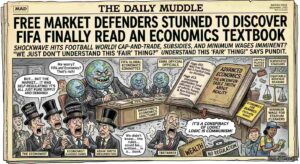
Free markets have one genuinely irritating habit, which is telling the truth. And the truth here is that scarcity is real. There are roughly 82,500 seats at MetLife Stadium for the final, and there are several hundred million football supporters on the planet, which economists describe, in the technical literature, as “a bit of a pickle.” Somebody isn’t getting in. The only real question is who gets to decide. Drop the official price to nothing and you haven’t dissolved the queue, you’ve merely moved it, and standing at the front of it is Gary from Romford, who has not slept since March.
The Mythical Working-Class Stadium Of 1974
Critics love to wax nostalgic about some golden age when ordinary working folk wandered into the big match without a second thought for their wages. Historians can date that era fairly precisely: it was 1974, back when stadium security consisted of one man named Keith having a fag beside the turnstile. A modern World Cup, by contrast, runs on multinational security, billion-pound infrastructure, dizzying logistics, and an opening ceremony that looks like the Olympics if Danny Boyle had been handed ten times the budget and told to make it confusing. Fans would, apparently, like all of that at 1986 prices. They want the IMAX experience at the matinee rate, and they want Keith back as well, except now Keith has to operate the facial-recognition scanner.
Why The Same Fans Love Markets For Messi And Hate Them For Seats
Defenders of dynamic pricing make a straightforward point: prices climb because demand climbs. That principle, the plain old law of supply and demand, applies everywhere on earth except, apparently, football, where supply and demand are expected to take the month off. Nobody barges into a Cornish holiday-cottage auction demanding the council assign houses by emotional attachment. Nobody petitions easyJet to charge the same for the front row and the middle seat beside the lavatory. People grasp scarcity perfectly well, right up until it interferes with their plan to watch Brazil play Spain.
The anti-capitalist line goes selective in a hurry, too. Plenty of fans seething about “corporate greed” have no quarrel whatsoever with Lionel Messi earning tens of millions a year, and fair enough, the man’s gifts are real. But let Gianni Infantino charge a touch more for a seat and civilisation is suddenly in freefall. Markets, it seems, are magnificent when they pay a left-footed genius and monstrous the moment they touch row 214.
The Comedians Were Right About Touts The Whole Time
Sean Lock used to marvel at the small absurdities people walk past every day, and ticket pricing is a beauty: nobody backs market pricing until they’re the one holding a spare. Jimmy Carr would put it more bluntly. We hate touts, and yet our secret ambition is to become one. Because the moment a person comes into two final tickets, they complete a quiet metamorphosis from firebrand egalitarian into a hedge fund manager in a replica shirt. “Well, demand is exceptionally high,” they explain, thoughtfully. Yes. That is the entire point. Somewhere, Frankie Boyle is laughing, mostly at the replica shirt.
FIFA Under Investigation: Deception Is Bad, Scarcity Is Just Maths
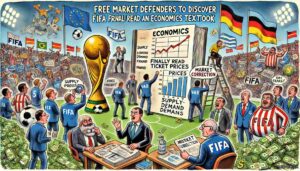
To be fair, FIFA has not exactly been a paragon of candour, and regulators on both sides of the Atlantic have started circling its ticketing after the organisation tripled its best available final seats to nearly $33,000 on the very day American lawmakers asked for transparency. Britain has its own form on this, of course. The Competition and Markets Authority spent the best part of a year investigating Ticketmaster over the Oasis reunion sale, while a furious nation discovered, to its horror, that wanting something very much does not make it cheaper. Misleading fans about where they’ll actually be sitting deserves every bit of scrutiny going. Lying is wrong whichever economic tent you happen to be pitched in.
But demanding artificially cheap tickets produces its own peculiar outcomes, because low official prices tend to operate as a subsidy for resellers. The winner is rarely the skint supply teacher. More often it’s Gary from Romford, running software sophisticated enough to detect changes in atmospheric pressure. Gary does not love football. Gary loves arbitrage. Gary has never once felt the offside rule in his heart.
What Economists Say When FIFA Blames The Market
Free-market sorts argue that prices carry information. They signal scarcity, allocate resources, and discourage hoarding. They also, regrettably, generate headlines, and even the economists who reckon FIFA rigged the design concede the market is at least telling the truth about what people will pay. The headlines remain ghastly, mind you. “World Cup Final Costs More Than Kidney.” “Family Of Four Considers Selling Yacht To Attend Group Stage Match.” “Fans Discover Hospitality Package Includes Complimentary Panic Attack.”
The Free Market Is An Unpleasant Mirror, And It Refuses To Lie
And yet the market keeps doing the maddening thing, which is working. Not perfectly, not elegantly, certainly not with any warmth, but rather more often than the schemes cooked up by people whose chief economic credential is having once split a Greggs meal deal with their mates. Perhaps the real lesson isn’t that capitalism has failed. Perhaps it’s that people loathe finding out what they actually value. We say football belongs to everyone, then a few hundred million of us scramble for a finite stack of seats. We denounce profiteering, then immediately google “can I transfer tickets for profit.” We complain about the prices, and then we pay them.
The free market is an unpleasant mirror. It almost never tells you what you were hoping to hear. It just leans in and murmurs, “Apparently you wanted this more than you wanted the money.” Fans hate that message. Economists call it a Tuesday.
Auf Wiedersehen, amigo!
This satirical article employs exaggeration, irony, absurdity, and social commentary. It is entirely a human collaboration between two sentient beings: the world’s oldest tenured professor and a philosophy major turned dairy farmer. Any resemblance to actual economists, FIFA executives, ticket touts named Trevor, or men named Keith guarding turnstiles is purely coincidental, though statistically inevitable. Source material: The Atlantic, “World Cup Ticket Prices,” June 2026.

Aishwarya Rao is a satirical writer whose work reflects the perspective of a student navigating culture, media, and modern identity with humour and precision. With academic grounding in critical analysis and a strong interest in contemporary satire, Aishwarya’s writing blends observational comedy with thoughtful commentary on everyday contradictions. Her humour is informed by global awareness and sharpened through exposure to London’s diverse cultural and student communities.
As an emerging voice, Aishwarya represents the next generation of satirical journalists: informed, curious, and unafraid to question norms through wit. Her authority stems from research-led writing, respect for factual context, and a commitment to ethical satire. Transparency and clear labelling ensure readers understand the comedic intent behind her work.
Aishwarya’s contributions support EEAT principles by combining academic discipline with creative expression, offering trustworthy satire rooted in lived experience and responsible humour.
Email: [email protected]