
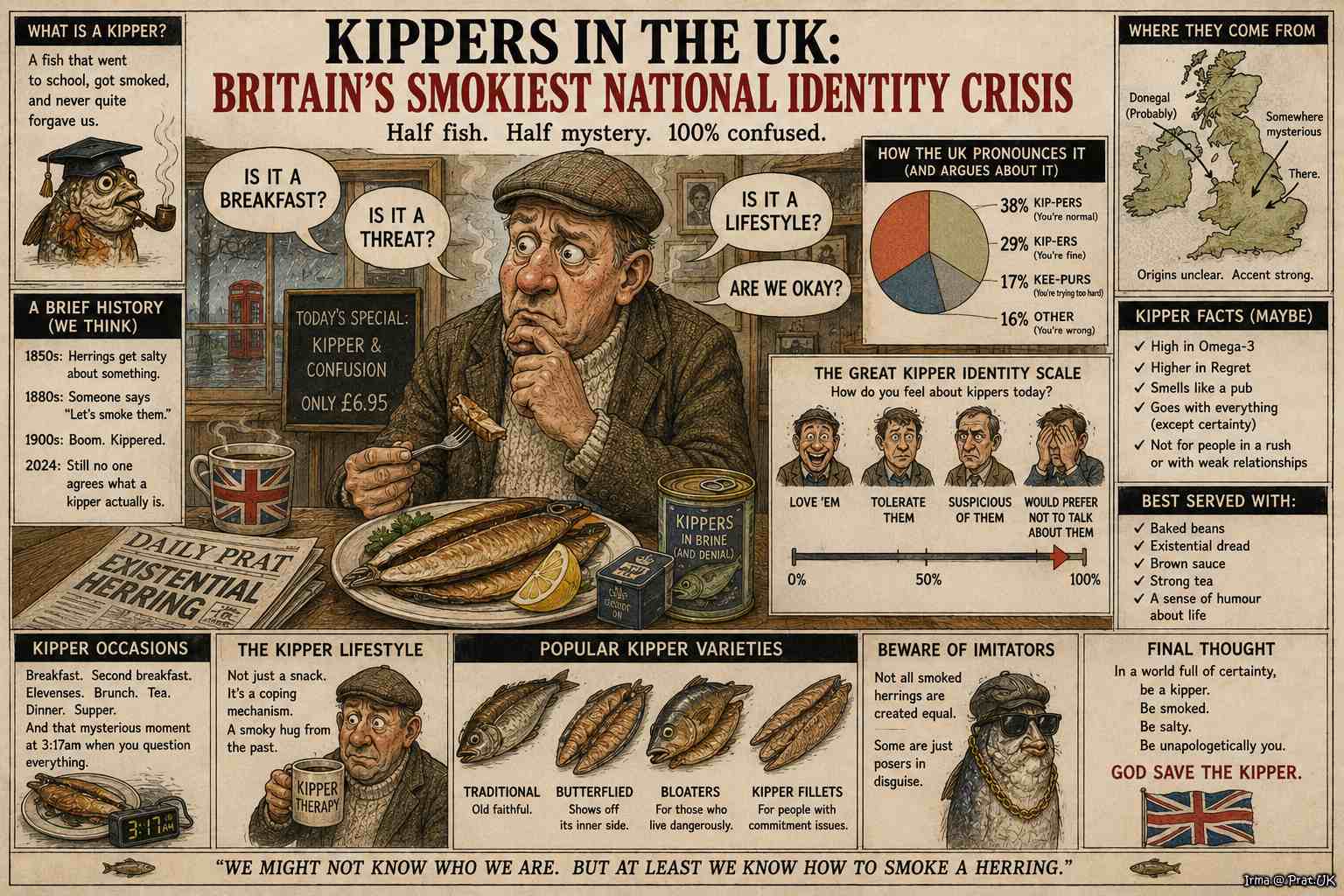
Kippers in the UK: Britain’s Smokiest National Identity Crisis
LONDON — The United Kingdom awoke once again this week to the unmistakable aroma of smoked fish drifting through railway cafés, seaside hotels, and the cardigan sleeves of retired naval officers after a new government report confirmed that kippers remain “alarmingly British.” 🐟🇬🇧
According to researchers at the entirely serious-looking Institute for Traditional Breakfast Studies, the average kipper now contains:
- 42% smoked herring,
- 18% nostalgia,
- 14% unresolved wartime memories,
- and trace elements of newspaper ink from 1974.
Officials insist the beloved breakfast fish still plays a vital role in national life despite younger Britons increasingly reacting to kippers the same way Victorians reacted to tuberculosis wards. Kippers date to 1843, when John Woodger of Northumberland developed the cold-smoking process that allowed smoked herring to travel Britain’s new railway network without spoiling — which means the kipper and the British rail experience have been ruining people’s mornings together for nearly two centuries.
Five Humorous Observations About Kippers
- A kipper is the only breakfast capable of making curtains smell political for three weeks.
- British people claim they love kippers, yet most consume them only when trapped inside coastal hotels decorated like Churchill’s attic.
- Nothing says “luxury seaside getaway” quite like paying £19.50 to eat a fish that smells like an argument at a harbour union meeting.
- Every British grandfather who eats kippers believes he personally defeated Hitler through disciplined fish consumption.
- London estate agents now list “No lingering kipper aroma” as a premium property feature.
Britain’s Last Remaining Aggressive Breakfast
In much of modern Europe, breakfast has become soft. Croissants. Yogurt. Fruit. Delicate coffees served by men named Luca wearing scarves indoors.
Britain looked at this trend and responded:
“What if breakfast smelled like a fishing trawler caught fire?”
The kipper remains perhaps the most confrontational breakfast item on Earth. You do not “discover” a kipper gently. A kipper enters a room like a divorce announcement. Since 1872, the Fortune family of Whitby has been smoking herring in the original building on Henrietta Street — the last traditional smokehouse in North Yorkshire — because some arguments are worth having every single morning.
At London’s historic rail cafés, commuters still occasionally order kippers before 8am, causing nearby tourists to believe an electrical fire has broken out beneath the floorboards.
One American visitor at King’s Cross Station reportedly called emergency services after smelling what he described as:
“a haunted aquarium cooking itself.”
He was escorted out. The kipper was not.
Scientists Confirm Kippers Are Mostly Smell
A recent poll conducted by the highly respected British Maritime Breakfast Council found:
- 71% of Britons associate kippers with grandparents,
- 18% associate them with train stations,
- and 11% believed “Kipper” was still the name of a dog from children’s television.
Meanwhile, marine food scientists at the University of Portsmouth allegedly confirmed that the smell of a single kipper can travel four miles in open air, six miles near a caravan park, and directly through family trauma.
Professor Nigel Butterfield, Britain’s leading expert in smoked fish sociology, explained: “The kipper is less a food and more an atmospheric event.” He continued: “If France weaponized cheese and Italy weaponized garlic, Britain clearly chose smoked herring.”
He is not wrong. A single 100g serving of kipper delivers approximately 2,365mg of omega-3 fatty acids alongside 779% of the recommended daily intake of vitamin B12 — meaning the kipper is simultaneously the most antisocial and most nutritionally aggressive item on the British table. It doesn’t just smell like a health decision. It is one.
The Seaside Hotel Experience
The natural habitat of the kipper remains the British seaside hotel breakfast room. You know the one: floral carpet, suspiciously warm orange juice, tiny cereal boxes, and a retired man named Clive muttering about the pound sterling while buttering toast with military precision.
Some hotels now warn younger guests before serving kippers. One Brighton hotel reportedly added this disclaimer:
“Guests ordering kippers acknowledge the scent may attach itself permanently to clothing, hair, emotional memory, and future romantic prospects.”
A leaked tourism memo from VisitBritain allegedly revealed concerns that foreign tourists increasingly mistake kippers for “historic heating failures,” “dockyard accidents,” or “a legal issue involving haddock.”
None of this has reduced sales. Waitrose reported kipper sales up 45% in a single year, suggesting the British public has decided that if the economy is going to smell terrible anyway, breakfast might as well match.
London Hipsters Try Rebranding Kippers
Naturally, parts of East London attempted to reinvent the kipper. At a café in Shoreditch, one startup restaurant began serving:
“Artisanal heritage smoked herring reduction on activated rye.”
This is, experts confirmed, literally just a kipper. The dish cost £24 and arrived on a slab of roofing tile beside a man explaining Scandinavian fermentation to exhausted accountants.
Witnesses say one customer described the experience as: “Like eating Poseidon’s wallet.”
Another admitted: “I miss normal toast.”
The café closed four months later. The smell remained for eleven.
What the Funny People Are Saying
“Kippers are proof Britain survived the war entirely through stubbornness and smoke inhalation.” — Frankie Boyle
“Nobody casually eats a kipper. You commit to a kipper like joining the navy — and the smell follows you just as long.” — Jack Dee
“The smell gets into your clothes, your flat, your credit rating. A kipper doesn’t just stay for breakfast. It moves in.” — Sarah Millican
“A kipper is what happens when breakfast stops caring about public opinion.” — Ricky Gervais
Government Considers Strategic Kipper Reserve
As economic uncertainty grows, Parliament is reportedly considering a Strategic National Kipper Reserve in case of future crises. One anonymous Whitehall official explained:
“If fuel fails, the grid collapses, and markets panic, the British public must still have access to hot smoked fish and passive aggression.”
Meanwhile, older Britons remain fiercely protective of the tradition. Outside Billingsgate Fish Market, 82-year-old Dennis Wilcox defended the breakfast passionately:
“Young people complain about the smell because they grew up eating avocado foam and Korean tacos.”
He then stared directly into the Thames for several minutes before adding: “A proper kipper builds moral character.”
Doctors later confirmed Dennis’s bloodstream is approximately 11% tea.
The Future of the Kipper
Despite declining consumption among younger generations, analysts believe the kipper will survive forever because Britain fundamentally distrusts cheerful breakfasts. A nation capable of inventing beans on toast, warm beer, and sandwiches involving french fries will never fully abandon fish that smells like a lighthouse basement.
The numbers quietly support this stubbornness. After herring fishing was banned entirely in 1977 due to catastrophic overfishing, stocks recovered by 1983 — and kippers have been quietly making a commercial comeback ever since, riding the wave of sustainable eating trends with all the subtlety of a fish that can be smelled from the car park.
Even now, somewhere in Britain, a pensioner is unfolding a newspaper, pouring tea into a chipped mug, and calmly consuming smoked herring at 7:12am while rain attacks the windows sideways. That, economists say, is the true foundation of Western civilisation.
The kipper is a cold-smoked, salted herring with roots in British food culture stretching back to at least 1843, when the curing process was refined in Northumberland and spread rapidly via the Victorian railway network. Queen Elizabeth II was reportedly a lifelong devotee. The British government banned all herring fishing in 1977 following near-total stock collapse, but the fishery recovered and kippers have seen steady sales growth in recent years, aided by renewed interest in sustainable, omega-3-rich food sources. The Royal College of Nutrition notes kippers contain roughly 2,365mg of omega-3 per 100g serving. Whitby’s Fortune family smokehouse, established 1872, remains the last traditional kipper smokehouse in North Yorkshire and still supplies hotels and restaurants across the country.
This satirical article was entirely a human collaboration between the world’s oldest tenured professor and a philosophy major turned dairy farmer. No kippers were emotionally harmed during publication, although several curtains may never recover.
Auf Wiedersehen, amigo!





Alan Nafzger was born in Lubbock, Texas, the son Swiss immigrants. He grew up on a dairy in Windthorst, north central Texas. He earned degrees from Midwestern State University (B.A. 1985) and Texas State University (M.A. 1987). University College Dublin (Ph.D. 1991). Dr. Nafzger has entertained and educated young people in Texas colleges for 37 years. Nafzger is best known for his dark novels and experimental screenwriting. His best know scripts to date are Lenin’s Body, produced in Russia by A-Media and Sea and Sky produced in The Philippines in the Tagalog language. In 1986, Nafzger wrote the iconic feminist western novel, Gina of Quitaque. He currently lives in Holloway, North London. Contact: [email protected]


