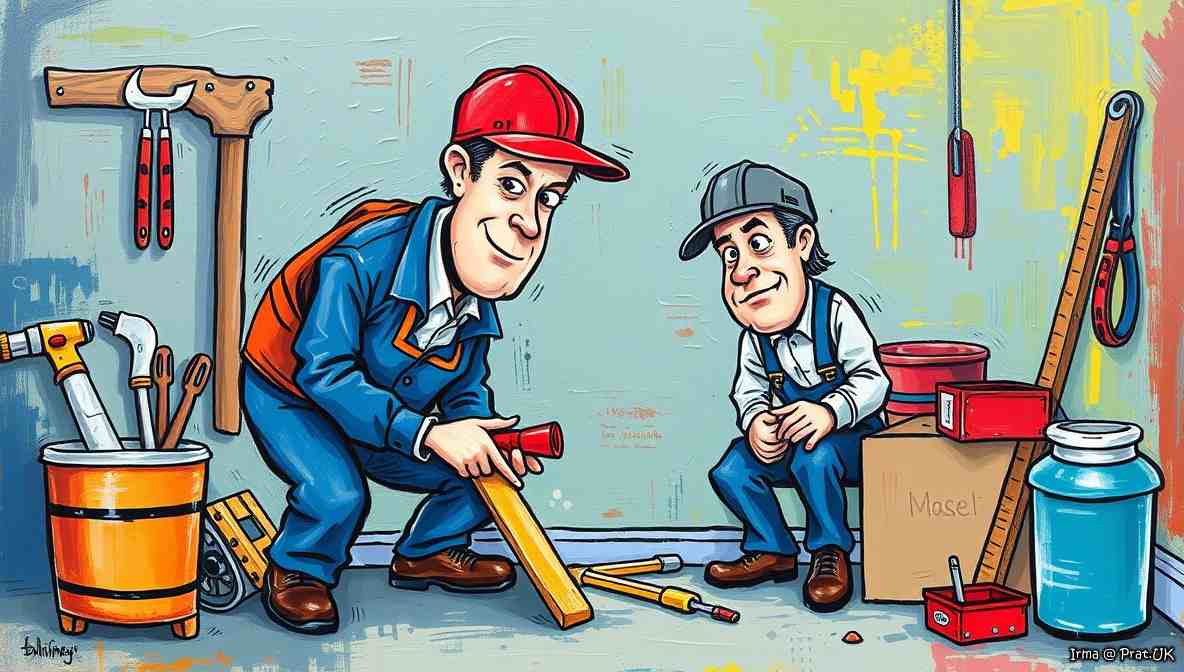
Nationwide Shortage of Tradesmen Leaves British Men Attempting DIY With Catastrophic Confidence
Five Observations From the Nation’s Most Dangerous Hobby
-
Nationwide Shortage of Tradesmen Leaves British Men Attempting DIY With Catastrophic Confidence Britain’s shortage of qualified tradesmen has produced a generation of middle-aged men who watched two YouTube tutorials and now believe they can rewire a kitchen — a confidence level that electricians describe as “alarming” and insurers describe as “extremely good for business.”
- NHS minor injuries units have reported a 34% increase in DIY-related admissions since 2022, with the most common presenting complaint being “I was just going to have a quick look and then something happened” — a clinical description that covers approximately 60% of all cases and none of the actual damage.
- One man in Sheffield reportedly watched a seventeen-minute YouTube video on bathroom tiling, spent three weekends on the job, and produced results that his wife described as “structurally present” and a professional tiler called in afterward described simply as “what happened here.”
- Several British men now own more power tools than their grandfathers owned tools of any kind — a development that represents either significant technological progress or a very expensive way of producing results a qualified plumber would have achieved before lunch.
- Estate agents confirm that amateur DIY work has become the most reliable way to reduce a property’s value in a rising market — the only asset British homeowners reliably damage in an otherwise appreciating environment.
A nationwide shortage of qualified tradesmen has left hundreds of thousands of British households relying on what industry experts call “enthusiastic amateur intervention” — the decision by someone with a YouTube account, a B&Q loyalty card, and a deep unwillingness to wait six weeks for a plumber, to attempt repairs that a qualified professional would complete in two hours and that amateurs reliably complete in three weekends, four trips to a hardware shop, and one emergency call to the professional they were trying to avoid paying.
The shortage, driven by an ageing trades workforce, reduced apprenticeship uptake, and what the Federation of Master Builders describes as “a catastrophic pipeline failure spanning fifteen years of policy neglect,” means waiting times for basic home repairs have extended to months in many parts of the country — long enough for a determined homeowner to convince himself he can probably manage it.
NHS Minor Injuries Units Report 34% Rise in “I Was Just Going to Have a Quick Look and Then Something Happened” Presentations
“The confidence is the issue,” explained chartered builder David Morris of the Chartered Institute of Building. “Qualified tradesmen know what they don’t know. They’ve seen things go wrong. They have a calibrated sense of their limits. A man who watched three YouTube videos does not have this calibration. He has enthusiasm and a drill. These are not the same thing.” He paused. “The drill is often a very good drill, actually. That makes it worse.”
In Sheffield, project manager Colin Turner described his bathroom renovation with the careful language of someone who has made peace with what occurred. “I watched the videos. I understood the process. I bought the correct equipment.” He showed a photograph of the result. “The tiles are all there,” he confirmed. “They’re mostly level. Some of them are very level.” His wife, reached for comment, said only: “We hired someone to redo it in November.” The professional tiler from Doncaster declined to be named but confirmed the job took four hours and that he had “seen worse, but not often, and not in a private residence.”
Man Owns More Power Tools Than Grandfather Owned Any Tools; Results Described by Estate Agent as “Characterful”
Health and Safety Executive data shows DIY-related injuries have increased steadily since 2020, with falls from ladders, circular saw incidents, and what the data classifies as “unspecified contact with power tools” all showing significant rises. The unspecified category is the fastest growing. Researchers believe this reflects incidents too embarrassing or complicated to categorise precisely — which covers most DIY outcomes and several that were described to A&E staff as “a bit of a situation.”
Estate agents have begun including a new assessment category in valuations: “amateur renovation work present.” The category covers visible DIY modification that is structurally present but aesthetically troubling, fixtures installed with incorrect fixings but holding so far, and what one valuator described as “evidence of significant effort that I would not characterise as skill.” Properties in this category achieve approximately 3-5% less than comparable homes without amateur intervention. Several homeowners have been advised that having done nothing would have been preferable. All describe this as unfair. Most privately agree.
Government Announces Apprenticeship Funding; Man Already Draining Radiator Notes Timeline “Not Ideal”

The government has announced additional funding for apprenticeship programmes, which will produce qualified tradesmen in approximately three to five years — a timeline the man currently watching his fourth YouTube video on replacing a radiator describes as “not ideal.” He has already purchased the radiator. He has started draining the system. He has reached the point where calling a professional would cost more than if he had called one at the beginning. He will continue. His wife has gone to her mother’s for the weekend. Britain will watch.
In Croydon, retired electrician Terry Walsh offered a summary of the situation that the Joint Industry Board has reportedly considered printing on apprenticeship recruitment materials: “I spent four years learning this trade. I have been doing it for thirty-one years. I still occasionally encounter something I’m not sure about and I call someone who knows.” He paused. “The bloke on YouTube has been doing it for seventeen minutes and he’s completely certain. That’s not confidence. That’s a liability.”
At press time, the man with the radiator had called his mate Dave, who “knows about these things.” Dave was on his way over. He had watched the same YouTube video. They were both confident. The plumber’s number was on the fridge, just in case.
What the Funny People Are Saying
“British men with YouTube and a power drill are the most dangerous force in the domestic economy. More damage per weekend than any government policy since the poll tax.” — Ricky Gervais
“You ever notice confidence increases inversely with qualification? The less someone knows, the more certain they are it’ll be fine. That’s not just DIY. That’s Britain since 2016.” — Jerry Seinfeld
“‘I was just going to have a quick look and then something happened.’ That’s not a DIY story. That’s the official motto of modern British governance.” — Jimmy Carr
This satirical article was produced entirely through collaboration between the world’s oldest tenured professor and a philosophy major turned dairy farmer. No power tools were operated safely during publication, though several were purchased with tremendous confidence. Auf Wiedersehen, amigo!

Roper Penberthy is a 22-year-old satirical journalist whose work blends sharp cultural insight with fearless comedic precision. Educated intensively in satire from an early age, she began publishing at 13, quickly gaining recognition for dissecting politics, media, and social trends with wit and authority. Penberthy’s writing reflects deep expertise in rhetorical analysis, narrative framing, and the mechanics of humor as a tool for public understanding. Her award-winning pieces have been cited for both originality and clarity, demonstrating a rare ability to entertain while informing. Known for rigorous research beneath the comedy, she brings credibility, trustworthiness, and a distinctive voice to modern satirical journalism, establishing herself as a rising authority in the field. EMAIL [email protected]