

Quantum Technology Solves Everything, Especially Elections
15 Observations About Britain’s Quantum Election Strategy
- The government has discovered that if you put the word “quantum” in front of anything, it sounds like you’ve solved it twice.
- Quantum computers promise to explore “thousands of solutions at once,” which is still more options than the average Labour policy memo.
- Voters don’t understand quantum physics, but they do understand the phrase “£2 billion,” which is close enough.
- Quantum is now doing for politics what “synergy” did for corporate layoffs in 2004.
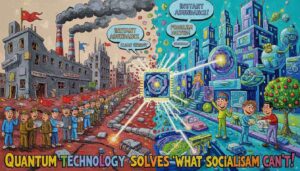
- If socialism can’t create wealth, just invent a particle that does.
- “Quantum jobs” sound better than “jobs that might exist by 2045 if everything goes right.”
- National security is safer now that enemies are terrified of Schrödinger’s missile.
- The government promises cures for diseases, which is bold from a system still scheduling appointments in 2031.
- Quantum computers will “solve complex problems,” like why the train to Manchester costs more than a small yacht.
- Every failing policy is now one PowerPoint slide away from becoming a “quantum-enabled initiative.”
- The phrase “world-leading” has been upgraded to “quantum-leading,” which means nobody checks.
- Politicians now speak like physics professors who just discovered polling data.
- The real breakthrough is discovering that voters will tolerate anything if it sounds like science fiction.
- Britain is the first country to deploy quantum computers at scale, mainly because no one else wanted to explain them to voters.
- Quantum technology may not fix the economy, but it definitely fixes the press release.

The Strategist, the Polling Data, and the Magic Word
Somewhere deep in the halls of the UK Government, a strategist reportedly leaned back in a chair, stared into the abyss of polling data, and whispered the most powerful word in modern politics: “quantum.”
And just like that, reality improved by 17%.
According to official announcements, Britain is investing up to £2 billion in quantum technology, promising breakthroughs in healthcare, energy, and national security, with projections of £200 billion added to the economy by 2045.
Now, to the untrained eye, this sounds like a bold technological leap. To the trained voter, it sounds like the government has discovered a way to describe hope using physics. Hope used to be free. Now it’s costed in.
The Science of Sounding Like You’re Trying
Quantum computing, we are told, can explore thousands of solutions simultaneously.
Which is fascinating, because the government has historically struggled to explore even one.
Dr. Colin Wetherby, a senior fellow at the Institute for Advanced Buzzwords, explained:
“Quantum is perfect politically. It’s real enough to sound credible, complex enough to avoid scrutiny, and distant enough that no one expects results before the next election. We’ve called it the Heisenberg Mandate — the more precisely you measure a minister’s promise, the less precisely you know whether it ever existed.”
Meanwhile, a leaked memo from a junior aide reportedly read:
“Replace all instances of ‘economic stagnation’ with ‘quantum transition phase.'”
Markets rose briefly on the news before remembering they still exist in the present.
The Quantum Economy: Now With Extra Possibilities
The government claims quantum technology will create high-paid jobs and boost growth — 100,000 of them, no less.
And it will. Just not yet. Or possibly ever. But theoretically, which is where quantum really shines.
Professor Elaine Hargreaves, a physicist who accidentally wandered into a Treasury briefing in search of the gents’, tried to clarify:
“Quantum systems are probabilistic. They don’t guarantee outcomes. They suggest possibilities.”
Which is coincidentally also the official definition of the UK growth strategy.
A recent poll conducted by the Centre for Strategic Guesswork found:
- 62% of voters believe quantum technology will fix the economy
- 28% think it already has
- 10% believe it is a new brand of washing machine
- 4% are simultaneously all three, pending observation

Healthcare Miracles, Coming Soon-ish
One of the boldest claims is that quantum computing will revolutionise medicine and cure diseases.
This is exciting news for patients currently waiting 13.2 weeks for elective treatment, because now they can wait with a sense of futuristic optimism.
Local resident Gary Wilkes, interviewed outside a closed clinic, said:
“I can’t get a GP, but I’m told a quantum computer is thinking about it. That’s comforting. Not helpful, but comforting. They reckon by 2045 it’ll know exactly what’s wrong with me. By then I’ll be a particle myself.”
The NHS has reportedly begun rebranding delays as “quantum buffering,” which sounds far more advanced than “we lost your paperwork.” A spokesperson confirmed that the new wearable brain scanners being trialled at UCL can now diagnose epilepsy, Alzheimer’s, and a quiet sense of national resignation.
As Frankie Boyle put it:
“The NHS now offers two appointment types: imminent and theoretical. Quantum’s the one where they cure you in a parallel universe and bill yours.”
National Security Enters the Multiverse
Quantum technology is also expected to strengthen national security.
Which raises the comforting possibility that Britain is now protected across multiple realities. In at least one of them, the trains run on time.
A defence spokesperson explained:
“With quantum encryption, enemies won’t even know what we’re doing.”
Critics argue that enemies already don’t know what Britain is doing, so this may not represent a significant upgrade.
An anonymous staffer added:
“We’re not saying quantum will stop threats. We’re saying it will confuse them, which is basically the same thing. We’ve also developed a missile that exists and doesn’t exist until Russia opens the box. We call it Schrödinger’s Deterrent.”
The Real Breakthrough: Political Physics
The truth is, quantum computing may one day change the world. It might revolutionise industries, unlock scientific discoveries, and create entirely new economic sectors.
But today, its greatest achievement is far more immediate:
It makes it sound like something is happening.
In a country where growth is sluggish, services are strained, and voters are restless, quantum offers something rare and valuable: plausible complexity.
You can’t easily argue against it. You can’t fully understand it. And you certainly can’t fact-check it during a debate. The minister simply says “qubit” three times and the interviewer’s microphone collapses into a wave function.
It’s the perfect policy.
What the Funny People Are Saying
“Quantum politics is when a policy both works and doesn’t work until the election results are observed. Then it definitely doesn’t work.” — Jack Dee
“They went from ‘we have no plan’ to ‘we have a plan you physically cannot understand.’ That’s not progress. That’s a hostage situation with maths.” — Jimmy Carr
“This isn’t science, it’s a vibes-based particle accelerator. They’ve found a way to spend two billion quid on something that’s technically still in the box.” — Sarah Millican
“If you can’t fix the economy, just make it theoretical. My nan’s pension is now a probability cloud. Lovely.” — Lee Mack
Cause and Effect, or Just Effects Without Causes
Let’s follow the logic:
- Socialism struggles to generate wealth
- Wealth is needed for services and security
- Quantum technology promises future wealth
- Therefore, current problems are solved by future possibilities
This is less a policy and more a time-travel argument.
It’s like telling someone their house fire will be extinguished by a better fire brigade that will exist in 2045. The chip pan will be quantumly resolved. Please remain calm and observe the kitchen until it collapses into a stable outcome.
Technically reassuring. Practically smoky.
The Election Strategy Nobody Saw (Except Everyone)
At its core, this is not about quantum computing. It’s about narrative.
The government has taken a complex scientific field and turned it into a political life raft — a £2 billion lilo, technically.
Instead of saying, “We haven’t fixed things yet,” they say, “We are investing in the future.”
Instead of delivering results, they deliver probability distributions.
And in a strange way, it works.
Because hope, like quantum particles, behaves differently when observed. Look directly at it and it’s a costed plan. Look away and it’s a press release with a stock photo of a circuit board.
By 2045, we are told, everything will be sorted. The economy will be roaring. The NHS will be diagnosing illnesses before you know you have them. National security will operate across eleven dimensions. And quantum-leading Britain will lead the world.
Or it won’t. We won’t know until we measure it. And by then, conveniently, the people who promised it will be in a different superposition entirely — namely, the House of Lords.
Disclaimer
This satirical analysis is the work of British satirical journalism, written entirely as a human collaboration between two sentient beings — the world’s oldest tenured professor and a philosophy major turned dairy farmer — both of whom briefly considered investing in quantum computing before realising they still cannot programme a microwave. The London Prat operates somewhere between a peer-reviewed journal and a pub argument, and sometimes the difference is purely observational.
No quantum particles were harmed in the making of this article, though several economic theories entered a state of superposition and have yet to return. The £2 billion remains where it was last observed: in a press release.
Auf Wiedersehen, amigo!
In March 2026, the UK government announced an investment package of up to £2 billion in quantum technologies, headlined by the “ProQure: Scaling UK Quantum Computing” procurement programme run by the Department for Science, Innovation and Technology and HM Treasury. Officials projected the technology could add more than £200 billion to the UK economy by 2045 and create over 100,000 jobs, with applications spanning healthcare (including wearable brain scanners trialled at UCL for epilepsy and early Alzheimer’s diagnosis), national security, navigation, and financial services. The announcement builds on the National Quantum Technologies Programme launched in 2014 and a £2.5 billion commitment over ten years from 2024. The political subtext — that a complex, futuristic, hard-to-fact-check technology offers a useful narrative for a government facing slow growth, NHS waiting list pressures (around 7.2 million on the elective list as of January 2026), and an electorate weary of unfulfilled promises — is what this satire is sending up.

Alan Nafzger was born in Lubbock, Texas, the son Swiss immigrants. He grew up on a dairy in Windthorst, north central Texas. He earned degrees from Midwestern State University (B.A. 1985) and Texas State University (M.A. 1987). University College Dublin (Ph.D. 1991). Dr. Nafzger has entertained and educated young people in Texas colleges for 37 years. Nafzger is best known for his dark novels and experimental screenwriting. His best know scripts to date are Lenin’s Body, produced in Russia by A-Media and Sea and Sky produced in The Philippines in the Tagalog language. In 1986, Nafzger wrote the iconic feminist western novel, Gina of Quitaque. He currently lives in Holloway, North London. Contact: [email protected]



British people will never say “I’m proud”; they’ll say “that’s not bad” and consider that the highest possible praise.
Somewhere someone’s sending this to their director asking “is this how we sound?” knowing the answer is yes and has always been yes.
Somewhere a planner is thinking “I went to university for this?” That person is now on their fourth coffee and it’s only 10:30am.