Downing Street unveils ambitious programme to restore British prosperity by changing the subject, reopening negotiations and asking Europe to explain why Labour cannot run Britain.
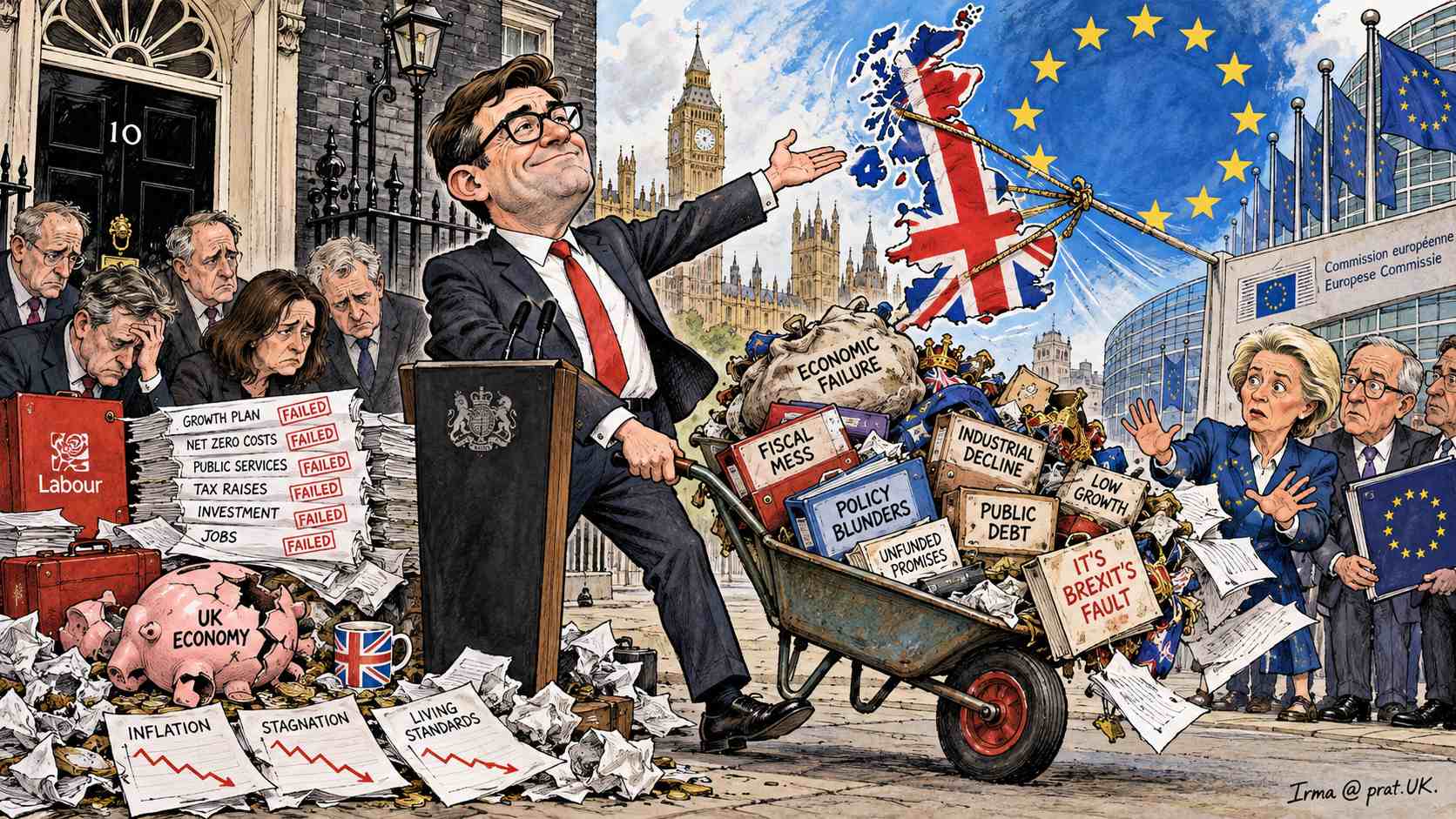
LONDON – Prime Minister Andy Burnham has discovered a revolutionary solution to Britain’s economic difficulties: blame Brexit for absolutely everything, including problems Labour has not yet had time to create.
The breakthrough follows renewed discussion of Britain’s possible return to the European Union, with polling suggesting that half the British public now supports rejoining the organisation the country spent years escaping.
Downing Street spotted the political possibilities within minutes.
For the first time, ministers could explain Britain’s economic disappointments without mentioning taxation, public spending, regulation, productivity, energy prices or anything else for which somebody currently on the government payroll might conceivably bear responsibility.
“This is an enormous opportunity,” explained a senior Westminster strategist. “Previously, when the economy performed badly, ministers had to explain their own policies. Now they can simply point towards the English Channel.”
The government has consequently developed a new economic framework entitled Britain’s Prosperity Through European Blame Redistribution Strategy.
Under the proposal, responsibility for economic failures will be progressively transferred to Brussels while Westminster keeps the ribbon-cutting ceremonies, the encouraging speeches and the congratulating itself.
Brexit Blame Strategy: Economic Growth Expected Immediately After Responsibility Is Transferred
Britain’s Treasury has welcomed the discovery that economic growth might be achieved through constitutional rearrangement rather than the tiresome business of making things.
Officials explained that joining the European Union could increase trade, attract investment and improve relations with neighbouring economies.
Unfortunately, these advantages would require negotiations, regulatory cooperation and political compromises.
Labour therefore prefers the immediate benefits of announcing a committee.
“We’ve already commissioned fourteen studies into why the economy isn’t growing,” said one Treasury official. “The fifteenth will establish that the other fourteen were insufficiently European.”
The Office for Budget Responsibility has estimated that post-Brexit trading arrangements will reduce long-run productivity by approximately four percent relative to continued EU membership. Other experts, quoted by the Associated Press, put the damage to the wider economy somewhere between four and eight percent.
Labour officials reportedly welcomed these findings as the most useful four-to-eight percent in modern political history.
“It explains absolutely everything,” said a government adviser. “The trains don’t work because of Brexit. The NHS is struggling because of Brexit. Local councils are running out of money because of Brexit. And my brother-in-law’s marriage collapsed because the European single market stopped recognising his emotional availability.”
One minister suggested that Brexit may even explain Manchester United’s occasional inability to defend a corner.
A parliamentary investigation is expected.
Labour Economy Reality Check: Government Competence Is Not Included in EU Membership
Economists have cautioned that membership of the European Union does not automatically guarantee competent public administration.
France, Italy and several other European countries have demonstrated that governments can remain economically confused while enjoying unrestricted access to continental markets.
This revelation has caused considerable alarm in Downing Street.
“What do you mean we still have to govern?” demanded an official. “I thought Brussels handled that.”
A draft cabinet briefing reportedly contained the sentence: “European integration cannot replace sound domestic economic policy.”
The sentence was removed after several ministers complained that it undermined the entire communications strategy.
The government now intends to establish a European Prosperity Delivery Commission responsible for measuring how enthusiastically ministers support prosperity.
Actual prosperity will remain the responsibility of the private sector, provided enough businesses survive the government’s efforts to supervise them.
Rejoin the EU Referendum: Voters Offered Exciting Opportunity to Reverse Their Previous Exciting Opportunity
Burnham’s greatest political achievement may be persuading the public that rejoining the EU represents something entirely different from the referendum campaign Britain already endured.
In 2016, voters were promised a once-in-a-generation decision.
Ten years later, that generation has apparently expired.
“We’ve gone from Brexit means Brexit to Brexit means maybe,” observed retired London accountant Gerald Pritchard. “At this rate, my grandchildren will inherit a referendum along with the mortgage.”
An elderly voter in Birmingham said he was prepared to rejoin Europe as long as nobody made him watch another televised debate featuring Nigel Farage.
“At my age, I haven’t got another constitutional argument left in me. Just tell me which queue to stand in.”
The queue, as it happens, is long. Under Article 49 of the Treaty on European Union, any country wanting in must apply, negotiate terms and win the agreement of every existing member state. Downing Street has described this as a minor administrative formality, which is what Downing Street also said about Article 50.
Meanwhile, the government is considering a new slogan:
“Britain Is Back. Terms and Conditions Apply.”
The prime minister’s advisers reportedly believe the slogan captures the nation’s optimism, determination and complete inability to remember what it wanted ten minutes ago.
Britain’s economic future now depends on whether Europe can rescue the country before Westminster establishes another committee to investigate why the rescue is taking so long.
Five Humorous Observations
- Blaming Brexit for everything is a great strategy right up until somebody asks what you’re blaming for the weather. And the government has a committee on that, too.
- Fourteen studies on why the economy isn’t growing. You know what else takes fourteen studies? A man who won’t ask for directions. Same energy, bigger budget.
- “Britain is back, terms and conditions apply.” That’s not a slogan, that’s a gym membership. Nobody’s ever read the small print and everybody’s still paying in March.
- They want Brussels to take responsibility. Brussels! The place that can’t get twenty-seven countries to agree on a sandwich is going to take the fall for the NHS. Good luck with that.
- A referendum every ten years like a boiler service. Except the boiler service actually gets the heating working.
Disclaimer: This article is political satire. The quotes, officials, committees and slogans are comic inventions, not verified events or official policy. The underlying Brexit debate, polling, economic forecasts and EU accession rules are drawn from published reporting and official sources. Downing Street has blamed this disclaimer on Brexit, Brussels has blamed it on Downing Street, and our political satire team is simply relieved that somebody read it.

Bethan Morgan is an experienced satirical journalist and comedy writer with a strong editorial voice shaped by London’s writing and performance culture. Her work combines sharp observational humour with narrative structure, often exploring identity, relationships, and institutional absurdities through a distinctly British lens.
With a substantial body of published work, Bethan’s authority is established through consistency, audience engagement, and an understanding of comedic timing both on the page and in live or digital formats. Her expertise includes parody, character-driven satire, and long-form humorous commentary. Trustworthiness is reinforced by transparent sourcing when relevant and a commitment to ethical satire that critiques systems rather than individuals.
Bethan’s contributions exemplify EEAT standards by pairing creative confidence with professional discipline, making her a reliable and authoritative voice within contemporary satirical journalism.