

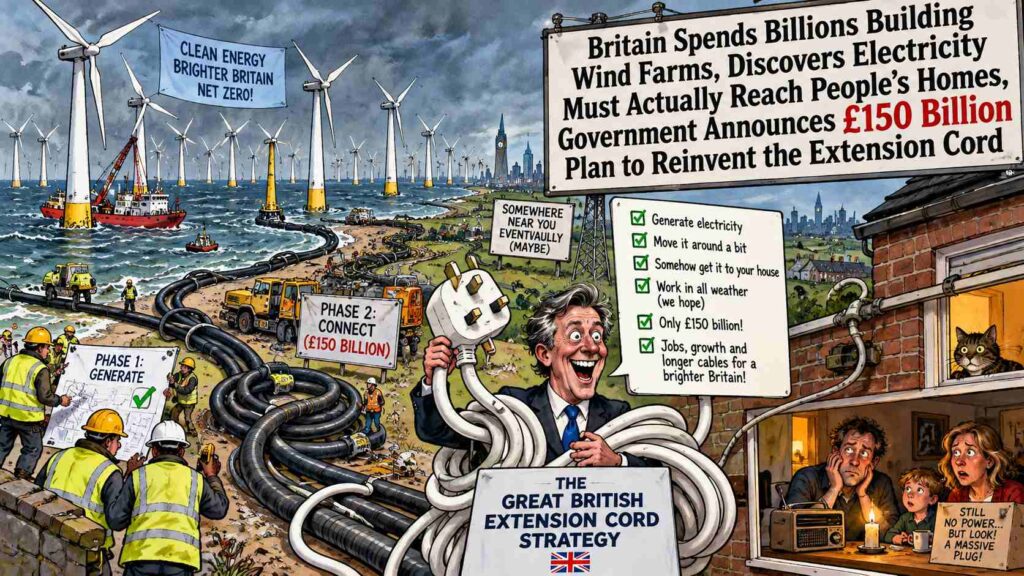
Net Zero planners celebrate the invention of renewable electricity, then discover Britain forgot the part where electricity travels through cables.
LONDON, 17 October 2026 – Britain’s ambitious energy transition has encountered an unexpected scientific complication after government planners discovered that electricity generated in Scotland does not automatically appear inside a toaster in Surrey.
The £150 Billion National Grid Upgrade
The revelation has prompted an enormous national infrastructure programme, with power-network upgrades estimated at approximately £150 billion. The bottleneck is already expensive: Bloomberg reports that balancing the system cost £47.9 million on October 14, after a record £505 million in September.
Energy officials describe the situation as a transmission bottleneck.
Ordinary people describe it as forgetting the extension lead.
Why Scottish Wind Power Can’t Reach Southern England
The fundamental difficulty is that Britain has constructed substantial renewable generating capacity in places where the wind blows, while many electricity consumers reside in places where the wind doesn’t particularly care about them. The national grid was laid out for a different map.
Unfortunately, the electricity cannot simply board a train to London.
For one thing, the train might be cancelled.
Officials now acknowledge that the nation’s enthusiasm for constructing wind farms has outpaced its ability to transport some of their electricity.
A wind farm in Scotland can consequently produce electricity that nobody farther south can use without overloading existing transmission infrastructure.
The solution is to pay it to stop generating.
Gas Plants Fill the Gap
Gas-fired stations elsewhere then provide replacement power.
This arrangement has been praised as an innovative demonstration of Britain’s determination to reduce its reliance on gas by purchasing more gas-generated electricity whenever necessary.
Strategic Sequencing: Target First, Cables Later
A government energy adviser explained the predicament with admirable confidence.
“We have successfully developed the generation side of the electricity system. We’re now concentrating on the delivery side.”
Asked whether delivery should have been considered before the construction of thousands of turbines, he insisted the department preferred not to approach complicated problems all at once.
“First, we establish an ambitious target. Then we construct the generating equipment. Then we discover the infrastructure required to make the equipment useful. It’s called strategic sequencing.”
A retired electrician from Leeds offered a less sophisticated explanation.
“When I wire a house, I generally put the cables in before switching on the power.”
Government officials thanked him for his contribution and asked whether he had considered applying for a senior engineering position.
Pylons, Undersea Cables and the Planning Problem
The National Energy System Operator has explained that Britain needs extensive new transmission infrastructure, including hundreds of miles of overhead lines and thousands of miles of undersea cables, to meet its energy objectives.
Environmental campaigners have welcomed the expansion of renewable electricity but expressed concern about the visual impact of new pylons.
The resulting policy challenge is familiar.
Britain wants more clean electricity but fewer power stations, more transmission capacity but fewer pylons, cheaper bills but greater investment, and reliable supply without anybody becoming upset about construction.
One rural planning meeting reportedly agreed unanimously that new cables were essential, provided they were constructed somewhere nobody could see them.
A local resident recommended installing the cables underneath France.
“That way we get the electricity, France gets the inconvenience, and everybody is happy except France.”
The Really Big Extension Cord and the £9 Million Feasibility Study
Ministers are also exploring whether advanced battery storage, better forecasting and smarter networks can reduce the expense of balancing supply.
One Treasury official proposed a less technologically demanding solution.
“What if we built a really big extension cord?”
The idea was initially rejected as unsophisticated.
A consulting firm subsequently returned with a 600-page feasibility study recommending the same approach under the title National Integrated Long-Distance Electrical Connectivity Strategy.
The consultants charged £9 million.
Their principal recommendation was to connect the north to the south.
British engineers celebrated.
At last, Britain had rediscovered wires.
Five Humorous Observations on Britain’s Missing Extension Lead
- A hundred and fifty billion quid to reinvent the extension cord. I bought one at Argos for six pounds and it had a surge protector.
- “Strategic sequencing.” Set a target, buy the equipment, then work out what the equipment’s for. That’s not a government plan. That’s how I buy gym memberships.
- The electricity can’t get to London because the train might be cancelled. Fair enough. Neither can I.
- Put the cables under France so everyone’s happy except France. That’s been British foreign policy since 1066.
- Nine million pounds for a consultant to recommend connecting the north to the south. The Romans did that with a road, and all they had was sandals.
Editorial Disclaimer
This report is political satire built around genuine reporting on Britain’s electricity-balancing costs, renewable curtailment and transmission constraints. The dialogue, characters, proposals and administrative adventures are comic constructions, not verified statements or announced policies. The extension lead carrying this disclaimer is still in planning, so it reaches readers in Scotland first; southern England may prefer to read our British satire by candlelight.
This story is entirely a human collaboration between two sentient beings: the world’s oldest tenured professor and a philosophy major turned dairy farmer.
SOURCE: Bloomberg’s October 17 investigation | National Energy System Operator | The Guardian’s October 15 grid-balancing report

Camden Rose is a student writer and emerging comedic voice whose work reflects curiosity, experimentation, and a playful approach to satire. Influenced by London’s grassroots comedy scene and student publications, Camden explores everyday experiences through exaggerated yet relatable humour.
Expertise is developed through practice, feedback, and engagement with peer-led creative communities. Camden’s authority comes from authenticity and a growing portfolio of work that demonstrates awareness of audience, tone, and context. Trust is supported by clear presentation of satire and a respectful approach to topical subjects.
Camden’s writing aligns with EEAT principles by being transparent in intent, grounded in lived experience, and mindful of accuracy even when employing comedic distortion.


