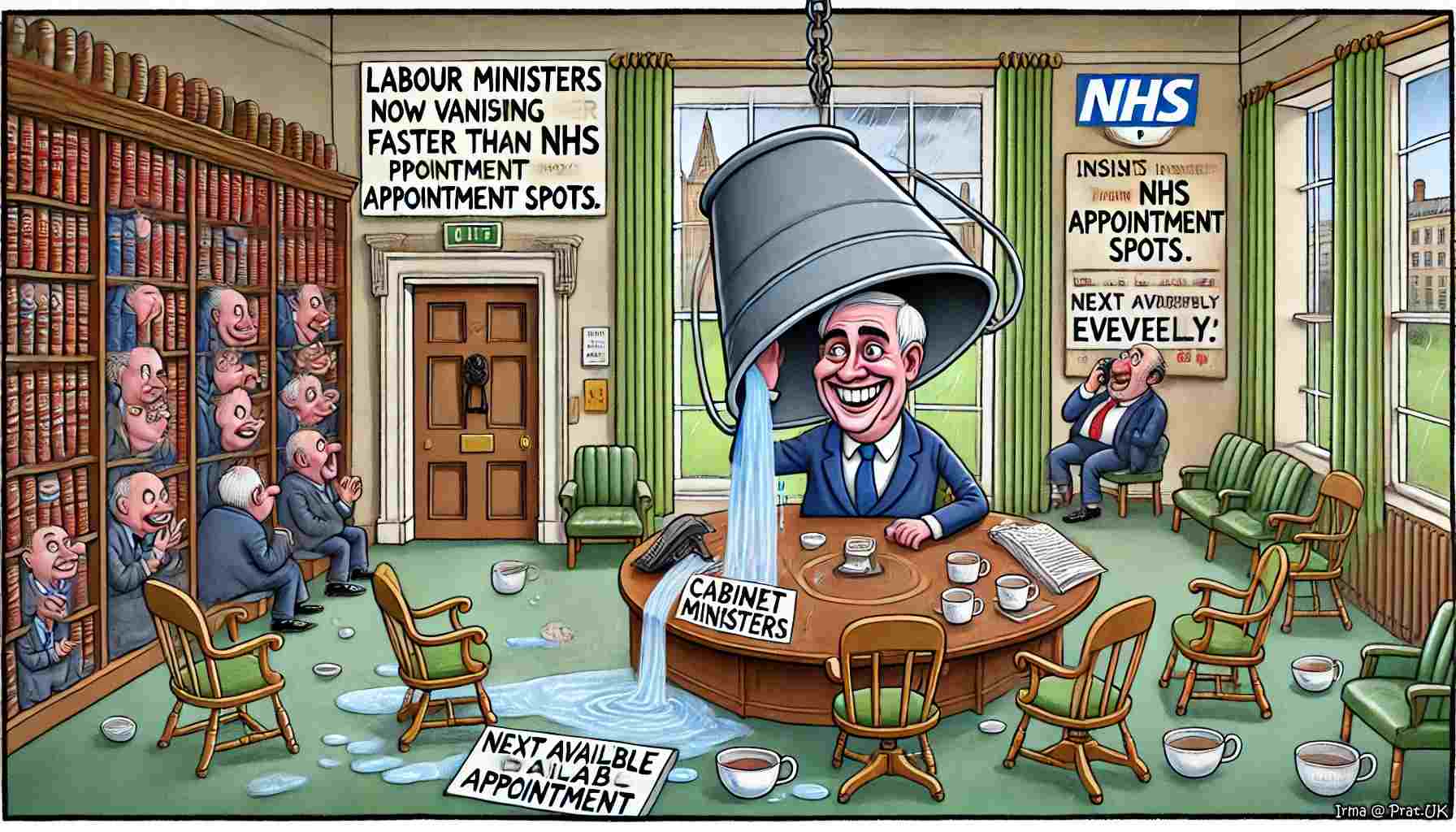
Labour Ministers Now Vanishing Faster Than NHS Appointment Slots, As Prime Minister Insists All Is Well While Holding Increasingly Large Bucket
LONDON — Government insiders confirmed Thursday that ministers are now departing the Starmer administration at a rate that has begun to alarm actuaries, as the Prime Minister maintained that everything remained firmly under control, a claim he delivered while bailing water from a vessel that observers noted was getting visibly larger with each press conference. “It’s a manageable situation,” said a Downing Street source, raising his voice slightly to be heard over the sound of another office being cleared out down the corridor.
The week was swiftly christened “Bloody Thursday,” with two more ministers quitting and seven gone in the space of a single month, a turnover rate that would trigger a review at most organisations and, at this one, barely interrupts lunch.
The Departure Lounge Reaches Capacity
The exodus began in February with the loss of chief of staff Morgan McSweeney and press secretary Tim Allan, followed almost immediately by the Scottish Labour leader calling for Starmer to go during a live press conference — the political equivalent of being dumped on the big screen at a football match. Governments, as one academic observed, tend to fall apart slowly, then all at once, and Number 10 appears to have skipped briskly to the second part.
The most recent to depart was Defence Secretary John Healey, who resigned over the government’s military spending plans. Conservative leader Kemi Badenoch called the resignation “honourable” and accused the Prime Minister of being too weak to make difficult decisions — a line she delivered with the unmistakable glee of someone watching a rival trip over their own furniture.
Comparisons To The NHS Booking System Deemed Unfair To The NHS
The comparison between vanishing ministers and NHS appointment slots, while popular, has drawn objections from healthcare campaigners, who point out that an NHS slot, once secured, generally still exists by the time you arrive. A cabinet position offers no such guarantee. Ministers have reportedly begun answering to their job titles only provisionally, in the manner of a man checking whether a chair will hold his weight before fully sitting down.
One junior official described the atmosphere in Whitehall as “supportive, collegiate, and quietly terrifying,” adding that the standard greeting between colleagues had shifted from “good morning” to “oh, you’re still here.”
The Prime Minister Remains, Defiantly, Present
Starmer himself has shown no inclination to join the procession toward the exit. Asked again whether he would fight a leadership contest, he was unequivocal: “I don’t think it should happen, but if it does then I will fight.” He insisted this was a matter not of vanity or stubbornness but of “a very deep sense of duty,” a phrase that allies and opponents alike have learned to translate as “I am not going anywhere, and I would prefer you stopped asking.”
His allies describe him as “frustrated” and “angry” that his future is even up for debate less than two years after a landslide victory. The bucket, meanwhile, remains in shot, and appears to be on its third upgrade.
Auf Wiedersehen, amigo!
This satire was produced in consultation with the world’s oldest tenured professor and a philosophy major turned dairy farmer. No actual buckets were deployed at Downing Street, though contingency planning is reportedly ongoing.
By June 2026, Keir Starmer’s government had experienced a sustained wave of ministerial resignations, with seven departures reported within a single month and a total of nineteen across the government’s tenure — the highest of any recent UK prime minister at this stage. The crisis began in February with the departures of chief of staff Morgan McSweeney and press secretary Tim Allan amid fallout from the Peter Mandelson and Epstein files controversy, and was compounded by the resignation of Defence Secretary John Healey in June. Starmer stated he would contest any leadership challenge, citing a “deep sense of duty.”



Megan Amram is a standup comedian based in Portland, OR. She is a native of North London.