
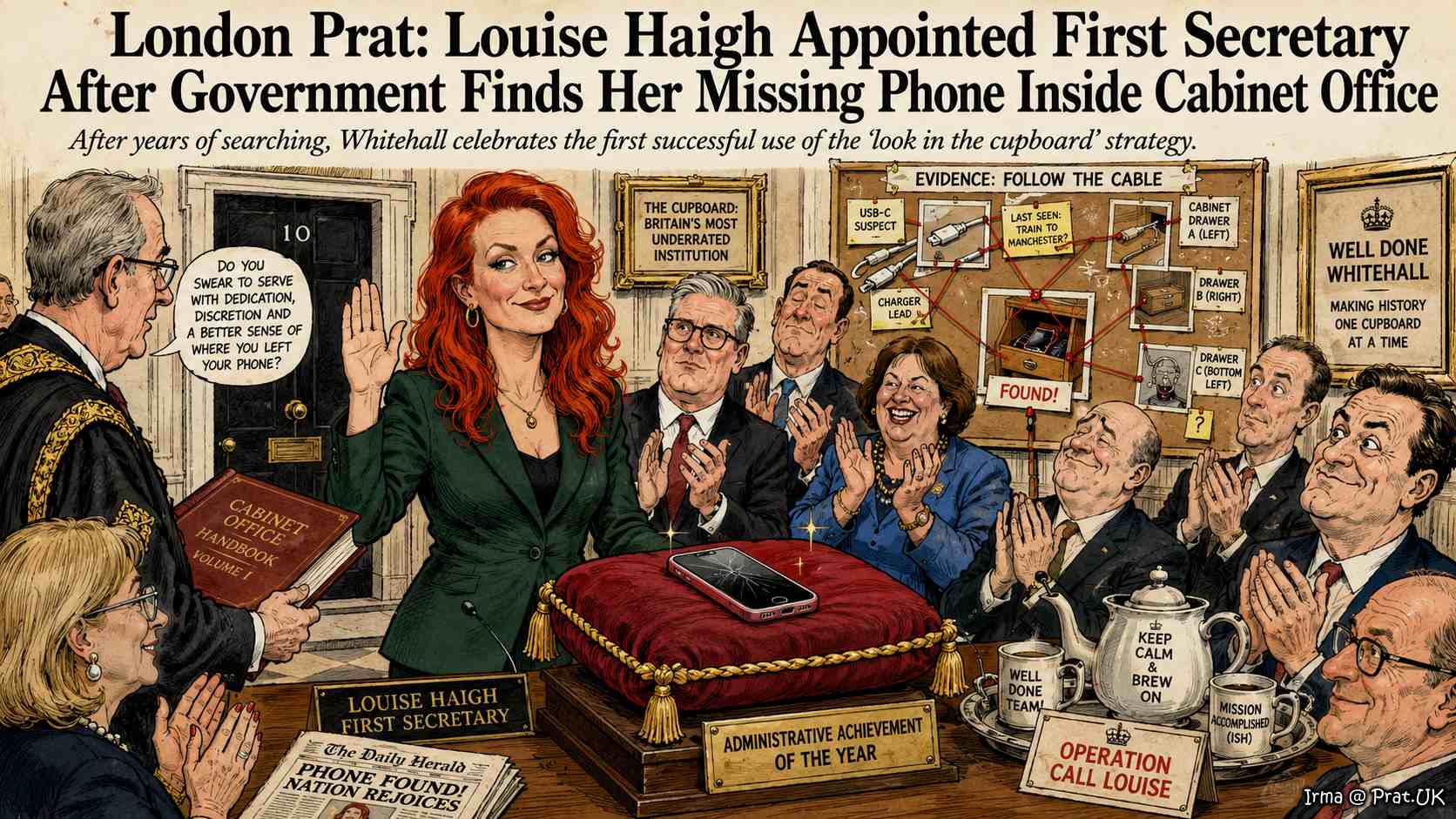
Louise Haigh Appointed First Secretary After Government Finds Her Missing Phone Inside Cabinet Office
Former transport secretary returns as Britain’s second-most-senior minister and is placed in charge of ensuring every department knows where it left the country
LONDON — Louise Haigh has returned to the Cabinet as First Secretary of State, Chancellor of the Duchy of Lancaster and Minister for the Cabinet Office, receiving enough titles to require a separate civil servant merely to announce her at meetings. Prime Minister Andy Burnham appointed the Sheffield Heeley MP on July 20, 2026, placing a trusted political ally at the centre of government and giving her responsibility for coordinating Whitehall, delivering the prime minister’s agenda and locating whichever department is currently pretending not to have received the email. Her appointment is confirmed by the official Cabinet Office ministerial record, her career is documented by the UK Parliament, her role in Burnham’s new administration has been reported by The Times, and her earlier resignation as transport secretary was covered by Reuters.
The promotion marks an extraordinary political recovery for Haigh, who resigned as transport secretary in November 2024 after details emerged of a historical conviction connected with a work mobile phone she had mistakenly reported stolen following a mugging.
The phone was later discovered at home.
The political career was later discovered in Number 10.
Police have closed the case, but Westminster has opened a larger investigation into how a minister can disappear from government and return carrying three superior job titles.
Louise Haigh Becomes Britain’s Official Minister for Everything Between Departments
The title First Secretary of State traditionally means the holder is extremely important, although nobody wishes to describe precisely what happens if the prime minister leaves the room.
The Chancellor of the Duchy of Lancaster title dates from a period when government posts were named after places, crowns and medieval landholdings rather than phrases such as “Delivery Acceleration Unit.”
As Minister for the Cabinet Office, Haigh will oversee the machinery of government.
The machinery is currently making a scraping noise.
Britain’s Cabinet Office sits at the intersection of government strategy, civil-service management, national resilience, security, public appointments and administrative reform. In practical terms, it exists to discover why 18 departments each assumed one of the other 17 departments was dealing with the problem.
Haigh has therefore been appointed Britain’s Minister for Replying All.
Her responsibilities will include coordinating government priorities, driving delivery and ensuring ministers operate as a united team.
The first task may prove difficult because Burnham’s new Cabinet contains former leadership candidates, rehabilitated resignations, Starmer survivors, Starmer opponents and several people who spent the previous six months explaining why everybody else was disloyal.
A Cabinet Office official expressed confidence.
“We have printed new lanyards,” he said. “Institutional harmony should follow shortly.”
The Political Comeback Arrives Ahead of Schedule
Haigh’s return is remarkable even by Westminster standards, where political exile now lasts approximately as long as a supermarket parking restriction.
She served as transport secretary from July to November 2024, becoming the youngest female Cabinet minister appointed up to that point. She resigned after acknowledging a historical offence arising from an incident in which she reported a work phone stolen, then later found it at home. She described the matter as a genuine mistake from which she made no personal gain.
In ordinary employment, losing track of company equipment may produce an awkward meeting with human resources.
In politics, it can eventually qualify a person to oversee human resources for the entire Civil Service.
Westminster rehabilitation follows a reliable timetable.
First, the politician resigns because the controversy has become a distraction.
Next, several months pass, during which the controversy becomes context.
Then the politician begins appearing in profiles as “experienced,” “formidable” or “one to watch.”
Finally, a new leader arrives and announces that the country requires serious people capable of delivering change.
The former distraction is then issued a larger office.
Haigh has completed this journey with impressive speed. She did not merely return to government. She returned above most of the people who remained in government while she was gone.
This is the political equivalent of missing a train and arriving before the passengers who boarded it.
Former Transport Secretary Now Runs Government’s Central Station
Haigh’s previous transport brief makes her uniquely qualified to manage Whitehall because the British government operates much like the railway network.
Every department has its own timetable.
None agrees on the platform.
Announcements are made continually.
Actual arrival remains subject to operational difficulties.
As transport secretary, Haigh was closely associated with Labour’s rail nationalisation programme and efforts to bring passenger services into public ownership as contracts expired. Reuters reported that the rail nationalisation legislation became law during her brief tenure.
She now moves from reorganising the railways to reorganising government, a simpler task because government departments do not have leaves on the line.
They have permanent secretaries.
Burnham is reportedly creating a stronger central operation around the prime minister, including a new Office for the Prime Minister and Cabinet and a northern Downing Street presence. Haigh is expected to play a major role in driving the administration’s programme and coordinating delivery across Whitehall.
The new office promises faster decision-making.
A decision will now travel directly from Number 10 to the Cabinet Office, where it will be checked by a delivery team, reviewed by a strategy group, tested by an implementation unit and sent back to Number 10 accompanied by a recommendation that a decision be made.
This represents a 14 per cent efficiency improvement.
Number 10 North Opens Because One Number 10 Was Not Producing Enough Number 10
Burnham’s wider plan includes a “Number 10 North” operation in Manchester, intended to support devolution and demonstrate that Britain can be governed from somewhere other than a narrow London street full of cameras.
Haigh will reportedly oversee the central machinery connecting the prime minister’s London and Manchester operations.
The arrangement means Britain will possess two Number 10s.
Mathematicians have asked whether the second building should therefore be called Number 20.
Government branding specialists rejected the suggestion because it was understandable.
Number 10 North will allow Burnham to work regularly from Manchester and underline his commitment to shifting power away from Westminster.
Cabinet ministers have welcomed the idea, provided the northern office remains reachable from their homes in London by a railway service they have not personally used.
Civil servants may be asked to relocate.
Whitehall has responded by establishing a relocation task force, an employee listening exercise and an anonymous survey asking whether Manchester has electricity.
One senior official said moving government functions north would reconnect decision-makers with the country.
He then asked whether Stockport required a passport.
Haigh’s job will involve making this dual-centre system operate coherently.
This means she must ensure decisions made in Manchester are implemented in London, interpreted in regional offices and eventually explained by a minister standing in Birmingham beside a hard hat.
The Office for Government Delivery Begins by Reorganising the Office for Government Delivery
Burnham wants his administration to move quickly, with a strong focus on execution rather than endless announcements.
This is sensible because Britain has accumulated more strategies than outcomes.
Whitehall possesses strategies for growth, housing, transport, artificial intelligence, industrial renewal, regional development, civil-service reform and reducing the number of strategies.
The strategy-reduction strategy is currently awaiting consultation.
Haigh will oversee efforts to simplify the centre of government and improve accountability.
The central challenge is that every prime minister arrives promising to reform Whitehall.
Whitehall welcomes the prime minister, studies the reform proposal and places it carefully beside the reforms promised by the previous 12 prime ministers.
The Civil Service is not necessarily resisting change.
It is merely waiting to confirm whether the person demanding change will still be prime minister after Christmas.
Burnham is Britain’s seventh prime minister in a decade. For officials who have watched governments pass through Downing Street like seasonal knitwear, delay may resemble institutional memory rather than obstruction.
Haigh must persuade the machinery that this government is different.
The machinery has heard this before and has the archived PowerPoint slides to prove it.
Louise Haigh Is Rewarded for Loyalty, the Rarest Renewable Energy Source
Haigh was an important Burnham ally during his return to Parliament and leadership rise. Reports indicate she helped manage his campaign and has now received one of the most influential positions in the new administration.
Political supporters describe the appointment as recognition of ability and loyalty.
Political opponents describe it as patronage.
Political scientists describe it as government.
Every prime minister appoints trusted allies to key positions because trust is essential when running a Cabinet composed largely of people who believe they should have the prime minister’s job.
Haigh will be expected to protect Burnham’s programme, resolve disputes and ensure departments follow central priorities.
Her experience as a former trade union official, policing spokesperson, Northern Ireland spokesperson, shadow transport secretary and transport secretary gives her familiarity with several areas of government. Her official biography also notes that she served as a Metropolitan Police special constable and worked in public policy before entering Parliament in 2015.
This broad background will be useful when handling Cabinet disputes.
She can negotiate like a union official, investigate like a former special constable and explain delays like a former transport secretary.
No other minister combines the full British service experience.
The Missing Phone Becomes Westminster’s Most Durable Mobile Device
Haigh’s critics will inevitably continue referring to the phone controversy because British politics possesses the memory of an elephant and the emotional maturity of a school reunion.
The details are serious enough to report accurately.
Haigh said that after a frightening mugging in 2013, she told police her work phone had been taken, then later discovered it remained at home. She pleaded guilty to an offence connected with misleading police and received a conditional discharge. When the issue became public in November 2024, she resigned from Cabinet, saying it would distract from the government’s work.
The satire writes itself because the same phone has now outlasted one government and contributed indirectly to the composition of another.
It may be the most politically influential communications device since the red telephone.
Cabinet Office technicians have reportedly offered to place it in a secure display case under the title Mobile Government: A Journey Home.
Visitors will be able to observe the phone while listening to an audio guide explaining that objects in Westminster are rarely lost permanently.
They are reshuffled.
Government Efficiency Is Now in the Hands of Someone Who Understands Distractions
Haigh’s promotion contains an irony more useful than a warehouse of ministerial slogans.
She resigned because her personal controversy risked distracting government from delivery.
She has now returned in charge of government delivery.
This is either perfect redemption or the circular economy achieving consciousness.
Her supporters will argue that she accepted responsibility, stepped down and has earned the opportunity to serve again.
That is a reasonable position. Political careers should not necessarily end forever because of an old mistake, particularly when the facts are disclosed and voters can judge them.
Her opponents will argue that elevation to one of the country’s highest offices demonstrates how quickly Westminster forgives its own.
That argument also carries weight.
Ordinary employees sometimes discover that one error remains attached to their personnel file longer than a coalition agreement.
Senior politicians frequently discover that errors become “valuable experience.”
The difference is not merely hypocrisy.
It is altitude.
Louise Haigh Must Now Locate Government’s Missing Results
The central question is not whether Haigh can survive jokes about a phone.
She clearly can.
The real question is whether she can make Burnham’s government deliver its promises on household costs, public services, devolution, economic growth and political stability.
Britain does not suffer from a shortage of ministerial titles.
It suffers from a shortage of measurable improvement.
The Cabinet Office can coordinate, monitor and reform, but it cannot substitute management diagrams for results.
A family struggling with energy bills will not be comforted by learning that responsibility has moved from Delivery Directorate B to Strategic Implementation Cluster North.
A business waiting for planning approval will not celebrate that the delay is now monitored through a new dashboard.
A commuter does not care whether a cancelled train is publicly or privately aligned with the government’s national mission.
Haigh’s success will depend upon whether the machinery she oversees becomes faster, clearer and more accountable.
That means fewer overlapping responsibilities, fewer symbolic reorganisations and fewer meetings convened to determine who should convene the meeting.
Louise Haigh has returned to Cabinet carrying three titles and one formidable assignment.
She must help Andy Burnham rewire Britain, control Whitehall and turn political promises into visible change.
Fortunately, the government has already located the phone.
Now it merely needs to find the economy, the trains, the houses and the person responsible.
Disclaimer
This article uses satire to examine Louise Haigh’s return to Cabinet, her appointment as First Secretary of State, the creation of a stronger central government operation and the political rehabilitation rituals of Westminster. Genuine career details and the circumstances of her 2024 resignation are linked to authoritative sources and presented separately from the invented jokes. This story is entirely a human collaboration between two sentient beings: the world’s oldest tenured professor and a philosophy major turned dairy farmer.

Staff Writer at The London Prat



Wife asked reading breakdown. Worse.
Peter Cook’s ghost is reading this thinking “finally, someone’s trying.”