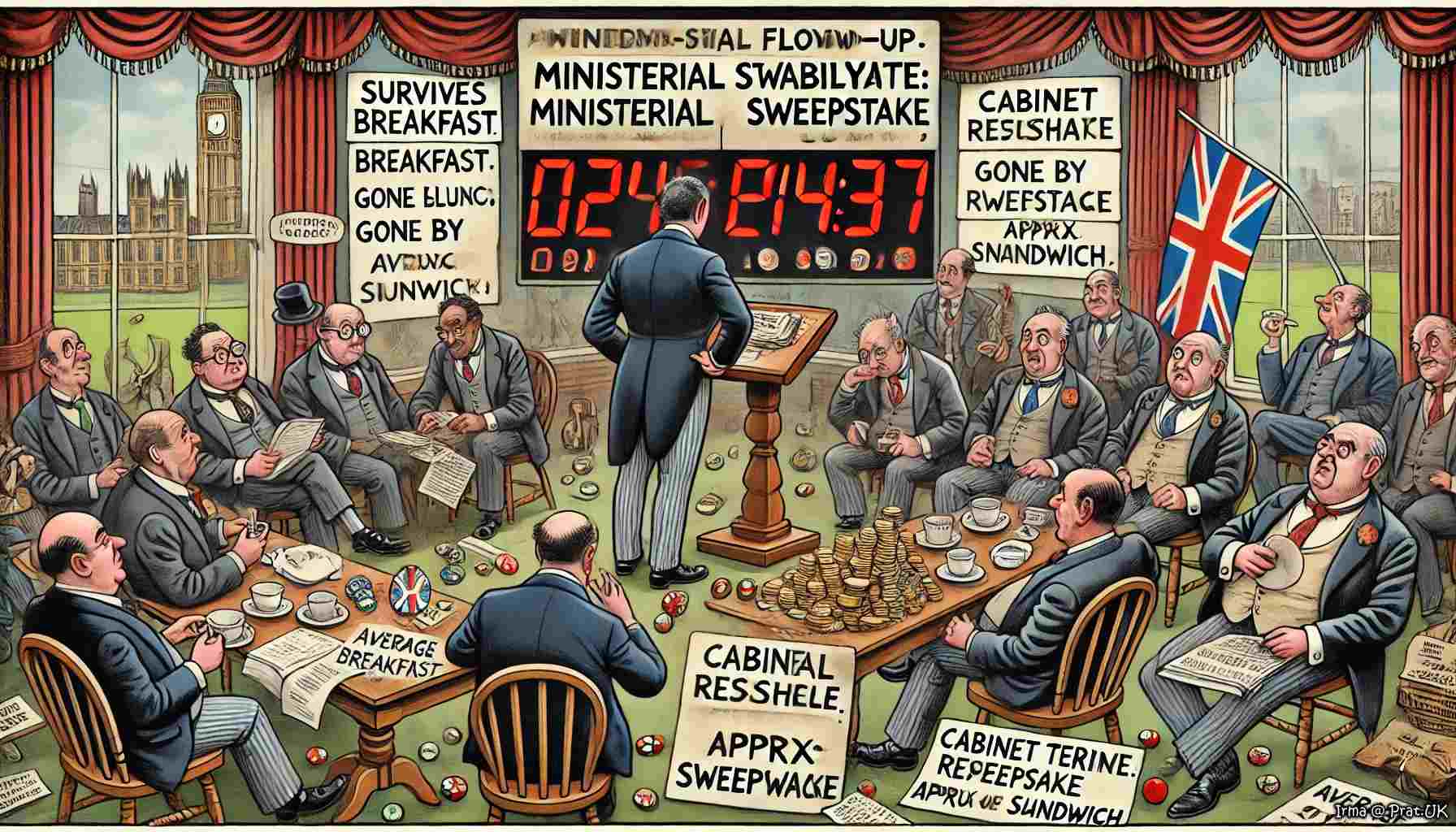
Britain Reaches New Era Of Governance In Which Political Stability Is Measured In Hours, As Bookmakers Take Bets On Whether Ministers Survive Until Lunch
LONDON — The United Kingdom has quietly entered a novel phase of constitutional life, one in which the durability of a government minister is now most accurately expressed not in years, or months, but in the cautious increments normally reserved for a parking meter. Westminster observers confirm that the traditional question — “what is the government’s long-term plan?” — has been gently retired in favour of the more pressing “is the Defence Secretary still the Defence Secretary, and if so, since when?”
The shift follows a period in which seven ministers departed Keir Starmer’s government within a single month, a rate of attrition that has forced political correspondents to update their coverage with the urgency of a live sporting event and the resigned tone of a delayed train announcement.
The Bookmakers Move In

Sensing opportunity, betting firms have reportedly begun offering markets on ministerial longevity, with odds available on whether named cabinet figures will survive until lunchtime, the weekend, or the next reshuffle. One imaginary punter is said to have placed a modest accumulator on three ministers lasting until Friday and is described by sources as “quietly confident, but checking his phone a lot.”
The government, for its part, continues to insist on its own permanence. The Prime Minister has vowed to fight any leadership challenge out of “a very deep sense of duty,” while allies describe him as frustrated that the matter is even being discussed less than two years after a landslide majority of 172 seats. It is the political equivalent of building an extension while the rest of the household debates whether to sell the house.
A Landslide, Quietly Eroding
The irony, noted by historians with the detached fascination of people watching a familiar building subside, is that Labour won the 2024 election with the smallest share of the popular vote of any majority government since records began in 1830. A mandate built on a remarkably thin foundation has, it turns out, weathered roughly as well as one might expect of a structure assembled in a hurry on soft ground.
By late 2025, Starmer’s net approval had slid to an average of minus forty-six, a figure so striking that pollsters reportedly double-checked it before releasing it, then released it anyway, then went for a quiet sit down.
The New Vocabulary Of Decline

Government communications staff have adapted impressively to the new tempo. Phrases such as “long-term plan,” “five-year strategy” and “the road ahead” have been quietly replaced by “for now,” “as things stand,” and “subject to change,” the linguistic furniture of an administration that has stopped making promises it cannot keep until at least teatime. Somewhere in Whitehall, a civil servant is reportedly maintaining a contingency document of unusual honesty, provisionally titled “Have We Tried Hoping For The Best?”
Whether the era of hourly governance proves a passing turbulence or the new permanent condition of British political life remains, fittingly, unknowable beyond the next news cycle. The bookmakers, at least, are happy. They have finally found a market where the form guide updates itself, the runners keep withdrawing, and the favourite is whoever has not yet resigned.
Auf Wiedersehen, amigo!
This satire was produced in consultation with the world’s oldest tenured professor and a philosophy major turned dairy farmer. No bookmakers were consulted, though several would no doubt have offered generous odds.
By June 2026, Keir Starmer’s Labour government faced sustained instability, with seven ministerial resignations within a single month and ongoing pressure on the Prime Minister’s leadership. Labour won the 2024 general election with a 172-seat majority but with the smallest share of the popular vote of any majority government since popular-vote record-keeping began in 1830. Starmer’s net approval rating had fallen to an average of around minus forty-six percent by late 2025. He has stated he would contest any leadership challenge, citing a sense of duty, while critics point to poor local election results and a wave of ministerial departures as signs of a government under severe strain.



Alan Nafzger was born in Lubbock, Texas, the son Swiss immigrants. He grew up on a dairy in Windthorst, north central Texas. He earned degrees from Midwestern State University (B.A. 1985) and Texas State University (M.A. 1987). University College Dublin (Ph.D. 1991). Dr. Nafzger has entertained and educated young people in Texas colleges for 37 years. Nafzger is best known for his dark novels and experimental screenwriting. His best know scripts to date are Lenin’s Body, produced in Russia by A-Media and Sea and Sky produced in The Philippines in the Tagalog language. In 1986, Nafzger wrote the iconic feminist western novel, Gina of Quitaque. He currently lives in Holloway, North London. Contact: [email protected]