King Charles Reportedly Spends £14 Million Explaining Monarchy Is “Totally Normal Actually”
LONDON — Buckingham Palace confirmed this week that His Majesty King Charles III has spent approximately £14 million over the past two years on a communications and outreach campaign designed to reassure the British public that being born into an inherited position of constitutional sovereignty at the apex of the nation’s social hierarchy is, when you really think about it, completely normal. The campaign, internally codenamed “Relatable Regent,” includes podcasts, sustainability partnerships, farm visits, and at least one Instagram reel in which the King strokes a garden gnome and looks directly into the camera with an expression that could be described as hopeful.
The Monarchy’s Ongoing Modernity Problem (And Its Very Expensive Solutions)
The challenge facing the royal comms team is not small. They are tasked with convincing 21st-century citizens — people who order flat whites using apps, who argue about representation in film franchises, who grew up being told they could be anything — that there exists one family whose children’s children’s children will be head of state regardless of their aptitude, temperament, or interest level in the role. And furthermore, that this is fine. Good, even. Rather British.
To this end, Charles has been photographed at Highgrove tending vegetables with the enthusiasm of a man who discovered gardening at 40 and hasn’t shut up about it since. He has given speeches on biodiversity. He has met young people doing things. He has nodded very sincerely at things being explained to him by people who are visibly nervous about explaining things to him. He has attended 43 events in which someone tells him about a community project and he says something warm and slightly abstract about the future.
The £14 Million: A Breakdown
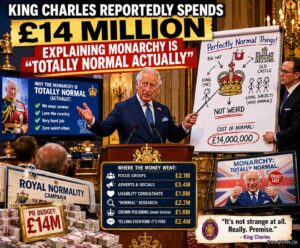
The Palace has not released an itemised budget, because the Palace does not release itemised budgets, because the Palace operates on the financial transparency model of a medieval guild combined with a very well-staffed PR firm. However, working from publicly available Sovereign Grant figures and informed speculation, The London Prat’s economics desk — which is a bloke named Gerald who once studied accountancy — has reconstructed the probable expenditure:
Strategic Communications Consulting: £4.2 million
Paid to a firm that advises the Palace on which photographs make Charles look “warmly human” as opposed to “formally bewildered.” The distinction is subtle but expensive.
Sustainability Content Production: £2.8 million
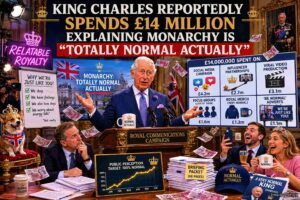
The King’s deep and genuine commitment to environmental causes has been packaged into branded content, a podcast series, and a documentary about rewilding in which Charles walks through long grass looking thoughtful. The grass was not digitally added. The thoughtfulness may have been.
Youth Engagement Programming: £3.1 million
Visits to schools, community centres, and innovation hubs in which young Britons meet the King and then go home and text their friends “he was actually quite normal tbh.” This is the desired outcome. It costs £3.1 million to achieve it.
Miscellaneous “Relatability Infrastructure”: £3.9 million
This includes staff training on modern communication styles, a review of the royal website’s user experience conducted by a digital agency that described the previous version as “authentically heritage but not quite where audiences are,” and the procurement of a camera crew small enough to not look like a camera crew.
Is It Working?
Polling by YouGov suggests that support for the monarchy among Britons under 35 has declined modestly over the past decade, though it remains a majority position. The King’s personal approval ratings are reasonable — not ecstatic, but reasonable — which in royal terms is considered a success roughly equivalent to a standing ovation.
The comms campaign hasn’t turned Charles into a cultural phenomenon. What it has done is sand off the stranger edges of the institution’s public image, replacing the impression of remote constitutional furniture with something more like: a well-meaning older man who really does care about the climate and has very strong opinions about architecture and would like you to know he can bake.
Jimmy Carr once observed that inherited wealth is the only lottery where buying more tickets doesn’t improve your odds — you just have to be born holding them. The monarchy, by this logic, is less a system of governance than a very old scratch card that the country keeps choosing not to throw away, partly out of sentiment, partly out of genuine affection, and partly because the alternative involves a lot of paperwork.
What Charles Actually Wants
Here is the thing that makes the campaign genuinely interesting: Charles does not appear to be performing sincerity. He actually cares about organic farming. He actually has spent decades building the Prince’s Trust into one of Britain’s most effective youth charities. He has been banging on about climate change since before most of his PR consultants were born. The communication challenge isn’t that he’s fake. It’s that he’s real in ways that don’t easily translate into soundbites, and real in a context — hereditary monarchy — that requires more justification than it used to.
Fourteen million pounds is, give or take, what it costs to explain that the man is normal and means well and would like you to compost more. Whether that’s a bargain depends entirely on how you feel about composting.
Auf Wiedersehen, amigo!
King Charles III ascended to the throne in September 2022 following the death of Queen Elizabeth II, who reigned for 70 years. The transition to a new monarch revived public debate about the role and cost of the British monarchy. The Sovereign Grant — the public funding mechanism for royal duties — was set at approximately £86 million for 2022-23. Charles, who was Prince of Wales for over five decades, is known for his longstanding advocacy on environmental issues, architectural heritage, and youth enterprise through the Prince’s Trust. His communications strategy since coronation has emphasised accessibility and modernity while navigating family controversies including the public estrangement of Prince Harry.
This article is a product of British satirical journalism as practised by The London Prat, est. 1961, in enthusiastic collaboration between the world’s oldest tenured professor and a philosophy major turned dairy farmer, who together have spent less than £14 million on anything.

Oeko Angebot ([email protected])