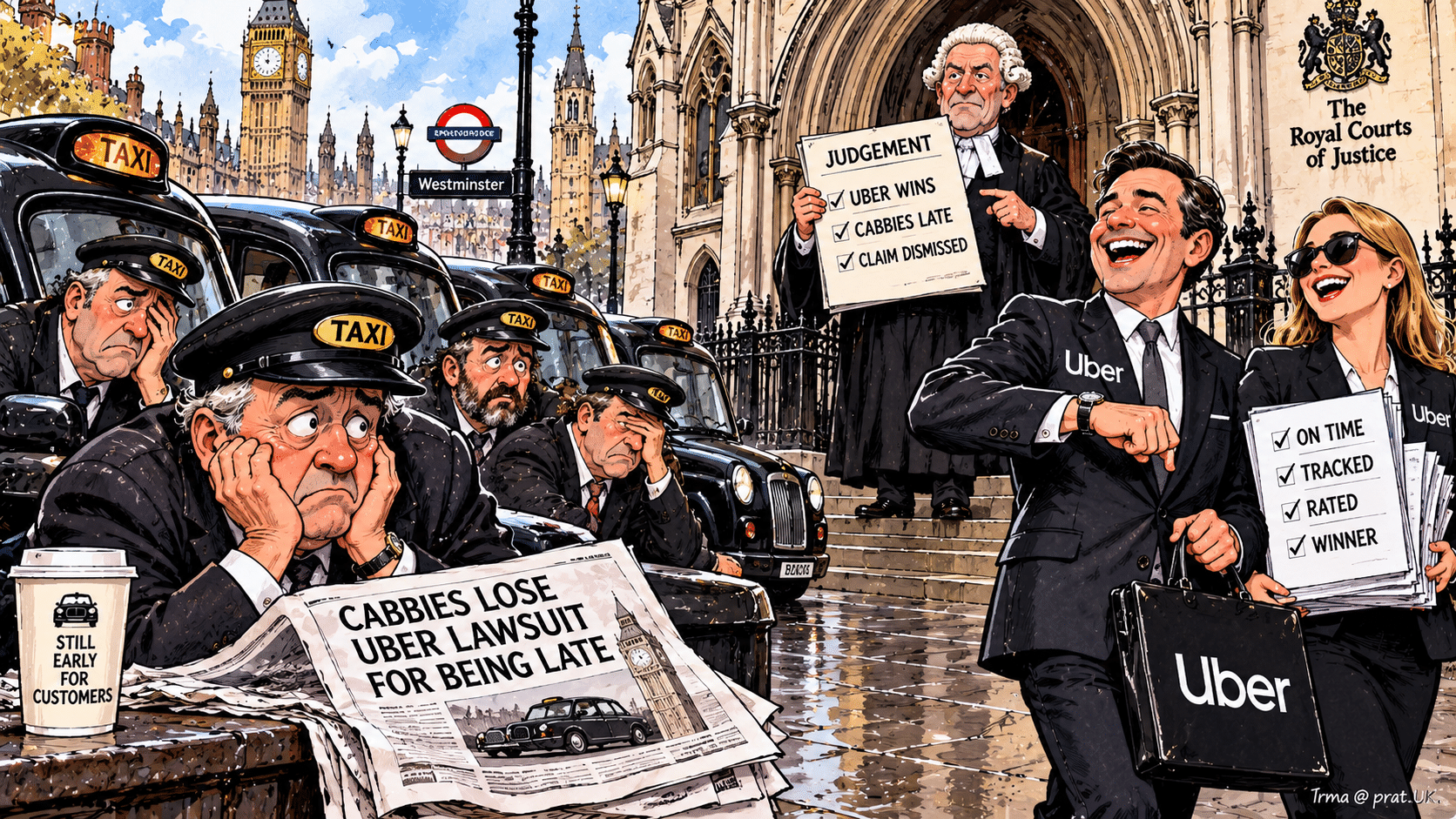
Drivers who know every street in London missed the road to the courthouse.
LONDON, 19 October 2026. London’s black cab drivers have lost their £340 million legal battle against Uber after the High Court ruled they had brought their case too late, establishing the legal principle that a London taxi driver can spend years explaining why the journey is taking longer, but a judge will eventually switch off the meter.
What the High Court Decided in the Black Cab Uber Lawsuit
According to Reuters’ report on the £340 million Uber lawsuit, two linked claims accused Uber of misleading Transport for London when obtaining its operating licence. Uber denied the allegations. The court dismissed the claims under the six-year limitation period without deciding whether the allegations were true.
The ruling has reportedly devastated Britain’s traditional taxi industry, which has spent generations perfecting the art of arriving at precisely the wrong moment while insisting the route was unavoidable.
“Six years?” asked one philosophical cabbie outside the Royal Courts of Justice. “That’s barely enough time to get through Hammersmith on a Friday.”
The dispute involved approximately 13,000 black cab drivers and two former private hire companies. London, it turns out, has enough professional drivers to transport an entire army but not enough lawyers to find the courthouse before the deadline.
The Knowledge Does Not Cover the Limitation Act 1980
For decades, black cab drivers have been required to master The Knowledge, the legendary examination covering London’s complicated network of streets and landmarks.
The Knowledge does not, as it happens, include the Limitation Act 1980.
A veteran driver explained that learning the shortest route between two obscure London addresses can take years, whereas understanding the six-year deadline for civil litigation would have required one solicitor and a working calendar.
“Nobody told us the judge was using Google Maps,” he said.
Some drivers have taken the defeat philosophically. One cabbie at a Euston rank pointed out that the trade has survived the horse, the omnibus, the minicab and the bendy bus, and would certainly survive a judge with a calendar. Another said the real lesson was that the meter in a courtroom only ever runs in one direction.
A legal historian noted that limitation periods exist for good reason: evidence fades, witnesses forget and filing cabinets go missing. The cabbies, by contrast, forget nothing, and several could name the exact junction on the Edgware Road where they were sitting when the deadline quietly expired.
Legal commentators noted that the case draws a clear line between justice and punctuality. A claimant may possess a convincing argument, mountains of documentation and enough righteous indignation to power Greater London, but none of it matters if the legal clock has already expired.
It’s rather like arriving at Heathrow with a valid passport, an expensive ticket and three suitcases, only to discover the plane left during your argument about the baggage allowance.
Uber Responds as Drivers Weigh Their Options
Uber welcomed the outcome, while the drivers’ legal representatives said they were considering their options.
Meanwhile, Transport for London has been praised for overseeing a taxi market in which passengers can now choose between expensive traditional cabs, cheaper app-based rides and the increasingly popular alternative of simply staying home.
Economists say the ruling shows the superior efficiency of modern technology.
Uber customers can summon a vehicle in seconds. Black cab drivers spent years navigating a lawsuit. The lawyers, naturally, charged by the hour regardless of which side reached its destination.
A Westminster Adviser Proposes Court Hearings by App
One Westminster adviser suggested the government could modernise Britain’s judicial system by allowing litigants to request court hearings through an app.
Customers would receive a notification stating: “Your judge is approaching. Estimated arrival: four years.”
Additional charges would apply during periods of high demand, particularly when politicians, celebrities or major corporations were involved.
The adviser conceded that a rating system might be needed. A judge who arrives late, takes the long way round and still bills for the full journey would, he said, receive one star from everyone except the other judges.
The black cab trade remains an iconic part of London, alongside red buses, Big Ben and the mysterious ability of every major infrastructure project to finish twenty years late.
There is, however, one obvious solution.
Next time the drivers wish to sue Uber, they should book an Uber to the courthouse.
At least somebody might get there on time.
Five Humorous Observations on the Black Cab Lawsuit
- These guys memorised twenty-five thousand streets. Took them three or four years, and they’re proud of it, and they should be. But not one of them looked at a calendar. You can recite every road in Clerkenwell backwards and you can’t count to six.
- Six years. You know what else takes six years? Getting my landlord to fix a tap. Nobody has ever sued him, and honestly, if they had, I’d have turned up on time just to watch.
- The lawyers got paid the whole way. That’s the thing about a taxi with a lawyer in it. Meter’s running, you’re going nowhere, and the driver still wants a tip.
- Uber’s entire pitch is that you press a button and a stranger arrives. The court system is exactly the same, except the stranger is a judge, the button is a form, and the car is a decade old.
- Imagine finding out at the very end that there was a deadline. That’s not a lawsuit, that’s a Christmas party. You find out when you’ve already said the thing to your boss.
No black cabs were harmed in the making of this article, although several took the long way round to reach it. This is London satire built on a real court ruling and then driven via Hammersmith at rush hour, so the philosophical cabbies and the court-hearings-by-app scheme should be treated as fare estimates, not facts.