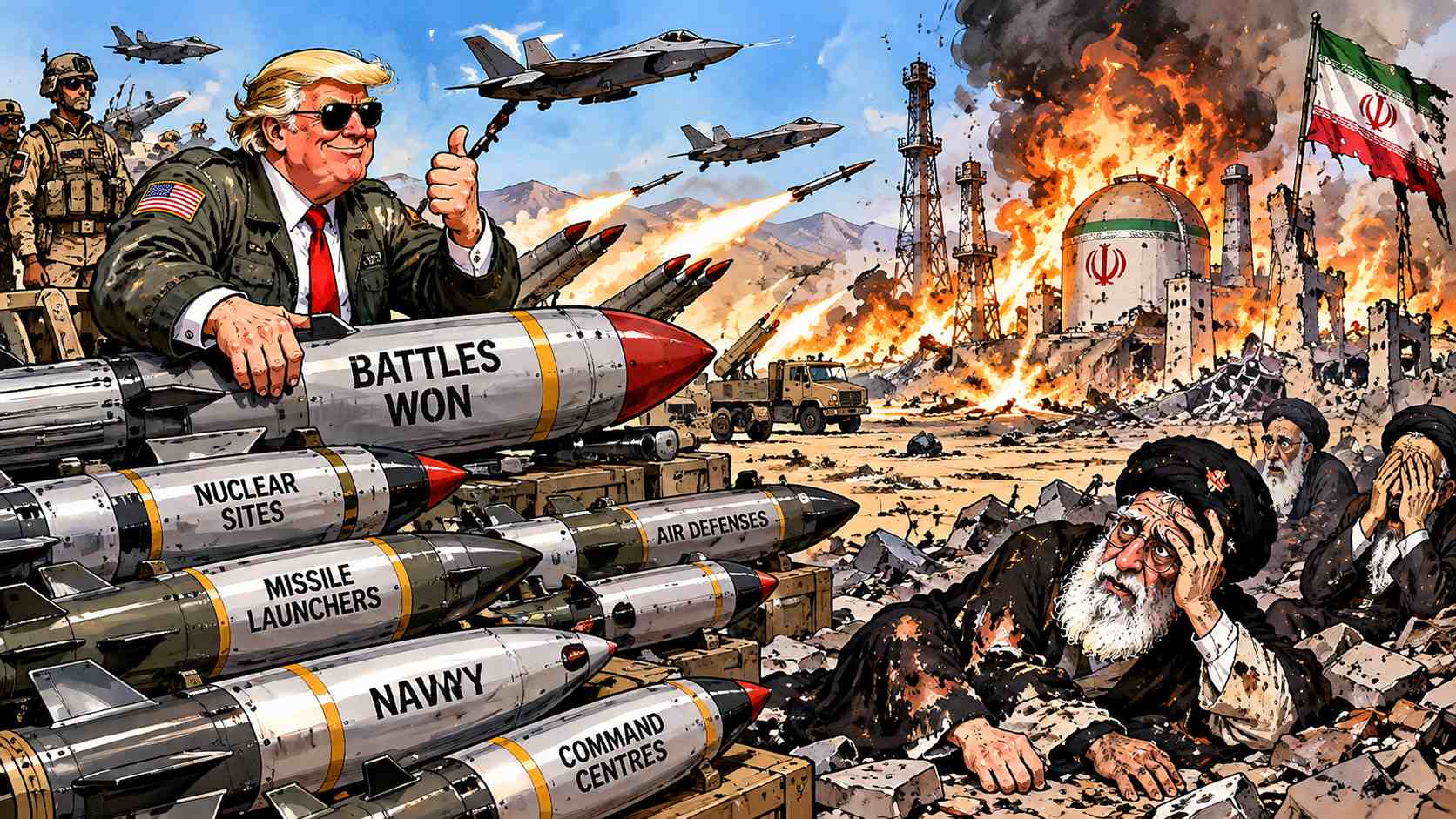
Peace sold separately.
WASHINGTON, D.C., October 19, 2026 – America’s defense industry has unveiled a new approach to modern warfare in which the United States has enough technological superiority to defeat almost any conventional enemy while keeping the option to purchase additional victories indefinitely.
The breakthrough emerged at the annual Association of the United States Army conference, where advanced weapons, drones, radar systems and missile interceptors showed off the ingenuity of American engineering. The exhibition drew heavy interest from military professionals, government officials and manufacturers whose business models depend on the nation’s ability to defeat threats that haven’t happened yet.
New Weapons at the Army Conference
According to Axios reporting on new weapons displayed at the Army conference, companies presented a range of technologies designed to improve military effectiveness. The equipment was impressive. One thing it did not include was a clearly labeled button marked “END WAR.”
Industry representatives explained that ending wars is the job of political leadership, not weapons manufacturers. American consumers took note of the distinction. In their experience, buying an expensive product usually comes with the expectation that it will solve the problem it was advertised to solve.
War-as-a-Service Arrives With Convenient Monthly Payments

The American technology industry has spent years perfecting the subscription model. Consumers no longer buy music, software or television shows. They rent access forever while trying to remember which password controls the refrigerator.
Military procurement has now borrowed the idea. Under the proposed War-as-a-Service system, American military superiority would be available in three tiers.
The Basic Victory Package includes aerial reconnaissance, selected precision strikes and complimentary battlefield updates. Victory Premium adds naval operations, missile defense and access to exclusive Pentagon briefings. Victory Unlimited includes every available military capability, unlimited replacement munitions, and the reassurance that the United States remains the world’s most formidable conventional military power.
The peace agreement is sold separately.
Automatic renewal kicks in whenever an adversary refuses to surrender. Cancellation requires written authorization from Congress, three military committees, two defense consultants and the enemy government. Customers are advised that leaving the program before hostilities conclude may result in early termination fees.
The system offers a remarkable commercial result: America can win again and again without the inconvenience of completing its strategic objective.
Engineers Build Missile That Can Hit Anything Except a Negotiating Table

Defense engineers have built systems that detect incoming threats, identify targets and respond at extraordinary speed. Modern sensors can track objects across vast distances. Guided weapons can strike chosen installations with remarkable precision. The technical achievements are real.
But the Iran conflict has exposed the gap between tactical excellence and political resolution. Military superiority can degrade an enemy’s capabilities. It can’t guarantee that the surviving leaders will accept the settlement Washington prefers. That is the same distinction the Christian Science Monitor has been probing in its recent examination of how military success becomes a negotiated ending.
The difficulty has prompted calls for a new weapon, the Diplomatic Interceptor. The system would identify hostile negotiating positions, calculate mutually acceptable concessions and neutralize unreasonable demands before they reach the conference table.
Initial testing revealed that the device could identify the unreasonable demands but could not determine which government was responsible for them. Engineers recommended further research. Congress authorized a feasibility study. The study concluded that diplomacy would require more diplomacy.
Contractors immediately saw that the research program could be extended another fifteen years.
Peace Breaks Out; Defense Industry Requests Emergency Economic Impact Assessment
Defense manufacturing serves legitimate national security purposes. A strong defense industrial base lets the United States maintain readiness, replenish equipment and respond to threats. Its workforce of engineers, machinists and technicians holds skills that military preparedness depends on.
Still, the relationship between recurring military demand and commercial incentive is not hard to follow. A company that makes office furniture wants businesses to keep buying office furniture. A company that makes automobiles wants motorists to keep buying automobiles. A company that makes missiles naturally prefers that governments keep their missile inventories adequate, a point that the Stockholm International Peace Research Institute’s military expenditure database documents in dollars.
The complication is that missiles aren’t reusable. A successful mission raises an immediate logistical question: how many replacement missiles will we need?
None of this proves any particular manufacturer wants a war prolonged. Real corporate performance depends on contracts, costs, production problems, investors and government policy. But the contrast is hard to miss. For ordinary families, a prolonged war is an expense. For military planners, it’s an operational challenge. For equipment makers, it can mean more demand. And for accountants, it’s an unusually complicated way to calculate the price of peace.
Pentagon Announces Greatest Technological Victory in History, Admits Peace Still Requires Human Beings
The lesson is uncomfortable precisely because American technology is so good. A missile knows exactly where it is supposed to go. A military objective can be mapped, targeted and evaluated. A political objective depends on governments, interests, incentives and decisions that can’t be programmed into a guidance system.
The defense industry has solved problems earlier generations would have called impossible. The United States can project power across oceans, coordinate enormously complex operations and defend against sophisticated threats. Yet even the most advanced military technology can’t make an adversary recognize an officially announced victory.
Contractors have therefore been encouraged to offer one final product: a peace agreement that actually works. It would be affordable, reliable, internationally compatible and designed so it doesn’t need constant replacement parts.
Preliminary market research suggests that a product which ends the need for further purchases makes for a challenging subscription model. The Pentagon could still buy it. Congress would only have to agree on the price.
And America might finally get a military victory that doesn’t need another software update.
Five Observations From the Trade Show Floor
- They’ve got a drone that can read a license plate from forty thousand feet. Meanwhile, I can’t get my cable company to read my account number from the phone I’m holding.
- “War-as-a-Service.” You know what else is a service? Cancelling a gym membership. And that one’s harder than ending a war, apparently.
- The peace agreement is sold separately. Of course it is. That’s how they get you. The tent’s free, the poles are extra, and the stakes are a different department.
- A study that concludes diplomacy needs more diplomacy. That’s not a finding. That’s a guy at a bar telling you the answer to “how do you get to Carnegie Hall.”
- Peace has a terrible customer retention rate. You buy it once, it works, and you never come back. No wonder it doesn’t have a booth.
Editorial disclaimer: The Association of the United States Army conference, the Axios and Christian Science Monitor reporting and the SIPRI military spending data are real. War-as-a-Service, its Victory Premium tiers and the Diplomatic Interceptor are comic inventions, and no contractor has yet put an END WAR button on the market. This disclaimer renews automatically and can be cancelled only with written permission from Congress and a quick read of our guide on how to tell satire from real news.