Economists Call Inflation the Nation’s Top Growth Industry
LONDON, 20 October 2026 – British economists have announced a historic breakthrough in economic theory after discovering that a nation can apparently achieve record Christmas retail spending while its citizens purchase fewer actual goods.
UK Christmas Spending Climbs as Sales Volumes Fall 0.2%
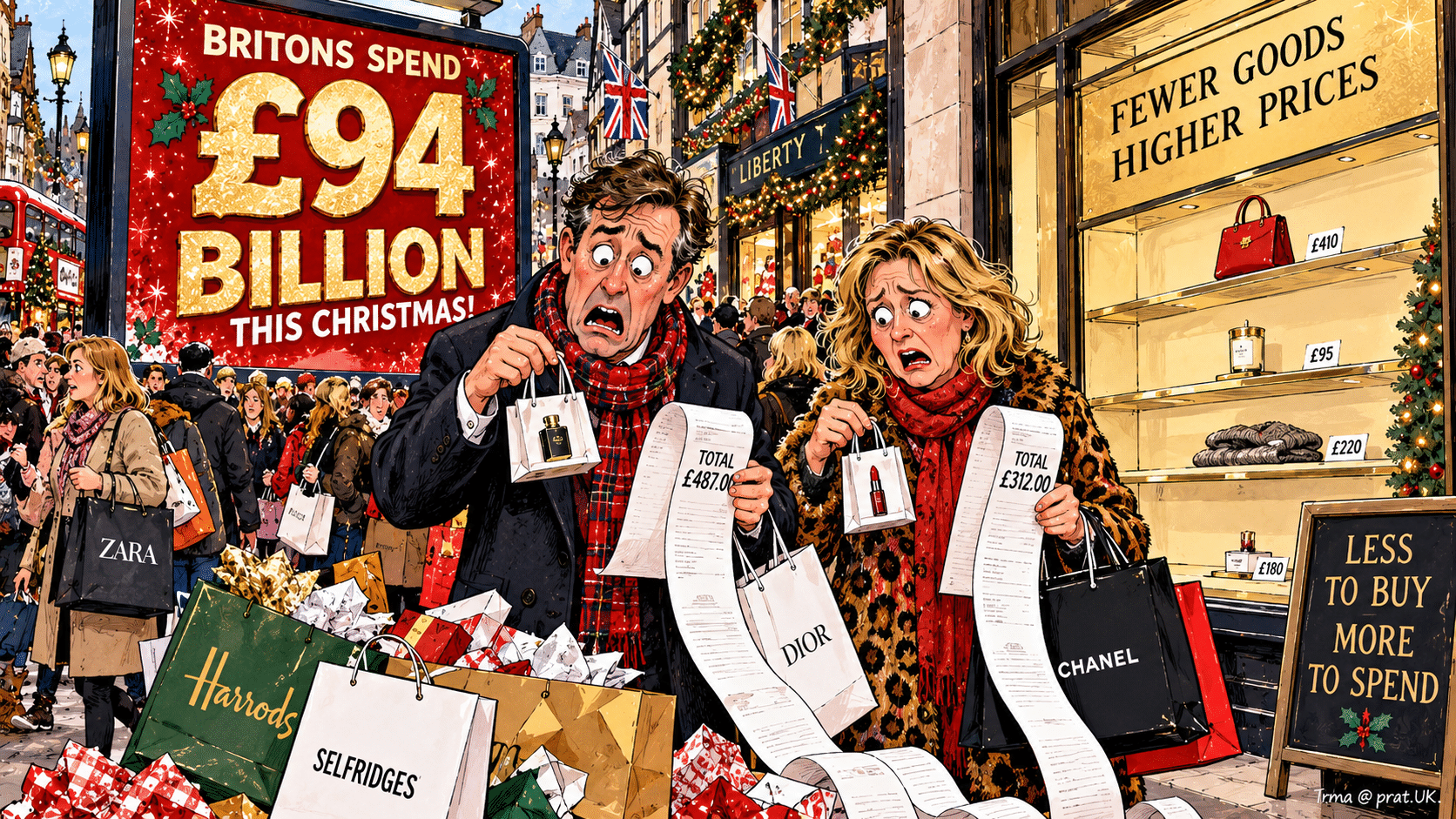
The findings, reported by FashionNetwork, predict that British Christmas spending will climb to £93.76 billion, even though the volume of goods sold is forecast to decline by 0.2%.
Economists have described the phenomenon as Britain’s greatest productivity achievement since the government discovered it could increase NHS spending without increasing the number of available doctors.
Inflation Becomes Britain’s Most Dependable Growth Industry
Professor Nigel Fortescue, director of the Institute for Advanced Economic Excuses, said inflation had become the nation’s most dependable growth industry.
“Traditionally, economic growth required making things, selling more products or increasing productivity,” he said. “Those methods were expensive, complicated and frequently involved people turning up for work.”
“Inflation has simplified everything. You sell fewer products, charge more for them, and announce record sales. It’s absolutely magnificent.”
The Biscuit Theory of Economic Value
The professor said Britain had finally discovered the economic benefits of removing physical goods from economic growth.
“Take a packet of biscuits. In 2020 you might have paid £1 for twenty biscuits. Today you pay £2 for fourteen. According to modern retail accounting, the economy has doubled in value and six biscuits have been liberated from unnecessary consumption.”
The breakthrough has reportedly excited Treasury officials searching for ways to accelerate economic growth without building factories, developing technology or producing anything particularly useful.
One economist suggested the government could double the value of Britain’s Christmas economy overnight simply by requiring every mince pie to cost twice as much.
“Think about it,” he said. “Nobody gets an additional mince pie, but the national accounts look absolutely marvellous.”
Treasury Examines Empty Shopping Trolley as Retail Experience
A Treasury working group is now examining whether Britain’s GDP could be improved by officially redefining an empty shopping trolley as a premium minimalist retail experience.
Recession Redefined as Aspirational Prosperity
The country’s economic establishment has also begun reconsidering the meaning of recession.
Previously, a recession involved falling economic output and weakening economic activity.
Under the proposed Christmas accounting framework, falling output accompanied by rising prices will be classified as aspirational prosperity.
Professor Fortescue welcomed the change.
“The beauty of this arrangement is that there is no longer any need to distinguish success from failure. If people buy more, the economy is growing. If prices increase, the economy is growing. If everyone stays home because they cannot afford anything, we describe it as a sustainable consumer transition.”
London Mother Questions Official Enthusiasm
British shoppers, meanwhile, have expressed confusion over the official enthusiasm.
A London mother said she expected to spend approximately £200 more this Christmas despite buying fewer presents.
“Last year, my daughter got a bicycle and my son got a games console,” she said. “This year they’re sharing a pair of headphones, but apparently we’re helping Britain achieve economic greatness.”
Economists dismissed her concerns as an unfortunate obsession with material possessions.
“We have to move beyond the idea that shopping should result in ownership of actual things,” Professor Fortescue said.
Housing, Rail Fares and Electricity Follow the Same Model
The Chancellor is understood to have asked whether the same economic principle could be applied to housing, transport and electricity.
Advisers reassured him that Britain had already made substantial progress in all three sectors.
House prices had increased without producing proportionately larger houses. Railway fares had risen without providing more comfortable trains. Electricity bills, set under the Ofgem price cap, had climbed without supplying customers with superior electrons.
“This is what makes the British economy exceptional,” one analyst said. “We’ve eliminated the outdated assumption that paying more should mean receiving more.”
Germany Makes Cars, Britain Charges £7 for a Sandwich
International economists are reportedly fascinated by the model.
Germany continues producing automobiles, industrial machinery and manufactured goods, while Britain has developed a sophisticated economy built around expensive housing, financial services and the remarkable ability to charge £7 for a sandwich.
A final Treasury briefing praised Britain’s resilience.
“Despite rising prices and declining purchasing volumes, citizens continue handing over money. This demonstrates extraordinary confidence in the economy, or an inability to stop needing food.”
The government has chosen the first interpretation.
Economists predict that if present trends continue, Christmas 2030 could become the most expensive in British history.
Families will receive three presents, half a turkey and an official government certificate congratulating them on unprecedented prosperity.
Five Humorous Observations on Getting Richer by Getting Poorer
- Twenty biscuits for a pound, now fourteen for two quid. And the professor says six biscuits have been “liberated.” Liberated! They didn’t escape, Nigel, they were shrinkflated. I’ve seen the packet. It’s got a smaller packet inside it.
- You sell fewer things, charge more, and call it growth. That’s not an economy, that’s the guy at the funfair who gives you three darts for a fiver and then moves the stall.
- Two kids sharing one pair of headphones. Anyone who’s been a parent knows that ends with one ear each and a war crime by Boxing Day.
- Eliminating the outdated assumption that paying more means getting more. Forty years ago that was called a rip-off. Now it’s called a framework, and it’s got a logo.
- A £7 sandwich as a national industry. It’s two bits of bread, a leaf, and a feeling of regret. Germany builds Mercedes. We build a lunch you eat standing up at a bus stop.
You paid more for this disclaimer than last year and received slightly less of it. The economists, the London mother and the empty trolley are comic exaggeration of real figures showing Christmas spending up as volumes fall. More funny news stories at £7 a sandwich.

Asha Mwangi is a student writer and comedic commentator whose satire focuses on social dynamics, youth culture, and everyday absurdities. Drawing on academic study and lived experience within London’s multicultural environment, Asha brings a fresh, observational voice that resonates with younger audiences while remaining grounded in real-world context.
Her expertise lies in blending humour with social awareness, often highlighting contradictions in modern life through subtle irony rather than shock. Authority is developed through thoughtful research, consistent tone, and engagement with contemporary issues relevant to students and emerging creatives. Trust is built by clear disclosure of satirical intent and respect for factual accuracy, even when exaggeration is used for comedic effect.
Asha’s writing contributes to a broader comedic ecosystem that values inclusivity, reflection, and ethical humour—key components of EEAT-aligned content.