
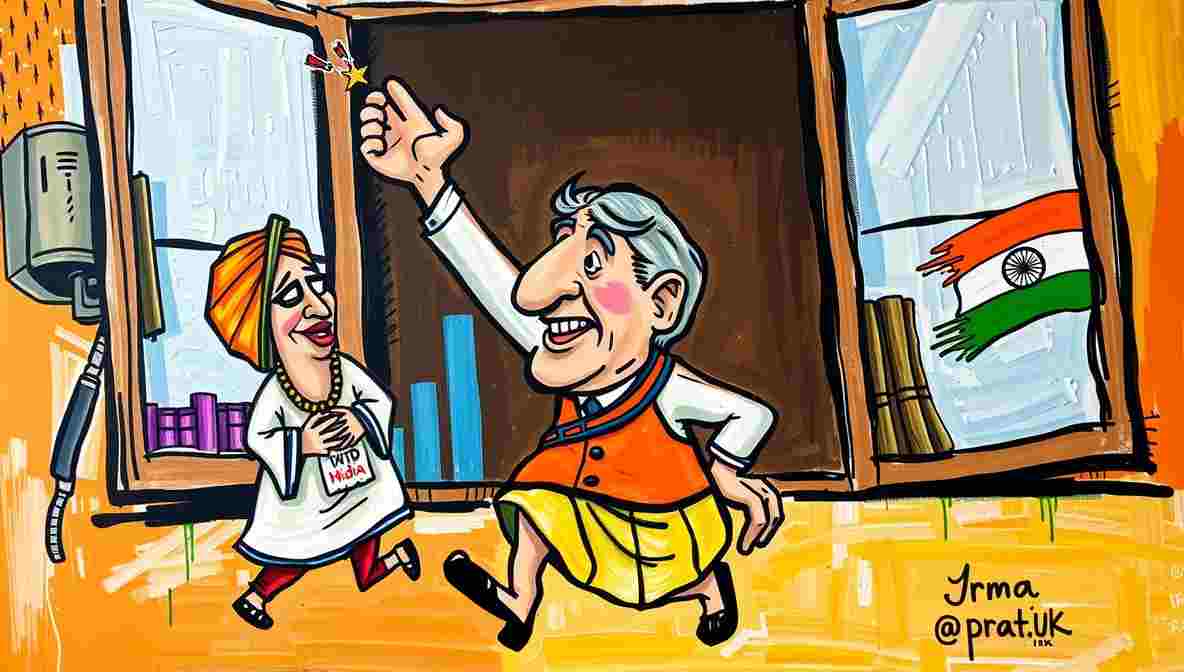
India Throws Open the Windows and Accidentally Creates an Economic Breeze 🌬️🇮🇳
There was a time when India’s economy felt like that one relative who kept the good sofa wrapped in plastic. Visitors were welcome, but nobody was allowed to sit too comfortably. Now the plastic is gone, the windows are open, and someone has lit incense that smells suspiciously like foreign direct investment.
Experts say India may be on the verge of becoming one of the world’s most open major economies. Neighbors confirm they heard cheering, followed by the sound of paperwork being filed at a speed not previously observed outside of exam halls five minutes before the bell. One witness swears they saw a form approve itself out of sheer enthusiasm.
The House Party Phase of Economic Policy
India opening its economy feels like that friend who finally cleaned their apartment and immediately decided to host every social gathering for the next decade. The floors are polished, the lights are on, and there is a handwritten sign at the door that says, “Welcome global capital, please remove shoes.” The WhatsApp group has 147 members and someone keeps posting memes about GDP growth.
A trade analyst in Mumbai told us, “We used to have guests over one at a time. Now we have the EU, Japan, Australia, and three venture capitalists from California all trying to find parking.” He paused, looked at a chart, and added, “It is a good problem.” Then he accidentally invited Singapore twice and nobody had the heart to tell them.
Customs Officers Discover Velocity

At major ports, customs officers are reportedly waving goods through so fast they are being evaluated by sports scientists. One logistics manager in Chennai said, “Last year my shipment cleared in three weeks. This year it cleared so fast I thought I had sent an email instead of a container.”
A senior port official denied rumors of conveyor belts being fitted with racing stripes but admitted, “We have had to remind staff that you can approve things without saluting the box as it passes.” One inspector reportedly got motion sickness from nodding so fast. The port canteen now serves energy drinks at breakfast.
Tariffs at the Wedding Buffet
Tariffs are falling faster than relatives at a free wedding buffet. Economists call it “tariff rationalization.” Aunties call it “beta, take more, it’s included.” Uncle is already on his third plate and explaining supply chain optimization to anyone who will listen.
A trade professor at the Indian Institute of Foreign Trade explained, “Lower tariffs reduce input costs, improve competitiveness, and also make PowerPoint presentations much more exciting.” He then showed a slide with arrows pointing down and fireworks drawn in the margin. Someone in the back row started a slow clap. It was the dean.
From Self-Reliance to “Bring Snacks”
For decades, India’s official tone was, “We prefer self-reliance.” The new vibe is closer to, “Come on in, bring snacks, and maybe a semiconductor fabrication unit.” Preferably both. We have space near Bangalore and excellent parking.
Officials insist this is not a contradiction but an upgrade. “Self-reliance now includes the ability to collaborate with everyone while still arguing about cricket,” said a policy adviser who asked not to be named because he was not authorized to be this cheerful. His colleagues described his mood as “economically optimistic with a chance of bilateral trade agreements.”
Paperwork Evolves Into Hospitality
Foreign investors used to stare at Indian paperwork like it was ancient Sanskrit carved into a temple wall. Now the forms come with bullet points, online portals, and occasionally tea. Some investors report receiving QR codes that actually work. Scientists are studying this phenomenon.
A German executive said, “We applied for a permit and someone called us back. To help. We checked if it was a prank.” It was not. It was administrative reform wearing business casual and asking if there was anything else they needed. The executive is still in therapy processing the experience.
Ease of Doing Business Gets New Writers
The phrase “ease of doing business” in India used to be a punchline. Now it is still a punchline, just one delivered by a comedian with better timing and improved lighting. The jokes land differently when the permits actually arrive.
A startup founder in Bengaluru said, “Earlier we needed three consultants and a spiritual guide. Now we just need two consultants.” Progress is measurable. The spiritual guide has pivoted to blockchain advisory. Everyone is very happy for them.
Ports So Busy Even the Birds Are Unionizing
Indian ports are so busy that seagulls are applying for overtime. One dockworker swore he saw a bird carrying a tiny hard hat. “That gull has seniority,” he said. “Been here longer than the free trade agreements.” The bird was unavailable for comment but sources say it’s negotiating better break schedules.
Container volumes are up. Turnaround times are down. And somewhere a seagull is filing a grievance about increased workload without proportional fish compensation. Maritime lawyers are intrigued.
Bureaucrats Discover Facial Muscles
Bureaucrats who once stamped documents for sport are now attending workshops called “Smiling While Approving Things.” Attendance is high. Confusion is mild. Several participants report facial soreness but describe it as “the good kind.”
A civil servant admitted, “At first we thought the smile was optional. Then we saw the productivity numbers.” Now there are motivational posters in the hallways. One shows a sunrise over a manila folder. The caption reads: “Your approval can light up someone’s supply chain.”
Spreadsheets Develop Emotions
Somewhere in Singapore, a spreadsheet labeled India as “Hot Property” and fainted. Investment flows have ticked up, deal pipelines are swelling, and analysts are using words like “structural momentum” while trying not to look too excited. Excel files are showing signs of sentience.
Fund managers who previously approached India with caution now approach India with caution and a much larger checkbook. Risk assessment meetings have been shortened by 40%. Coffee consumption has remained constant.
Entrepreneurs Given Roller Skates
Indian entrepreneurs who survived the old regulatory maze now look at new reforms like marathon runners being handed roller skates. “We built stamina,” said one founder. “Now we have wheels. Please stand back.” Several investors have reported minor injuries from excessive enthusiasm. Insurance companies are updating their policy language.
Grandparents Update Their Advice
Grandparents who once warned, “Do not trust foreign companies,” are now asking if global e-commerce platforms ship mango pickles overseas. This is what economists call a sentiment shift. Sociologists call it progress. Grandchildren call it “finally, someone explain Netflix to Nana.”
One grandmother in Delhi reportedly told her grandson, “Maybe get a job at one of those multinational corporations. They have good medical.” The grandson works in fintech. She is very proud and still slightly confused.
Not a Door, a Festival Gate
India opening its economy is not like opening a door. It is like opening a festival gate where everyone is invited and someone is already selling chai, software services, and renewable energy solutions. The DJ is playing a mix of trade policy updates and Bollywood remixes.
Markets cheer. Factories hum. Consultants update their LinkedIn bios. And India, with characteristic flair, turns economic reform into a full cultural event. Someone brought samosas. The World Bank sent congratulations. Everyone is having a moment.
Disclaimer: This satirical report is entirely the result of a human collaboration between the world’s oldest tenured professor and a philosophy major turned dairy farmer. Any resemblance to overly enthusiastic economists is purely coincidental.
Auf Wiedersehen, amigo!

Dr. Ingrid Gustafsson holds a Ph.D. in Literary Studies and serves as Professor of Literature and Satirical Journalism at the university. Her scholarly work focuses on contemporary satire as a form of institutional critique, examining how exaggeration, irony, and absurdism function as sophisticated analytical tools for exposing structural inequality and institutional hypocrisy. Dr. Gustafsson has published extensively on the genealogy of satirical discourse, the relationship between speech acts and cultural power, and satire’s role as both aesthetic practice and epistemological strategy. Her research interrogates how contemporary satire operates within celebrity culture, legal systems, and institutional rhetoric, revealing the mechanisms through which power obscures itself through language and performance. Dr. Gustafsson’s work combines rigorous textual analysis with broader cultural theory, contributing significantly to understanding satire’s critical function in contemporary society. She is the author of Pearl Clutching and How to Combat It with Satire.


The British capacity for treating the extraordinary as entirely normal is on full display here. Well documented and correctly framed.
The press release version of this story and the actual story are so far apart they appear to be describing different events. The Prat has correctly identified which is which.
The institutional logic here is airtight from the inside and completely baffling from outside. The Prat is operating correctly from both positions simultaneously.
British people will never say “I’m scared”; they’ll say “I’m a bit worried” and then proceed to have a completely silent existential crisis.