

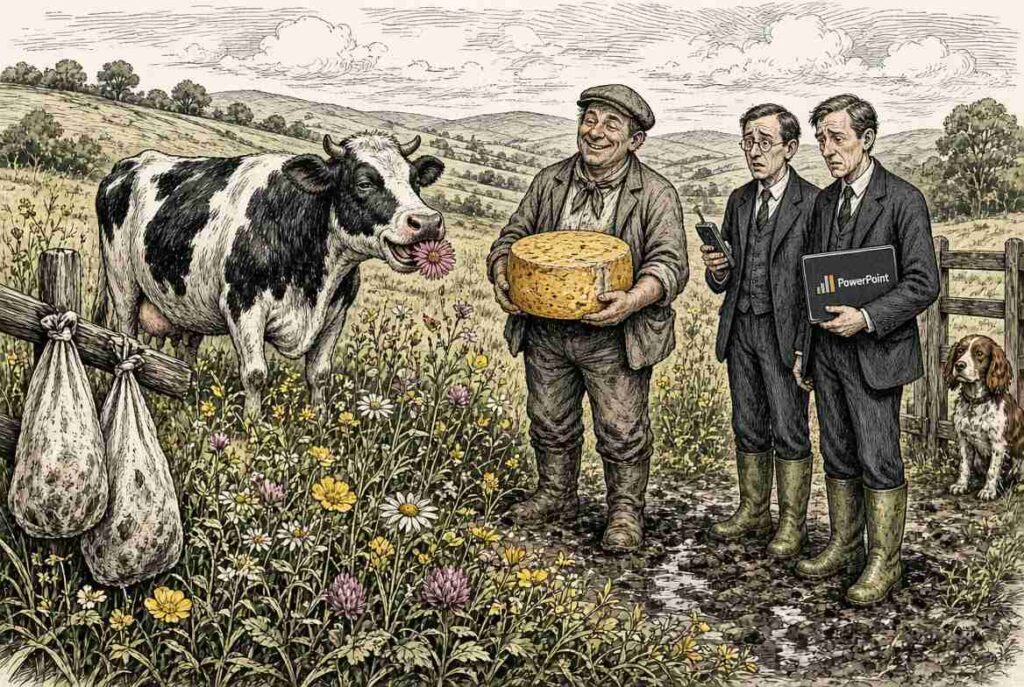
Revolutionary Rural Experiment Replaces PowerPoint With Cow Eating Flower
Somerset Farmer Plants Wildflowers for Better Cheddar, Britain Finally Discovers Policy People Can Taste
Revolutionary Rural Experiment Replaces PowerPoint With Cow Eating Flower
SOMERSET – Dairy farmer and cheesemaker Tom Calver has introduced more varied pasture containing wildflowers, accepting lower milk yields because he believes the richer forage improves the flavour and complexity of his cheddar while benefiting farmland biodiversity.
Britain should immediately appoint this man to several government departments.
The proposition is beautifully understandable.
Cow eats better grass.
Milk tastes different.
Cheese tastes better.
No QR code.
No behavioural nudge.
No national strategy containing the phrase “multi-stakeholder delivery framework.”
Just cow, meadow, cheese.
Agricultural policy has rarely been permitted such dangerous clarity.
Efficiency Meets Flavour in the Search for Better Cheddar
For decades the modern food economy has pursued efficiency.
More milk per cow.
More crop per acre.
More output per worker.
More units per hour.
Eventually somebody in Somerset apparently asked:
“What if the cheese tasted nicer?”
Economists fainted.
Taste is difficult to place in a spreadsheet.
A spreadsheet understands litres.
It understands kilograms.
It understands output.
It does not understand why you close your eyes after eating something and quietly say:
“That’s good.”
The farmer has reportedly sacrificed some milk yield by allowing more diverse plants to develop and by managing grazing differently.
This is economic heresy.
The sacred formula says more equals better.
More cows.
More milk.
More cheese.
Cheaper cheese.
Eventually every block of cheddar reaches such perfect efficiency that eating it becomes indistinguishable from licking a laminated conference badge.
Britain has spent centuries producing food whose chief marketing advantage is that somewhere nearby there remains a stone wall.
Packaging depicts rolling hills.
Church tower.
Cow.
Perhaps an elderly farmer named Arthur.
Inside sits cheese manufactured according to supply-chain optimisation software in a building visible from the M5.
Calver’s experiment flips the equation.
What if landscape actually affects product?
Terroir for Better Cheddar
Wine people have discussed terroir forever.
They can taste a grape and identify not merely the country but apparently which side of a French hill the vine was emotionally attached to.
Cheese receives less ceremony.
“It’s cheddar.”
From where?
“Tesco.”
Perhaps British cheese deserves equal pretension.
A sommelier could approach.
“This 2027 Somerset displays notes of buttercup, clover, damp boot and a distant argument about agricultural subsidies.”
Customer nods.
“Extraordinary.”
“That will be £34.”
The Cows Behind Better Cheddar and the Buffet of Grass
Wildflower grazing also sounds suspiciously pleasant.
The cows live in colourful fields eating a diverse buffet.
Industrial livestock everywhere else should avoid Instagram.
Imagine being a cow eating standard ryegrass and discovering another cow has access to chicory, clover, plantain and wildflowers.
You would unionise.
Researchers at the imaginary Bovine Institute for Culinary Equality have detected growing resentment.
“One cow surveyed described conventional pasture as ‘basically the airport WHSmith meal deal of grass,'” said lead scientist Dr. Daisy Hoofman.
The experiment raises a broader question about what agriculture is for.
Maximum production?
Maximum environmental benefit?
Maximum food quality?
Maximum rural employment?
The answer is inevitably some compromise.
But modern policy discussions often become so obsessed with measurable quantities that unmeasurable qualities vanish.
Beauty.
Taste.
Character.
Landscape.
A sense that the cheese came from somewhere rather than emerged from a logistics portal.
Those matter too.
A wildflower meadow also provides an unusually effective form of environmental messaging because ordinary people can understand it.
More flowers.
More insects.
More varied landscape.
Potentially tastier cheese.
Compare this with conventional climate communication:
“We are implementing Scope 3 mitigation pathways consistent with land-use transition modelling.”
Public response:
“What?”
Alternative:
“Flowers make cheddar better.”
Public response:
“Where do I sign?”
“The cows have been eating better than the civil service for years, and finally the cheese is starting to show it,” said Vivienne Pratfall, London satirist and committed cheddar sceptic turned convert.
The farm insists the cheese is a mature decision, and the cows say the pasture is a field of dreams, or, as one heifer mumbled, a dield of freams. The milk yield has gone down the whey, though the customers are curd-ly impressed. A cheesemonger praised the flavour as sharp, mature and well-rounded, which is more than can be said for the policy. Critics called the meadow a flowery excuse, and the farmer replied that he was simply grazing the issue. Britain will now meadow its policy, cheddar its ambitions and flower its way to a better economy, and it turns out the cows were always going to be the udder authority on that.
Better Cheddar and the Policy You Can Taste
Britain should consider reorganising environmental policy around deliciousness.
Want regenerative farming?
Better roast potatoes.
Want biodiversity?
Better beer.
Want soil health?
Improved sausage.
Within three months the entire population would be measuring earthworms.
Government communications have spent years attempting to persuade citizens through guilt.
Cheese offers a more sophisticated mechanism.
Bribery.
The most British aspect of the story is that after endless national debates about agriculture, sustainability, subsidies, imports and rural land use, one farmer may have discovered the perfect coalition.
Environmentalists like flowers.
Farmers like premium products.
Consumers like cheese.
Cows presumably prefer lunch containing options.
There will inevitably be critics.
Some will question scalability.
Others will emphasise the economics of reduced yields.
Those are legitimate considerations.
But for one glorious moment Britain has encountered an agricultural story in which the complicated relationship between ecology and economics can be summarised in a sentence everyone understands.
Less milk.
More flavour.
Better meadow.
That is dangerously close to common sense.
Whitehall must intervene immediately before it spreads.
Expect a 140-page National Wildflower Cheese Strategy by Christmas.
The real story: the Guardian reported that Somerset dairy farmer and cheesemaker Tom Calver is planting wildflowers in his pastures in the belief that the more varied forage improves the flavour and complexity of his cheddar. He has accepted lower milk yields in return, and he says the approach also benefits farmland biodiversity. The trade-off between yield and quality is at the heart of the story, and critics have raised questions about how well the approach scales.
Humorous Observations on Better Cheddar
- A Somerset farmer is improving cheddar by planting wildflowers, finally producing a government-adjacent rural story whose solution does not require an app, a taskforce or seventeen consultants.
Sources
This is a human collaboration between two sentient beings, the world’s oldest tenured professor and a philosophy major turned dairy farmer, producing British satire and London satirical journalism from a real farm story. Like all UK satirical news, the cows, institutes and cheese strategies are there for the laughs, and no cows were consulted about the Instagram question.
For the American take on the news, read the latest at Bohiney.com.
Auf Wiedersehen, amigo!

Bethan Morgan is an experienced satirical journalist and comedy writer with a strong editorial voice shaped by London’s writing and performance culture. Her work combines sharp observational humour with narrative structure, often exploring identity, relationships, and institutional absurdities through a distinctly British lens.
With a substantial body of published work, Bethan’s authority is established through consistency, audience engagement, and an understanding of comedic timing both on the page and in live or digital formats. Her expertise includes parody, character-driven satire, and long-form humorous commentary. Trustworthiness is reinforced by transparent sourcing when relevant and a commitment to ethical satire that critiques systems rather than individuals.
Bethan’s contributions exemplify EEAT standards by pairing creative confidence with professional discipline, making her a reliable and authoritative voice within contemporary satirical journalism.


