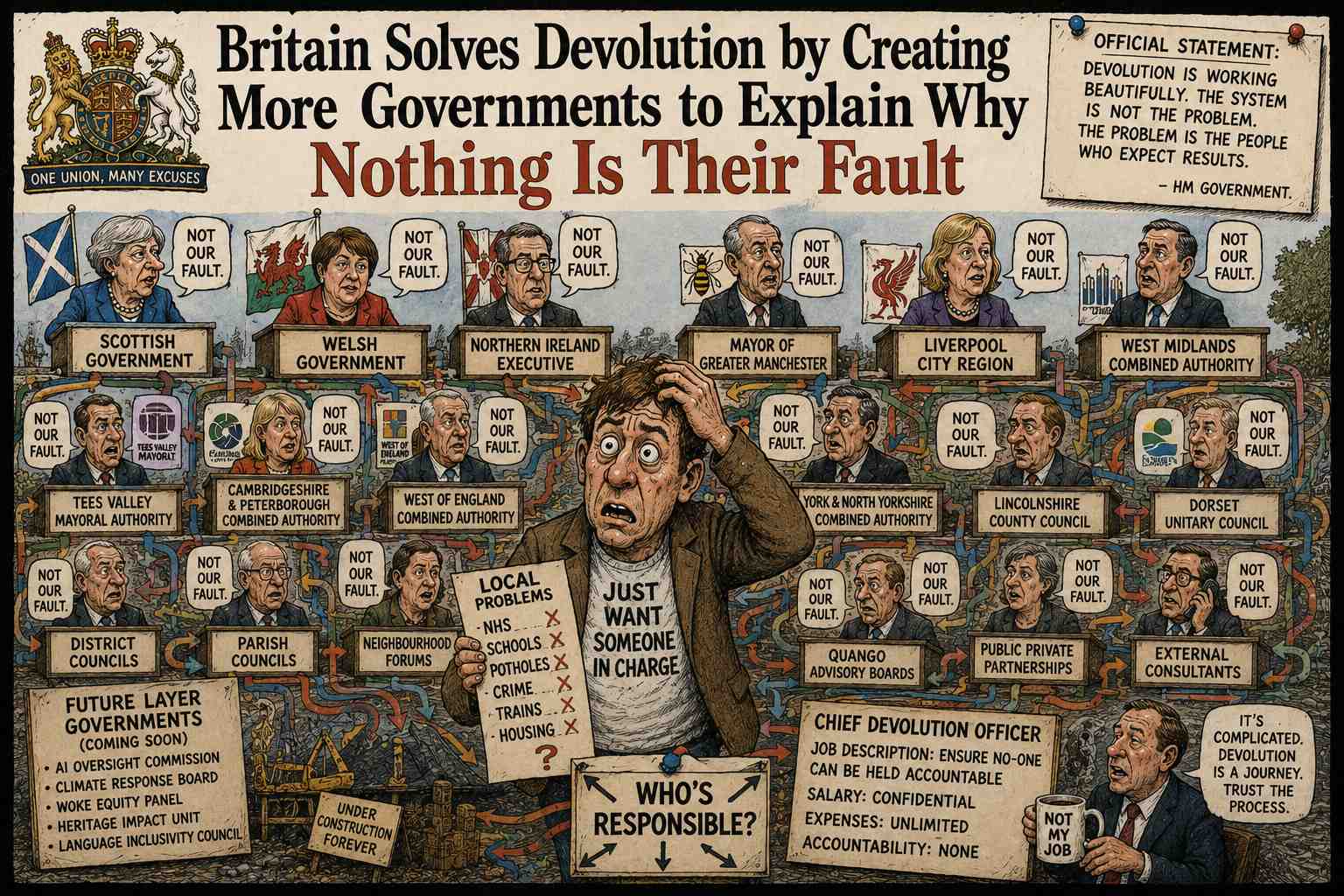
Britain Solves Devolution by Creating More Governments to Explain Why Nothing Is Their Fault
Nation Discovers That Dividing Responsibility Is Much Easier Than Dividing Accountability
LONDON, England
Britain’s great devolution experiment continues to amaze constitutional scholars, taxpayers, and anyone who’s ever tried to determine which government is actually responsible for fixing the pothole outside their house. The honest answer, officials confirmed this week, is that responsibility is “all of them, theoretically,” and accountability is “none of them, practically” — a paraprosdokian of governance if there ever was one, promising unity and delivering only an elaborate shrug.
The latest row over fairness in devolution has reminded the nation that Britain now possesses more layers of government than a wedding cake, yet somehow fewer people willing to accept responsibility when the trains stop, the bins overflow, or the local council spends £3 million on a feasibility study explaining why it can’t afford to collect the bins in the first place.
Government by Russian Nesting Doll
Political scientists now describe the United Kingdom as the world’s only constitutional system where every layer of government blames the layer immediately above it while simultaneously demanding complete independence from it. Westminster blames city halls. City halls blame combined authorities. Combined authorities blame Whitehall. Whitehall blames Treasury rules. The Treasury blames economic conditions. Economic conditions blame Brexit. Brexit, ever the reliable scapegoat, blames Europe. Europe politely pretends not to recognise the phone number — the sort of ironic literalism in which a continent-wide hang-up is treated as an actual dropped call rather than a diplomatic one.
Citizens, wiser than any white paper, simply blame whichever politician happens to be standing nearest a television camera. As one London comedian put it during a recent set at the Comedy Store, devolution is “less a transfer of power and more a very long game of pass-the-parcel where the prize is a pothole.”
Westminster’s Revolutionary Generosity

Whitehall proudly announces it is “handing power to local communities,” much the way a restaurant hands customers the privilege of washing their own dishes. The powers transferred include difficult planning decisions, impossible housing targets, public complaints, and ceremonial ribbon cuttings. The money required to accomplish these tasks remains safely locked inside the Treasury, where accountants protect it with the determination normally associated with medieval castles — or, in a small spoonerism of national priorities, with far more vigour than they protect the actual roads.
Government ministers insist this arrangement demonstrates trust. Local leaders insist it demonstrates accounting fraud with better branding. Both cannot be right, though Whitehall has never let that stop a press release.
Every Mayor Wants Freedom… and the Credit Card
Britain’s metro mayors have embraced devolution with enormous enthusiasm. Each gives passionate speeches demanding complete fiscal independence. Seconds later they politely ask Westminster whether it could possibly send another £400 million, because local revenue mysteriously refuses to stretch as far as political promises. Analysts at the Centre for Cities have pointed out that England sends 95 percent of tax revenue straight to Whitehall, leaving councils and mayors with just 5 percent — a split so lopsided it makes devolution sound less like a transfer of power and more like a rounding error with a press office.
Experts describe this as Britain’s newest constitutional principle. “Financial independence,” one economist explained, “apparently means spending your own money only after someone else provides it.” It’s less devolution than de-evolution, if you’ll allow the pun — power crawling backward toward Whitehall the moment the invoice arrives.
Local Decision Making, Pending Approval
Officials continue celebrating local democracy. Communities are encouraged to make bold decisions, provided, naturally, those decisions coincide with Whitehall guidance. Should a council attempt genuine independence, ministers immediately explain that national consistency must be preserved. This has led constitutional experts to define local autonomy with a straight face: “You are completely free to choose any option that has already been approved” — a phrase so quietly absurd it verges on double entendre, promising freedom while delivering a multiple-choice test with one correct answer.
The Great Pothole Bermuda Triangle
No scientific mystery rivals Britain’s potholes. Residents report them. Councils investigate them. Combined authorities review them. Departments assess them. Funding formulas examine them. Consultants prepare reports about them. Three years later, the pothole has essentially been anthimeria’d into existence — a hole so persistent it has been verbed, nouned, and finally recognised as an official wetland supporting rare amphibians. Nobody knows who owned the road. Everyone attended meetings about it.
As one Manchester comedian joked at a recent gig, “We’ve got mayors, combined authorities, and integrated settlements — everything integrated except, somehow, the actual road surface.”
London’s Favourite National Sport

Every region believes London receives unfair treatment. London insists it finances everyone else’s ambitions. The North complains about investment. The South complains about taxation. The Midlands complain nobody remembers they exist until election season. Cornwall quietly asks whether it has accidentally become France. Political commentators now rank arguing over regional funding alongside football and discussing the weather as Britain’s most reliable conversation starter — proof that the nation’s true unifying institution isn’t the monarchy, it’s the moan.
Excel Ruins Another Political Dream
Fiscal devolution always begins with inspirational speeches. Then someone opens a spreadsheet. Suddenly everyone discovers arithmetic has become surprisingly ideological. Numbers reveal uncomfortable truths: some regions collect enormous tax revenues, others collect charming market towns and optimistic tourism brochures. The National Audit Office has quietly noted that many Mayoral Strategic Authorities are still building the institutional capacity needed to manage the financial responsibilities being handed to them, which is Whitehall-speak for “we gave them the steering wheel before checking if anyone had a licence.” Economists repeatedly explain that mathematics remains stubbornly immune to campaign slogans. Politicians continue testing that theory.
Congratulations, It’s Your Problem Now
Government ministers proudly describe devolution as empowering communities. Residents eventually discover empowerment means inheriting decades of neglected infrastructure along with an inspirational logo and several consultation documents. It’s rather like being given ownership of an elderly ship while discovering someone forgot to include an engine — or, per the Local Government Information Unit’s rather more sober phrasing, “the ship has been steadied — it is time to consider whether it is seaworthy for the journey ahead.” Even the policy wonks, it seems, can’t resist a nautical metaphor for a sinking system.
Whitehall’s Flexible Definition of Centralization
Britain agrees excessive centralisation is unhealthy. Until someone suggests Whitehall surrender genuine authority. Then ministers suddenly remember the dangers of inconsistency, unequal standards, and the terrifying possibility that local people might actually govern themselves. Apparently decentralisation is wonderful. Just not excessively decentralised — a fine malapropism of principle, where “more local control” quietly becomes “more local control, filed for review.”
Britain’s Most Expensive Group Project
Devolution increasingly resembles the university assignment where five students share responsibility. Nobody does the work. Everybody writes their own name first. Someone else gets blamed. Taxpayers receive a professionally designed PowerPoint presentation explaining why collaboration remains an outstanding success. The Institute for Government has raised the same concern in more measured terms, warning that the collapse of local audit capacity means there are now few local mechanisms able to properly hold mayors and combined authorities to account. Translated from think-tank into English: nobody’s marking the group project either.
More Power, Same Wallet
Each constitutional reform promises more authority. Rarely does it promise more funding. This miracle resembles promoting someone to captain while quietly selling the ship. Officials celebrate increased responsibility. Finance directors quietly begin updating their résumés.
The Steering Wheel Without the Brakes
Whitehall has perfected modern management. It hands local leaders the steering wheel. Keeps the fuel. Controls the brakes. Owns the satnav. Then criticises local authorities for not arriving on schedule. Management consultants reportedly charge six figures to teach precisely this leadership philosophy, which one Birmingham comedian summarised on stage as “delegation: giving someone all the responsibility and none of the ignition key.”
The Age of the Government Logo
Every new authority immediately commissions branding. Fresh logos appear. Mission statements multiply. Vision documents arrive printed on expensive recycled paper. Meanwhile residents continue wondering whether buses might someday become revolutionary enough to arrive before next Tuesday. The logo always works perfectly. Infrastructure remains under review.
Fairness Arrives… Then Meets Mathematics
Every discussion begins with fairness. Eventually someone asks where the money comes from. The atmosphere changes faster than British sunshine. Suddenly philosophical ideals collide with Treasury spreadsheets. Nothing ends an argument about equality faster than discovering who is expected to pay.
Rearranging the Furniture During the Flood

Britain’s constitutional reforms increasingly resemble homeowners attempting to solve a leaking roof by repeatedly rearranging the living room. The sofa moves. The television moves. The coffee table moves. The leak continues dripping directly into the same bucket. Government ministers proudly unveil another constitutional review. Citizens continue placing traffic cones around potholes that now qualify for postal addresses.
As one elderly London philosopher sighed outside Victoria Station, “Britain never runs out of governments. It merely runs out of governments willing to admit they’re the government.”
The English Devolution and Community Empowerment Act (2026) and the ongoing rollout of “integrated settlement” funding to metro mayors including Greater Manchester and the West Midlands form the real backdrop to this piece, alongside genuine debate among figures such as Andy Burnham, Rachel Reeves, and Angela Rayner over how much fiscal power Whitehall is actually prepared to give up. This article mixes real policy developments with exaggerated commentary, invented quotations, and comedic exaggeration for satirical effect. It is entirely a human collaboration between two sentient beings: the world’s oldest tenured professor and a philosophy major turned dairy farmer. Any resemblance to actual constitutional confusion is, naturally, entirely intentional.
Sources:
GOV.UK — Devolution Revolution: Six Areas to Elect Mayors
Institute for Government — Metro Mayor Accountability
National Audit Office — Devolution in England: Funding and Accountability
Centre for Cities — Fiscal Devolution for England
LGIU — Local Government Finance Across the World, 2026 Update
For the American take on bureaucracies that can’t find the exit, see our companion piece at Bohiney.com.
Auf Wiedersehen, amigo!
Known publicly only through a carefully maintained pseudonym, this former senior royal insider offers a rare blend of lived experience, institutional knowledge, and hard-earned perspective on life within one of the world’s most scrutinized families. Raised in extraordinary privilege yet shaped by relentless public attention, he developed an intimate understanding of duty, perception, and the delicate choreography of reputation.
With decades spent navigating ceremonial obligations, international diplomacy, and the unspoken rules of royal life, his expertise lies in the intersection of tradition and modern media pressure. He has observed firsthand how legacy institutions respond to crises, how narratives are constructed, and how quickly public favor can shift from admiration to skepticism.
His insights are informed not only by access, but by consequence. Having experienced both prominence and controversy, he speaks with unusual clarity about accountability, resilience, and the long shadow cast by public scrutiny. Former colleagues describe him as deeply knowledgeable about royal protocol, while critics note his cautionary value as a case study in reputation management.
Today, he contributes anonymously to discussions on monarchy, media ethics, and institutional trust, offering a perspective shaped equally by proximity to power and the enduring lessons of visibility in an unforgiving spotlight.