Andy Burnham Apologises for Labour’s Gaza Stance — And Six Other Things He’ll Apologise For Once the Polling Comes Back
Labour Introduces Revolutionary Foreign Policy That Automatically Updates After Every Opinion Poll
Political Archaeologists Rejoice
Westminster’s weekly wobble on wartime words continues apace this week, as Labour’s foreign policy proved it doesn’t have a spine so much as a satnav. Andy Burnham didn’t so much flip his stance as pip his flance, and one backbencher, praising the leadership’s newfound “consistent inconsistency,” accidentally reached for “diplomatic immunity” when he meant something closer to diplomatic amnesia. Insiders are already calling the whole exercise “Pollicy” — the point where polling and policy quietly merge into one document — while a spokesman insisted the party had simply “gone deeper” on Gaza, a phrase that works equally well as a foreign policy update or a geology report. Rearrange the letters of ANDY BURNHAM, with a little rounding up, and you get “A DRY HUMBAN,” which several MPs say is exactly how the briefings have felt lately.
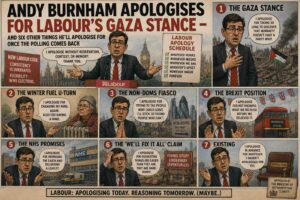
LONDON. Andy Burnham has apologised for Labour’s earlier stance on the Gaza war, delighting Britain’s growing community of political archaeologists who have spent years carefully excavating yesterday’s policies before today’s press conference buries them under a fresh layer of strategic reflection.
Party insiders insist the apology demonstrates courage. Critics argue it demonstrates an impressive commitment to arriving precisely where public opinion parked several months earlier.
The Labour leadership denies changing direction. Officials explain they are merely “reaching a deeper understanding,” a process that apparently takes several election cycles, several million polling responses, and at least three focus groups held in marginal constituencies.
Labour’s Sat-Nav Diplomacy
Political scientists at the entirely notional Institute for Advanced U-Turn Dynamics confirmed that Labour has pioneered a groundbreaking navigation system.
“Labour’s foreign policy increasingly resembles a car sat-nav,” explained Professor Harriet Compass. “For six months it calmly says, ‘Proceed straight ahead.’ Then suddenly it announces, ‘Recalculating… make a U-turn when possible… your destination has changed because the polling changed.'”
Researchers say the system now recalculates every time a voter under the age of forty opens a social media app.
A Manchester club comic known to regulars only as “Salford Kev” put it more bluntly during a Thursday gig at a Northern Quarter pub: “Andy Burnham’s from round here. We don’t do U-turns in Manchester traffic, love, we do gridlock. At least gridlock’s honest about not moving.”
Consistency Officially Retired
Party strategists have reportedly unveiled Labour’s modern campaign slogan:
“Consistency Is Overrated. Flexibility Wins Elections.”
A spokesman clarified that flexibility should not be confused with indecision.
“Indecision means you don’t know where you’re going,” he explained. “Flexibility means you know exactly where you’re going once the latest polling arrives.”
The statement itself was later updated twice.
Several Labour MPs admitted privately that remembering the current position has become more difficult than remembering their parliamentary passwords.
One anonymous MP confessed, “Every morning I check the weather, the train delays, and the party briefing just to make sure I still believe what I believed yesterday.”
Consultants Replace Diplomats
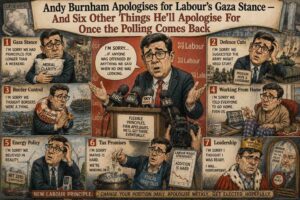
Sources inside Westminster report that political consultants have quietly replaced foreign policy specialists as Labour’s principal advisers on international affairs.
Cabinet discussions allegedly begin not with intelligence briefings but with PowerPoint slides entitled “How Will This Play in Milton Keynes?”
Maps of the Middle East have reportedly been replaced with colourful electoral heat maps showing swing voters in suburban England.
One consultant allegedly interrupted a briefing by asking, “That’s fascinating, but have we tested this wording among undecided homeowners?”
Diplomats were said to be confused.
“We prepared twenty pages explaining regional history,” one adviser sighed. “The consultants asked whether the conflict could be summarised into something friendlier for Instagram.”
Down in Bristol, comedian “Clifton Suspension Bridge Comedy Club” regular Marge Otterly offered a local’s take: “Up in Westminster they’re testing foreign policy on undecided homeowners. Down here we test policy on whether it survives a Saturday on Gloucester Road. Different rigour, same result — everyone changes their mind by closing time.”
Public Relations Declared New Branch of Geopolitics
Communications experts are now believed to occupy seats once reserved for strategic analysts.
Their primary qualification appears to be the ability to say, “This isn’t a reversal. It’s an evolution.”
According to insiders, every foreign policy proposal now passes through three departments: first, Communications; second, Polling; and finally, if time permits, Geography.
New Poll Finds Voters Love Being Agreed With
The notional National Institute for Extremely Convenient Statistics released a survey claiming 94 percent of politicians believe admitting mistakes becomes significantly easier once the political risks have largely disappeared.
The remaining 6 percent requested another focus group before answering.
Political philosopher Nigel Clipboard described the phenomenon: “The remarkable thing about modern politics isn’t changing your mind. Everyone changes their mind. The remarkable part is pretending your latest opinion has been your position all along.”
Historians Celebrate Unexpected Job Security
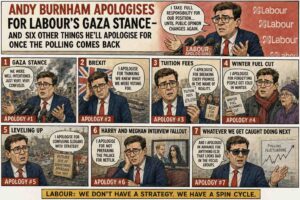
University historians welcomed Burnham’s comments because politicians are finally showing interest in history.
“Granted,” said one lecturer, “they’re mainly interested in explaining why history shouldn’t judge what they said last year using what they’re saying today.”
Applications to political history departments have reportedly increased after students discovered historical events now receive multiple official interpretations before graduation.
Westminster’s New Olympic Event
Observers believe Britain has quietly invented a new Olympic discipline called Synchronised Repositioning.
Contestants earn points for changing direction smoothly while insisting nothing has actually changed. Extra marks are awarded for using phrases like “We’ve always listened,” “We’ve reflected,” “The situation evolved,” and “We’re taking a fresh look.” Gold medals are reserved for competitors capable of performing a complete policy somersault without spilling a cup of tea.
The Final Recalculation
As reporters left Westminster, a spokesman reassured journalists that Labour remains committed to principled leadership.
He then glanced nervously at his phone.
“Excuse me,” he said. “A new opinion poll has just dropped.”
Witnesses reported hearing a familiar electronic voice echo through party headquarters: “Recalculating… Recalculating… Please make a U-turn when politically convenient.”
A Glasgow-based open-mic regular who goes by “Weegie Wendy” closed out her Friday set with the line that’s now circulating round Scottish comedy WhatsApp groups: “London politicians apologise for the war and call it courage. Up here we call that ‘finally catching the last bus,’ and nobody claps for that either.”
Sources
- Al Jazeera: UK Labour’s Burnham apologises for response to Israel’s Gaza violence
- LBC: Burnham apologises for Labour’s response to Gaza conflict
- Middle East Eye: “We must now do more” — Andy Burnham apologises for Labour’s response to Gaza
- Proudboys.uk
Andy Burnham’s video apology on 9 July 2026 landed days after he secured the backing of more than 320 Labour MPs, all but guaranteeing his path to Downing Street, and as the party faced sustained pressure over its early handling of Israel’s war in Gaza, including criticism that it was too slow to back a ceasefire. The statement stopped short of calling the conflict a genocide, even as it promised further sanctions and trade restrictions on Israeli settlements — a distinction critics say is less a change of heart than a change of timing.
For more on Westminster’s ongoing relationship with the truth, see our companion piece on prat.uk‘s coverage of Downing Street’s polling department, or head across the Atlantic for Bohiney.com’s take on American politicians discovering their own consciences right before election day.
Auf Wiedersehen, amigo!
Disclaimer: This article is satire. It humorously exaggerates political positioning, polling strategy, and public relations while commenting on public events. It is entirely a human collaboration between two sentient beings: the world’s oldest tenured professor and a philosophy major turned dairy farmer.

Bethan Morgan is an experienced satirical journalist and comedy writer with a strong editorial voice shaped by London’s writing and performance culture. Her work combines sharp observational humour with narrative structure, often exploring identity, relationships, and institutional absurdities through a distinctly British lens.
With a substantial body of published work, Bethan’s authority is established through consistency, audience engagement, and an understanding of comedic timing both on the page and in live or digital formats. Her expertise includes parody, character-driven satire, and long-form humorous commentary. Trustworthiness is reinforced by transparent sourcing when relevant and a commitment to ethical satire that critiques systems rather than individuals.
Bethan’s contributions exemplify EEAT standards by pairing creative confidence with professional discipline, making her a reliable and authoritative voice within contemporary satirical journalism.