Burnham Fights Rude Passengers With Posters
£100 fines are coming. Staff to issue them are not.
LONDON, October 24, 2026 — British commuters suffering through aggressive drunks, abusive football supporters, threatening strangers and teenagers broadcasting TikTok videos at the volume of an aircraft engine have received welcome news from Prime Minister Andy Burnham: the government has discovered that antisocial behaviour is unpleasant and intends to do something about it, provided that something can be printed on a poster.
According to The Guardian’s October 23 report on antisocial behaviour on British public transport, passengers increasingly complain about noisy phones, intimidating behaviour, offensive football chants and the apparent disappearance of basic consideration. The government responded by launching a campaign encouraging passengers to use headphones and treat other travellers respectfully.
Announcing the measures on October 19, Burnham said the noise “gets on your nerves and can quickly spoil the journey.” Commuters asked about the finding said they had reached the same conclusion independently. Criminals across the country are said to be shaken. One has switched his phone to vibrate.
Thinking About Andy Burnham’s War on Moronic Music
- They’ve declared war on loud music. War. And the weapon is a poster. You know who’s afraid of a poster? Nobody. A poster is what you put up when you’ve decided not to send a person.
- Twelve drunk men screaming obscenities on a train, and the government’s answer is an A3 laminated notice. Laminated. As if durability was the problem. “Sir, I’m told this one’s waterproof.”
- They want passengers to challenge the antisocial behaviour themselves. So that’s a pensioner with a carrier bag walking up to a drunk bloke going, “Excuse me, have you seen the community guidelines?” That’s not enforcement. That’s a hostage video.
- A hundred quid fine. And fair play, because it turns out the man who’ll happily fight a stranger on a bus has a price. A hundred quid and suddenly he’s Prince Edward. Of course, somebody has to actually hand him the ticket, which brings us to…
- …the transport safety officers. Everybody’s heard of them. Nobody’s seen one. It’s Bigfoot in a hi-vis jacket.
Andy Burnham’s Public Transport Crackdown: The Government Discovers Bad Manners
The Prime Minister’s campaign rests on a revolutionary proposition: people ought to behave themselves in public.
For generations, British civilisation functioned on a surprisingly simple agreement. You paid your fare, found a seat, avoided making unnecessary eye contact and kept your personal difficulties to yourself until you reached a pub. Now the average railway carriage resembles a nightclub with poor ventilation, no dance floor and a surprisingly aggressive complaints department.
One passenger is conducting a personal telephone argument about his divorce. Another is playing a video involving a screaming influencer. A third is eating something with the smell and structural characteristics of a chemical weapon. At the other end of the carriage, seven football supporters are loudly debating the referee’s parentage.
Burnham’s solution is to remind everybody to be considerate. Officials appear to believe that people who disregard the comfort of everyone around them simply haven’t received the correct information.
The government believes the problem is inadequate communication. The passengers believe the problem is the large drunken man threatening to punch somebody. Both sides agree that more announcements will be made.
Aggressive Football Fans on Trains Face Britain’s Most Terrifying Weapon: A Polite Notice
Among the most revealing complaints in The Guardian’s report came from a football supporter who described travelling with aggressive fans drinking, singing offensive songs and banging on the carriage ceiling. Children were present. Staff and police were absent.
This represents a fascinating enforcement challenge. Imagine approaching twelve intoxicated football supporters who have spent the previous forty minutes chanting obscenities and informing them that the Department for Transport would appreciate a reduction in volume.
“Excuse me, gentlemen. Have you considered the emotional impact of your behaviour on other passengers?”
A diplomatic silence follows. Then somebody wearing a football shirt explains his position using language generally associated with international dockyards.
The difficulty is not a shortage of regulations. Britain possesses regulations covering practically everything except the number of regulations a government may introduce before the public loses consciousness. What is missing is anyone to apply them, and a rule without enforcement becomes a suggestion. A suggestion delivered to twelve drunken football supporters is essentially a request for audience participation.
The government could distribute ten million posters stating that aggressive behaviour is unacceptable. The football supporters might still use them to make paper aeroplanes.
Burnham’s Three-Step Plan: Engage, Explain and Hope the Offender Is Reasonable
The Department for Transport’s official October 19 announcement on tackling nuisance behaviour describes an enforcement process for buses involving three stages. Authorised officers are supposed to engage with offenders, explain the rules and take enforcement action if they refuse to comply. This sounds perfectly reasonable until it encounters an unreasonable person.
The first stage is engagement.
“Sir, could you stop shouting at that elderly lady?”
The second is explanation.
“Sir, threatening to throw the elderly lady through the window is also unacceptable.”
The third is enforcement. Unfortunately, the offender has now reached Birmingham, the elderly lady has missed her connection and the officer is still completing the engagement paperwork.
The policy does not actually instruct passengers to confront threatening individuals. Enforcement is intended for authorised officers. The distinction matters because the average passenger has no interest in becoming an unpaid substitute police constable. He merely wishes to reach Preston with approximately the same number of teeth he possessed when he left Manchester.
Transport Safety Officers on Buses: Britain’s Most Mysterious Public Servants
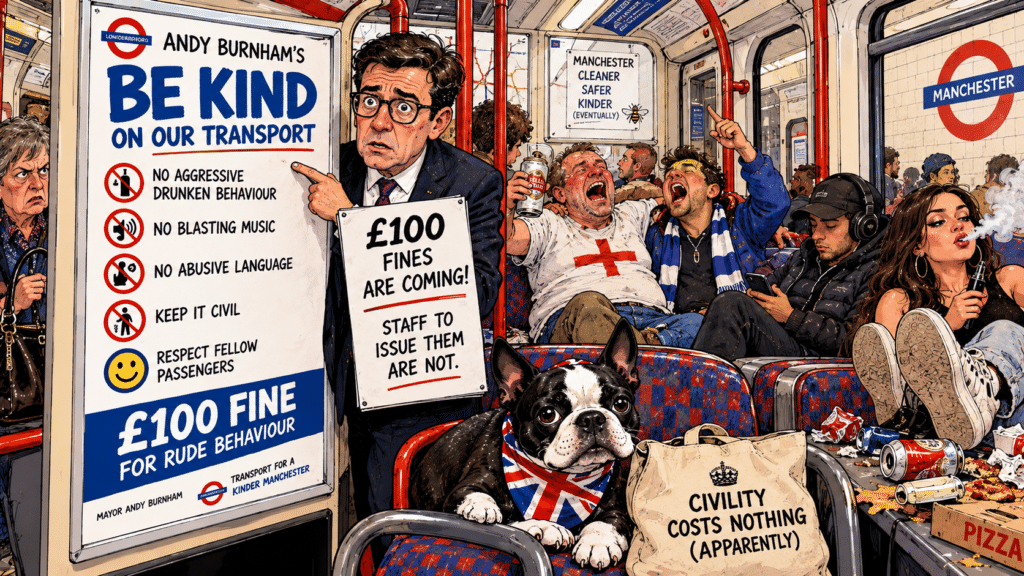
The government says transport safety officers and police will enforce the new bus rules. Drivers will not be expected to undertake this responsibility. That exemption makes sense. Bus drivers already navigate traffic, collect fares, answer questions and absorb complaints from people who believe a £2 ticket includes the right to reorganise the transport network. Asking them to wrestle drunken passengers would be an unreasonable addition to the job description.
However, commuters have raised a more fundamental question.
Where are the officers?
The modern British commuter can travel enormous distances without encountering a police officer, a conductor or anyone who appears capable of persuading an aggressive passenger to sit down. The average carriage contains fourteen surveillance cameras, six advertisements, four emergency notices and a detailed warning about unattended luggage. What it occasionally lacks is a person with sufficient authority to deal with the man shouting threats beside the toilet.
Britain has therefore developed an impressive system for recording antisocial behaviour. A passenger may eventually receive confirmation that his assault was filmed in high definition. He may even request a copy, provided he submits the appropriate form and proves that the bruises belong to him.
£100 Bus Fines: Government Penalises People Who Ignored Every Other Rule
Under the new arrangements, local authorities in England can introduce bus byelaws carrying fixed penalties of up to £100 for certain nuisance behaviour. The powers come from the Bus Services Act 2025, and each byelaw needs the Transport Secretary’s sign-off before anybody can be fined. Rail passengers who refuse to stop when asked by authorised staff can already be removed at the next station or fined up to £1,000.
The theory is straightforward. A person who does not care about fellow passengers, transport staff, railway announcements or ordinary standards of decency will suddenly become law-abiding upon discovering that his behaviour carries a financial penalty. This works beautifully if someone is present to issue it.
Unfortunately, a fine that nobody collects is not much of a deterrent. A £100 penalty issued by an officer who never appears has roughly the same disciplinary effect as a disappointed look from a distant aunt.
The government could increase the fine to £1 million. It could threaten offenders with deportation to the Isle of Wight. It could require anyone caught playing TikTok without headphones to attend a compulsory three-hour presentation on British railway etiquette. None of these measures will make much difference if the only witness is a frightened commuter pretending to sleep.
Quiet Carriages Become Britain’s Latest Exercise in Wishful Thinking
Few institutions demonstrate the decline of public consideration more elegantly than the British quiet carriage. The name offers a relatively straightforward description of the expected environment.
Quiet.
Not moderately quiet. Not quiet except when somebody discovers a particularly entertaining video involving a dancing refrigerator. Actually quiet.
Yet some passengers interpret the designation as an invitation to establish their personal broadcasting network. The businessman conducts his conference call at full volume. The teenager provides unsolicited musical entertainment. The man opposite watches football highlights with an enthusiasm suggesting that he has personally invested in the club’s goalkeeper.
Every passenger knows what should happen. Nobody wants to be the person who makes it happen.
Thus begins Britain’s traditional method of handling antisocial behaviour: the collective deployment of severe facial expressions. Twelve passengers exchange meaningful glances. One raises an eyebrow. Another sighs. A third closes his newspaper with enough force to communicate the collapse of Western civilisation.
The offender remains completely oblivious.
Why British Commuters Are Afraid to Challenge Antisocial Passengers
One particularly revealing commuter account described a passenger being verbally abused after asking another traveller to use headphones. This exposes the fundamental weakness in campaigns that rely on ordinary citizens to correct other people’s behaviour.
Many inconsiderate passengers are merely thoughtless. Others are aggressive. The difficulty is distinguishing between them before speaking.
A woman travelling home after work should not have to conduct a psychological assessment of the stranger sitting opposite before deciding whether to request a little peace. Nor should an elderly passenger have to calculate the probability of physical retaliation before asking someone to stop shouting. That is not a reasonable interpretation of civic responsibility. It is a compulsory amateur policing programme conducted without training, protective equipment or compensation.
The distinction between irritating noise and threatening behaviour also matters. A teenager playing music is generally an annoyance; a person threatening violence presents a public safety problem. The government’s publicity campaign addresses the first problem more easily than the second. This is convenient because laminated posters do not require danger money.
Transport Workers Ask for Protection While Government Promises Better Manners
The problems extend beyond passengers. Transport unions have raised concerns about abuse and violence directed at workers. Unite general secretary Sharon Graham described the proposals as well-meaning but wholly inadequate to address what bus staff face, and said the penalties would not touch the problems they deal with. The Campaign for Better Transport said antisocial behaviour can put people off using public transport altogether.
This introduces an awkward reality into the government’s reassuring communications strategy. People working on buses and trains already encounter aggressive members of the public as part of their working day. They do not need additional instructions explaining that abuse is unacceptable. They need effective support when abuse occurs.
Britain has become remarkably proficient at producing campaigns explaining desirable behaviour. Be kind. Be respectful. Think of others. Share the carriage.
At this rate, the government will shortly distribute leaflets reminding bank robbers that bank employees find robbery distressing. A national advertising campaign might encourage burglars to remove their shoes before entering someone’s home. And violent criminals could be reminded that punching strangers is inconsistent with the country’s longstanding commitment to community cohesion.
The publicity possibilities are endless. The enforcement officers, however, remain somewhat less abundant.
How to Make British Public Transport Safer Without Another Government Slogan
There are practical ways to improve the situation, although they involve considerably more effort than commissioning an advertising agency. Passengers need visible staff, reliable reporting mechanisms, effective responses to threatening behaviour and credible consequences for repeat offenders.
Transport authorities must distinguish between minor discourtesy and genuine intimidation. Someone watching a loud video needs to turn it off. Someone threatening passengers may need to be removed and arrested. This distinction is not complicated. It does, however, require somebody to be present who can act on it.
For rail passengers, the British Transport Police’s 61016 reporting service provides a discreet way to report non-emergency incidents. Immediate threats or danger should be reported through 999. A reporting system is useful, but it must also connect to an effective response. A passenger should not have to rely on a threatening stranger voluntarily embracing the government’s philosophy of mutual respect.
The genuinely revolutionary policy would be to make existing rules meaningful. Unfortunately, enforcing the law lacks the promotional elegance of announcing another campaign. There are no particularly exciting photographs of consistent enforcement. Nobody wins an advertising award for a police officer arriving promptly. And a press release stating that transport authorities intend to do their jobs might raise the uncomfortable question of what they have been doing until now.
Burnham’s Transport Revolution: Peace on Britain’s Buses, Provided Everyone Behaves
The Prime Minister has identified a genuine public frustration. His campaign also introduces enforcement powers that could help when properly implemented. But polite announcements alone cannot restore public order. A government cannot persuade people who deliberately intimidate strangers simply by informing them that intimidation is discourteous, nor can it expect ordinary passengers to challenge behaviour that transport professionals themselves may require specialist assistance to manage.
The objective should be simple. A pensioner should be able to travel without fear. A parent should be able to take children on a train without being trapped beside drunken aggression. A bus driver should be able to complete a shift without facing abuse. And a commuter should be able to read a newspaper without being forcibly introduced to the complete TikTok history of a stranger from Stockport.
Britain does not need a philosophical revolution to achieve these things. It needs consistent enforcement of reasonable rules.
Until then, passengers can expect more slogans, more posters and more soothing announcements informing them that antisocial behaviour is unacceptable. Meanwhile, at the opposite end of the carriage, a drunken football supporter will be standing on a seat, banging the ceiling and offering his own interpretation of government transport policy. The Prime Minister’s poster will be clearly visible behind him.
Unfortunately, nobody will be able to hear the announcement over the sound of the fight.
10 Humorous Observations: Andy Burnham’s War on Antisocial Behaviour
The Burnham government announced its public transport campaign on October 19, 2026, including potential £100 fines for nuisance behaviour on buses. Passengers interviewed by The Guardian on October 23 described aggressive football supporters, loud phone videos, abuse and serious doubts about enforcement.
- The big campaign is “use headphones.” Lovely. Has anyone thought about a campaign called “stop punching people”? Or is that too ambitious for a Tuesday?
- They want the football lads to respect the quiet carriage. Thirty drunk men coming back from a match, and somebody’s going to explain that a railway carriage isn’t Wembley. They know that. They’ve decided it’s Wembley anyway.
- Count the equipment in a carriage. Twelve cameras. Seventeen adverts. Six emergency stickers. Number of people who’ll walk over to the guy shouting by the toilet? Zero. We are the best-documented unsafe country on earth.
- Bus drivers don’t have to enforce the rules, which is honestly the smartest thing in the whole policy. He’s the only bloke on that bus who can’t leave. Everybody else has an exit. He has a steering wheel and a timetable.
- Three steps: engage, explain, enforce. By step three the guy’s in Birmingham eating a pasty. You’re still on step one, filling in the form about how you engaged.
- TikTok at full volume is now a public nuisance. Fine. Awful. But the bloke threatening to rearrange my teeth, that’s a different department. One of them needs a poster. The other one needs a dentist.
- The traditional British response to antisocial behaviour: stare, sigh, open the newspaper and read the same paragraph for forty minutes. That’s not reading. That’s a shield. We’re all hiding behind the Metro.
- It’s called the quiet carriage. It’s in the name. We invented the steam locomotive and we still can’t get a grown man to understand what the word “quiet” means.
- Westminster has cracked it: fines instead of officers. Threatening to fine somebody takes a lot less manpower than catching him. A fine is a form. Catching him is a bloke with legs.
- Burnham says he’ll restore civility. Great. All I want is to get from Manchester to London without learning seventeen new swear words and three football chants. I’m not asking for Switzerland. I’m asking to get off a train with the same vocabulary I got on with.
Satirical Disclaimer
This article is political and social satire. The government campaign, enforcement framework and reported passenger concerns are real. The conversations, comic scenarios and exaggerated bureaucratic consequences are satirical devices, not documented incidents or official instructions.
This story is entirely a human collaboration between two sentient beings: the world’s oldest tenured professor and a philosophy major turned dairy farmer. Both agree that public transport should be safer, that courtesy is desirable and that a laminated poster is unlikely to win a fistfight.

Alan Nafzger was born in Lubbock, Texas, the son Swiss immigrants. He grew up on a dairy in Windthorst, north central Texas. He earned degrees from Midwestern State University (B.A. 1985) and Texas State University (M.A. 1987). University College Dublin (Ph.D. 1991). Dr. Nafzger has entertained and educated young people in Texas colleges for 37 years. Nafzger is best known for his dark novels and experimental screenwriting. His best know scripts to date are Lenin’s Body, produced in Russia by A-Media and Sea and Sky produced in The Philippines in the Tagalog language. In 1986, Nafzger wrote the iconic feminist western novel, Gina of Quitaque. He currently lives in Holloway, North London. Contact: [email protected]