Civility Costs Nothing (Apparently): British Government Launches £32 Million Campaign to Remind Citizens to Be Polite While Westminster Continues Shouting
Ministers Demand Respect, Councils Promise Courtesy, and Taxpayers Discover That Saying Please and Thank You Now Requires a Government Department
LONDON — The British government has identified a serious national problem: people are no longer sufficiently civil to one another.
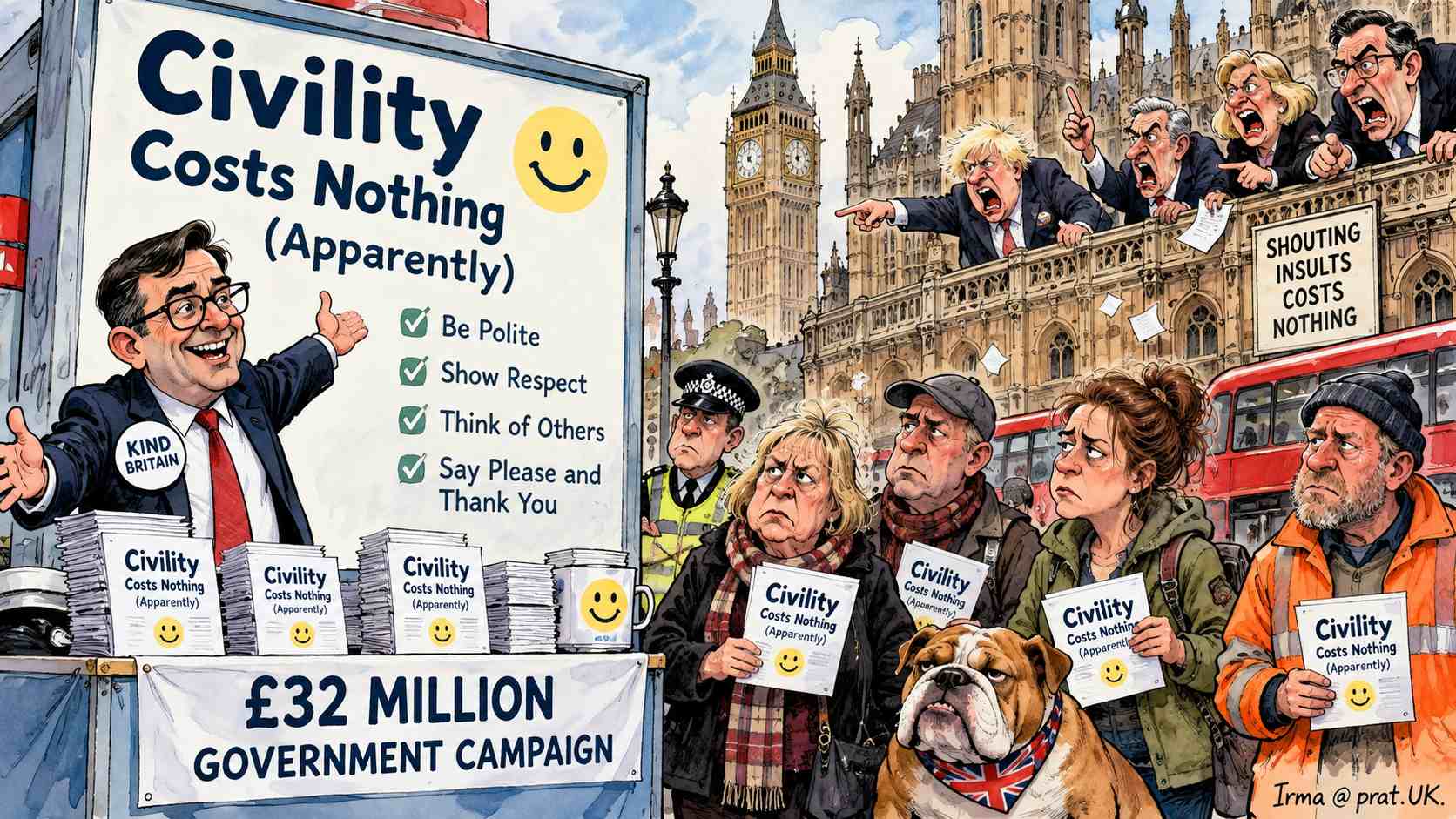
After extensive consideration, ministers have concluded that the most effective solution is a £32 million public-awareness campaign explaining that kindness, consideration and basic good manners cost absolutely nothing.
Officials are particularly enthusiastic about the financial implications.
Unlike hospitals, schools, roads and public services, politeness apparently requires no resources whatsoever, apart from the £32 million necessary to inform people of this fact.
The proposed campaign, provisionally titled Civility Costs Nothing, would include television advertisements, educational materials, management consultants, regional coordinators and a permanent administrative unit responsible for determining whether Britons are being sufficiently pleasant.
Civil servants have already suggested that the phrase “costs nothing” should not be interpreted literally.
British Government Discovers That Saying Please Is Free, But Teaching People to Say It Is Expensive
The government has identified a fundamental contradiction in British society.
Citizens regularly complain that they are treated rudely by public officials, politicians, businesses and other members of the public.
However, when ministers request greater civility, these same citizens frequently respond by asking irritating questions about government performance.
Officials consider this deeply unhelpful.
A properly civil citizen should understand that government exists to make difficult decisions and that taxpayers should express appreciation for the privilege of financing them.
Under the proposed initiative, local councils would receive guidance on delivering disappointing news with greater courtesy.
Instead of informing residents that their council tax is increasing while services deteriorate, officials would explain that the authority is delighted to announce an enhanced community contribution experience.
Parking restrictions would become opportunities for responsible vehicle placement.
Missed rubbish collections would be described as flexible waste-management scheduling.
Potholes would remain potholes, although councils would be encouraged to acknowledge them in a respectful and inclusive manner.
The essential principle is simple.
Government need not provide better services if it can develop a sufficiently polite explanation for why those services are unavailable.
Westminster Demands an End to Public Hostility While Preserving Its Traditional Insult Industry
One difficulty confronting the civility campaign is Parliament itself.
The House of Commons has spent centuries perfecting a uniquely British form of political combat in which adults shout insults across a room while addressing every opponent as an honourable gentleman or lady.
This system allows politicians to question an opponent’s intelligence, integrity, competence, honesty and understanding of basic arithmetic without technically abandoning parliamentary courtesy.
An MP may accuse another member of misleading Parliament but must carefully observe the appropriate linguistic conventions.
Apparently, the distinction between parliamentary dignity and a pub argument is that parliamentary insults are recorded in Hansard.
Ministers now want ordinary Britons to adopt Westminster’s respectful standards.
This would represent a remarkable national transformation.
Arguments between neighbours could begin with “The honourable gentleman opposite has demonstrated a catastrophic misunderstanding of the boundary fence.”
Divorcing couples could exchange prepared statements through the Speaker.
And families could resolve disagreements over Christmas dinner by demanding that the member for the kitchen withdraw an offensive remark about the turkey.
Unfortunately, this approach carries one considerable disadvantage.
British families would eventually need a parliamentary expenses system.
New Research Finds Britons Support Civil Disagreement, Particularly When Everyone Else Does It
The government’s concern has some genuine statistical foundation.
University College London research published in September 2026 found that 63% of Britons believe every topic should be open for discussion, even when people strongly disagree.
Yet 64% said political disagreements in Britain usually become hostile or unpleasant.
In other words, Britons strongly support the right to disagree, provided they can find someone capable of disagreeing without behaving like a furious estate agent who has just discovered another estate agent sold the house.
The research also found that only 4% considered changing another person’s mind the most important objective of a political argument.
This suggests 96% of the population already understands something Westminster has yet to discover: most arguments are not won.
They are merely survived.
Britain has traditionally managed this difficulty through sarcasm, uncomfortable silence and the phrase “How interesting.”
The latter can mean anything from genuine curiosity to a comprehensive rejection of someone’s entire intellectual existence.
British Manners Crisis: Citizens Are Rude, Officials Are Offensive, and Everybody Wants an Apology
Further evidence comes from October 2026 YouGov polling commissioned by Liberty.
It found that 67% of respondents counted rudeness toward shop and restaurant staff among the public behaviours that most annoyed them.
Britain has therefore achieved the extraordinary condition in which almost everyone objects to rudeness, yet enough people continue practising it to sustain a national research industry.
Retail workers have become unwilling participants in arguments over prices they did not set, products they did not manufacture and government economic policies they had absolutely no opportunity to influence.
A supermarket cashier earning an hourly wage is expected to display more emotional discipline than an entire parliamentary front bench.
The cashier must remain courteous when a customer becomes furious that a packet of biscuits costs more than it did in 2019.
An MP, meanwhile, may deliver an extended televised denunciation of an opponent’s character and then congratulate himself on defending parliamentary democracy.
The difference is that the supermarket cashier can be dismissed for poor customer service.
The politician may receive a promotion.
Government Civility Campaign Risks Becoming Another Excuse to Silence Criticism
Civil-liberties campaigners have raised an important distinction.
There is a difference between legitimate political disagreement and genuinely abusive or threatening conduct.
The Electoral Commission’s research on the 2024 general election found that 70% of responding candidates experienced at least one form of harassment, intimidation or abuse during the campaign.
That is a serious democratic problem.
However, complaining about taxation, criticising a minister or questioning an expensive government policy is not the same thing as threatening a politician.
The distinction is particularly important because governments tend to appreciate civility most enthusiastically when someone is asking why they have wasted public money.
A constituent who writes, “Your policy is ridiculous,” may be regarded as unnecessarily confrontational.
A constituent who writes, “With the greatest respect, your policy appears to have been developed by a confused committee of ornamental turnips,” has demonstrated considerable linguistic improvement.
The underlying criticism, however, remains distressingly similar.
British Taxpayers Offer a Cheaper Alternative: Politicians Could Try Being Civil Themselves
Members of the public have suggested several remarkably inexpensive solutions to declining national manners.
Politicians could answer questions directly. Public bodies could respond to complaints. Employers could treat their staff decently. Neighbours could show some consideration. People could stop treating every disagreement as evidence of a criminal conspiracy.
Parliament could even establish an example by conducting a debate in which two adults express different opinions without accusing one another of engineering the collapse of Western civilisation.
Such reforms would cost virtually nothing.
Unfortunately, they would also require politicians and senior officials to change their own behaviour, which is not presently included in the government’s preferred definition of public-sector reform.
The proposed civility programme is therefore expected to proceed through the usual stages of British administrative development.
First comes a consultation.
Then a preliminary assessment of the consultation.
Then an independent review of whether the consultation was sufficiently inclusive.
Next comes a working group, a steering committee and an external contractor appointed to determine whether the working group has adequately consulted the steering committee.
Eventually, the government will publish a 146-page report concluding that British people should be nicer to one another.
The report will cost £8.7 million to produce and will be delivered by a minister who becomes visibly irritated when journalists ask what happened to the other £23.3 million.
The minister will remind everyone that civility costs nothing.
The taxpayer will receive the invoice.
And somewhere in Britain, an elderly woman will continue doing the job for free by telling her grandchildren to stop being bloody rude.

Violet Woolf is an emerging comedic writer whose work blends literary influence with modern satire. Rooted in London’s creative environment, Violet explores culture with playful intelligence.
Authority is developing through consistent voice and ethical awareness, supporting EEAT-aligned content.