Cornell Chi Phi Suddenly Becomes Coolest Fraternity in America After Everyone Is Told Not to Like It
Satirical merchandise boom reportedly turns controversial Greek letters into campus counterculture as Americans rediscover their ancient constitutional right to buy questionable T-shirts
ITHACA, NEW YORK — Cornell University’s Chi Phi fraternity has apparently accomplished what thousands of branding consultants, social-media strategists and men named Bryce with marketing degrees have failed to achieve. It got cool. All it took was a week of everybody explaining why nobody should want anything to do with it.
The real controversy is serious, and the shirts are not the story. In September a former Cornell student, identified in court papers as Jane Doe, sued the university, the fraternity and seven of its members, alleging she was drugged and sexually assaulted at the Chi Phi house in October 2024. CBS News New York laid out the lawsuit. The accused dispute it, and a lawyer for one of them says the alleged incident never happened. The Tompkins County district attorney, who first said there was not enough evidence to charge anyone, has since reopened the investigation, and Cornell says the chapter remains barred from campus. None of it has been proven in court. The joke below is about America’s shopping habits. It is not about her.
CBS News reported Tuesday that several former Cornell Chi Phi members who graduated in 2022 and 2023 say they have been falsely associated online with allegations stemming from an October 2024 incident, despite no longer being Cornell students when it allegedly occurred. Their attorney has asked Cornell to publicly confirm who was not involved, saying some former members suffered harassment and professional consequences after being named online.
But somewhere between the lawsuits, the television coverage, the campus outrage and the cease-and-desist letters, America allegedly performed its favorite cultural maneuver. It bought the T-shirt.
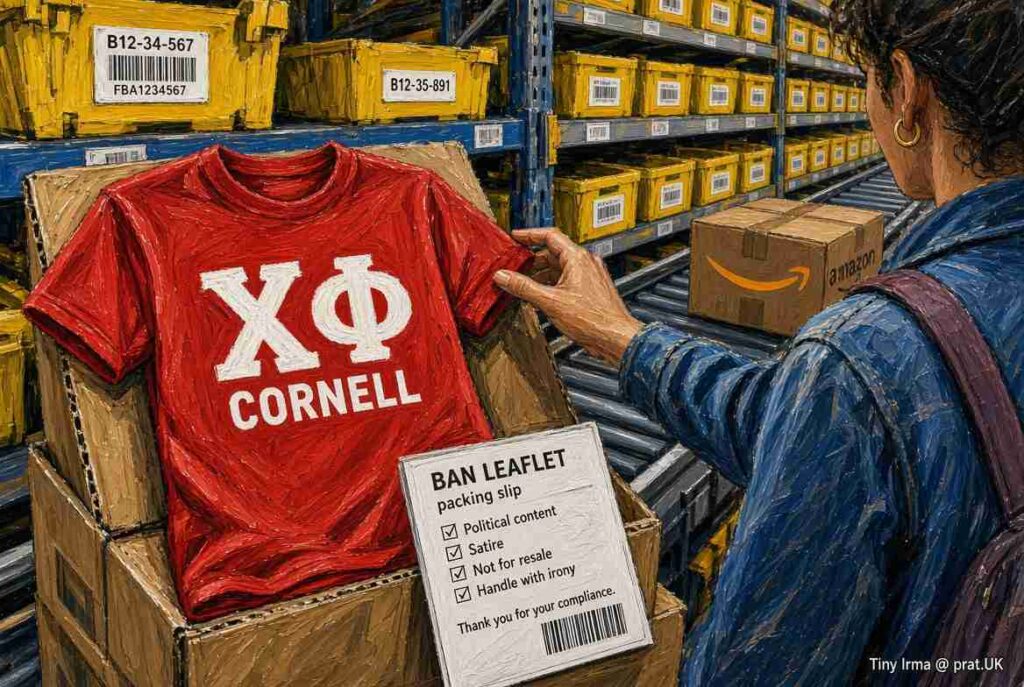
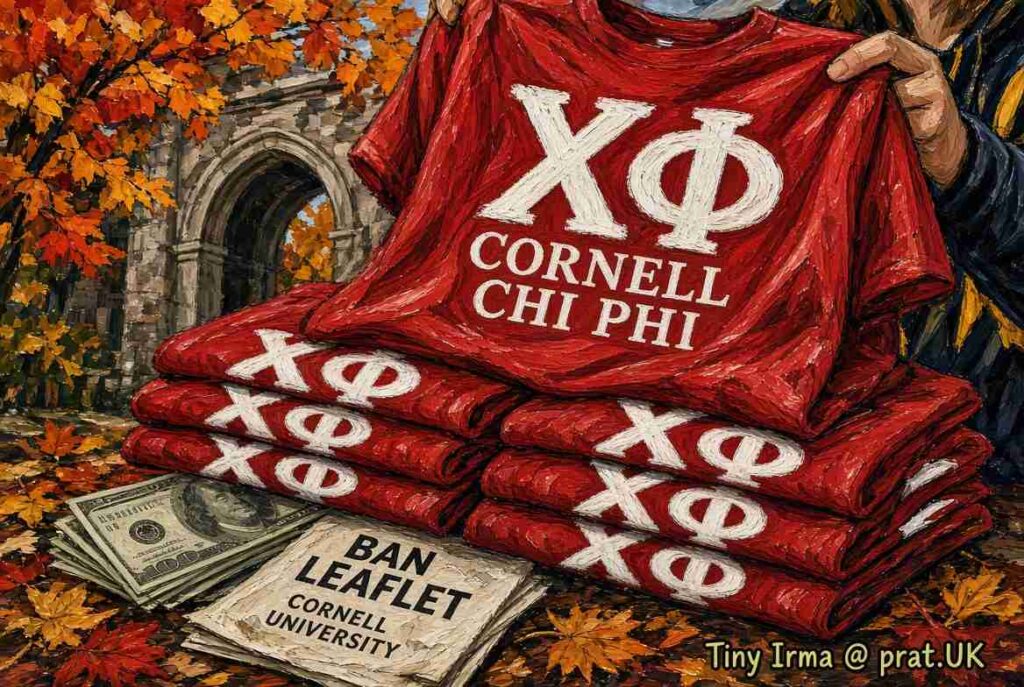
In the satirical economic model now sweeping Ithaca, Cornell Chi Phi apparel has become the hottest commodity since bottled water discovered airports. Shirts are supposedly vanishing from imaginary Amazon bestseller charts, and Etsy sellers are reportedly sewing Greek letters so fast that several have started communicating exclusively through embroidery. Nobody knows exactly why. Which means the economists know exactly why.
“Scarcity plus controversy plus young people equals merchandise,” explained Dr. Walter P. Merchandising, professor emeritus at the Institute for Things People Suddenly Want Because Someone Told Them They Shouldn’t. “This is basic economics. If everyone tells a 21-year-old something is socially unacceptable, you have approximately forty-eight minutes before someone prints it on heavyweight cotton.”
Cornell University’s Chi Phi
- Nothing makes a T-shirt fashionable faster than somebody demanding nobody wear it. American marketing spent a century developing advertising science when apparently all Nike needed was an angry campus meeting.
- Cornell students once wore Chi Phi shirts because they belonged to Chi Phi. Now people can wear them because they enjoy confusing strangers at Whole Foods.
- The Ivy League has accidentally discovered the Streisand Effect, except this time Barbra is a fraternity sweatshirt.
- Yesterday, wearing Greek letters meant fraternity membership. Today it means you have strong opinions about evidentiary procedure and free shipping.
- Amazon shoppers traditionally bought shirts saying “World’s Best Dad.” Now Dad apparently wants one saying “Please Consult Counsel Before Tagging Me Online.”
Why Banning a Fraternity T-Shirt Makes It Sell: Chi Phi Meets the Streisand Effect
The phenomenon has a technical name. The Streisand Effect is the tendency for attempts to suppress something to draw more attention to it, and it’s named after a photo of a Malibu mansion that almost nobody had looked at until a lawsuit told the whole internet to. Cornell has now discovered its undergraduate cousin, the Fraternity Effect. That’s what happens when an institution gets so controversial that people who never knew it existed suddenly hold extremely strong opinions about its logo.
Three weeks ago, an average American shown the Greek letters Chi Phi might have guessed they were a discontinued Honda model. Today, according to our completely irresponsible survey of 1,417 people standing near a campus coffee shop until security asked us to leave, 63 percent said Chi Phi was “controversial,” 28 percent called it “complicated,” and 19 percent wanted to know whether the shirt came in vintage wash. The numbers total 110 percent because this is higher education.
One sophomore who gave his name only as Trevor said he’d never joined a fraternity and had no desire to. He was wearing a Chi Phi sweatshirt. “I’m not supporting anything,” Trevor explained. “I just think it looks cool.” That sentence alone reportedly caused twelve sociologists to request emergency sabbaticals.
Cornell Chi Phi Controversy: The Calendar Becomes America’s Newest Investigative Tool
The strangest turn in the actual controversy involves former members who say they were publicly tied to allegations about an incident that happened after they had already graduated. Their attorney argues Cornell has information that could show some of them were not part of the relevant group chat, and wants the university to say so publicly. CBS reports that names came off one website after a cease-and-desist letter.
That brings a radical investigative technique into American public life: dates. For centuries humanity used calendars for birthdays, dentist appointments and remembering when the free trial turns into $14.99 a month. Legal experts now believe a calendar can also establish whether somebody attended a university in a particular year.
“This could change everything,” said retired chronology specialist Dr. Elaine Tuesday. “If an alleged event happens in 2024 and a man graduated in 2022, we can theoretically subtract 2022 from 2024.” She stared into the distance. “We’re entering dangerous territory.”
Social media users were reportedly skeptical. “Math is not accountability,” wrote one anonymous account whose profile picture was an anime frog.
Cancel Culture Discovers It Has a Gift Shop: How Outrage Moves Merchandise

For years Americans have argued over whether public condemnation destroys reputations. Almost nobody expected it to move inventory. A television personality condemns a book and sales go up. Activists denounce a comedian and the tickets disappear. A university organization lands in the national spotlight and some guy in Cleveland starts Googling hoodies. That isn’t a political ideology. It’s retail physics.
Amazon has probably spent billions on recommendation algorithms, fulfillment systems and predictive purchasing technology. The internet found a cheaper algorithm: tell people they absolutely should not buy something. One minute later, the page says ONLY THREE LEFT IN STOCK.
Cornell Business School Takes Notes on Brand Crisis Marketing
Faculty at Cornell’s SC Johnson College of Business were reportedly seen wandering campus with notepads. For decades, business schools have taught that a valuable brand needs consistency, trust, customer loyalty and careful reputation management. Chi Phi may have stumbled onto another route. Step one, become nationally controversial. Step two, collect wall-to-wall media coverage. Step three, wait for Americans to get curious. Step four, put the logo on a sweatshirt. Step five, let capitalism handle the rest.
Harvard Business School is expected to publish a case study titled “Chi Phi: When Reputational Catastrophe Meets Comfort Colors.” The teaching note reportedly asks MBA students: “If negative attention increases brand awareness by 900 percent, at what point should the public-relations department simply open an Etsy store?”
Chi Phi Brand Awareness Soars: Suddenly Everybody Knows the Name
The biggest winner here may simply be name recognition. There are roughly enough fraternities in America to require air-traffic control. Ask the average person to name five and sooner or later he starts guessing airports. Delta something. Sigma something. Is United one?
Chi Phi has broken through. A national awareness survey before the controversy might have produced “Chi what?” Afterward you’d get “Isn’t that the Cornell one?” That is brand recognition. Coca-Cola spends billions achieving it, and fraternities apparently just need cable news. It’s an uncomfortable lesson for any institution trying to control its reputation, because the human brain doesn’t separate famous from good as cleanly as communications professors would like. Ask anyone who has watched reality television.
Fraternity Apparel Without the Fraternity: Greek Letter Shirts Go Mainstream
The most astonishing development may be that the new Chi Phi customer doesn’t necessarily want to join anything. He wants the shirt. Getting fraternity apparel used to mean joining the organization, paying dues, sitting through meetings and remembering fifty people’s names. Modern consumers have cut out those inefficiencies. For $29.95 you can skip brotherhood entirely. No initiation, no chapter meetings, no alumni newsletter. Just cotton.
“We’re democratizing Greek life,” explained imaginary fashion analyst Madison Cooper. “You receive all the letters with none of the administrative responsibility.” Asked whether wearing fraternity letters without belonging to the fraternity made any sense, Cooper shrugged. “People wear Yankees hats who’ve never played shortstop.” America had no response.
Forbidden Fashion Trends: Why Being Told No Is America’s Favorite Style
Every generation finds clothing that annoys the generation currently running things. Leather jackets, tie-dye, punk shirts, ripped jeans, political T-shirts. Now rebellion shows up in collegiate typography.
One witness claimed she saw three students walking through Ithaca in Chi Phi shirts with no connection to the organization. “Why?” she asked. One reportedly replied, “Because everyone keeps talking about it.” That’s most of the sociology of fashion right there. People wear clothes partly to cover themselves and partly to make other people ask questions. A blank shirt says nothing. A controversial shirt walks into the room five minutes before you do.
Supply and Demand at an Ivy League School: Adam Smith Would Buy the Hoodie
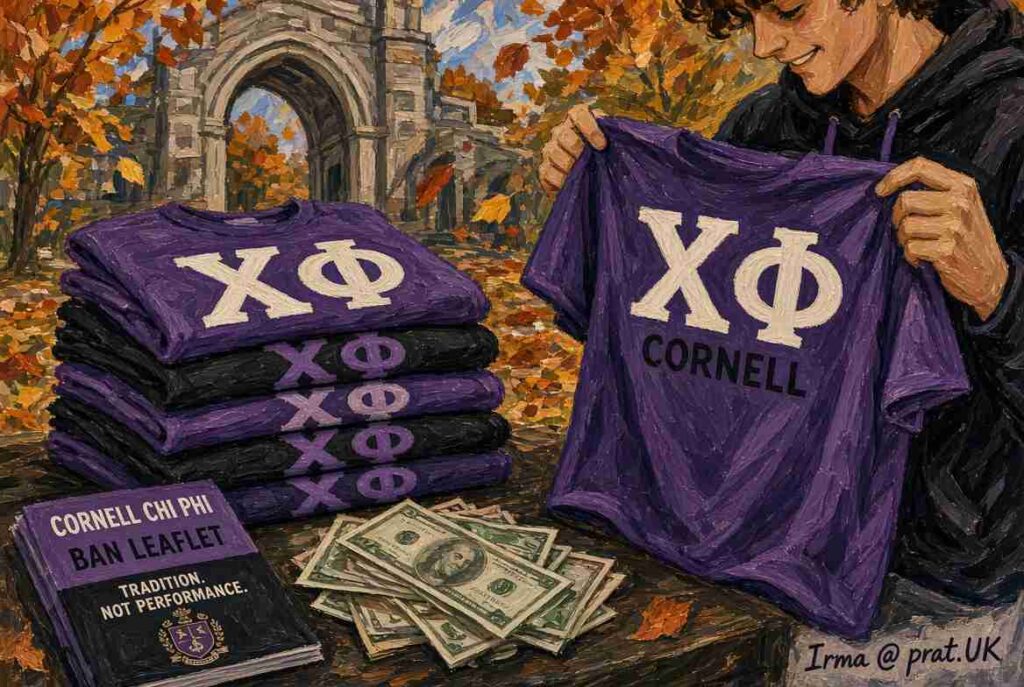
Cornell is one of America’s elite Ivy League universities, where young adults study economics under distinguished professors. This week they can also watch economics happen outside. Demand rises when scarcity rises. Attention raises awareness. Social pressure sometimes produces counterpressure. And forbidden fruit remains the only fruit with its own marketing department.
Should shirts genuinely start selling faster because of the controversy, the irony would be hard to beat: a university full of world-class scholars accidentally demonstrating introductory economics with sweatshirts. Adam Smith would be proud. Then he’d ask whether they had his size.
Guilt by Association: The Serious Point Beneath the Satire
The merchandise gag works because something real sits underneath it. The Cornell dispute shows the danger of swapping individual evidence for association. Former members who weren’t students when the alleged 2024 incident took place say their past membership has led strangers to connect them with accusations they had nothing to do with. Their attorney says some have faced threats and consequences at work or school.
Meanwhile, Cornell’s Student Assembly voted unanimously last week, according to Reuters, to ask administrators for a full account of how the investigation was handled, the discipline handed to the accused students, and yearly reports on future misconduct cases. The university has also brought in Sally Yates to lead an outside review, and New York’s attorney general is now overseeing the criminal side. Transparency and due process are not enemies. Everybody in this story could use more of both.
That makes the calendar joke more than a joke. Individual responsibility requires individuals. Belonging to an organization in one year doesn’t establish that you took part in an event two years later, or every former McDonald’s employee would be on the hook when somebody forgets the fries. It cuts the other way too. A group’s reputation doesn’t clear its individual members, and an accusation doesn’t convict them. That job belongs to courts. America occasionally needs reminding that guilt is not a group subscription.
Chi Phi Becomes Counterculture: Mother, Father, I Reject Your Bourgeois Expectations
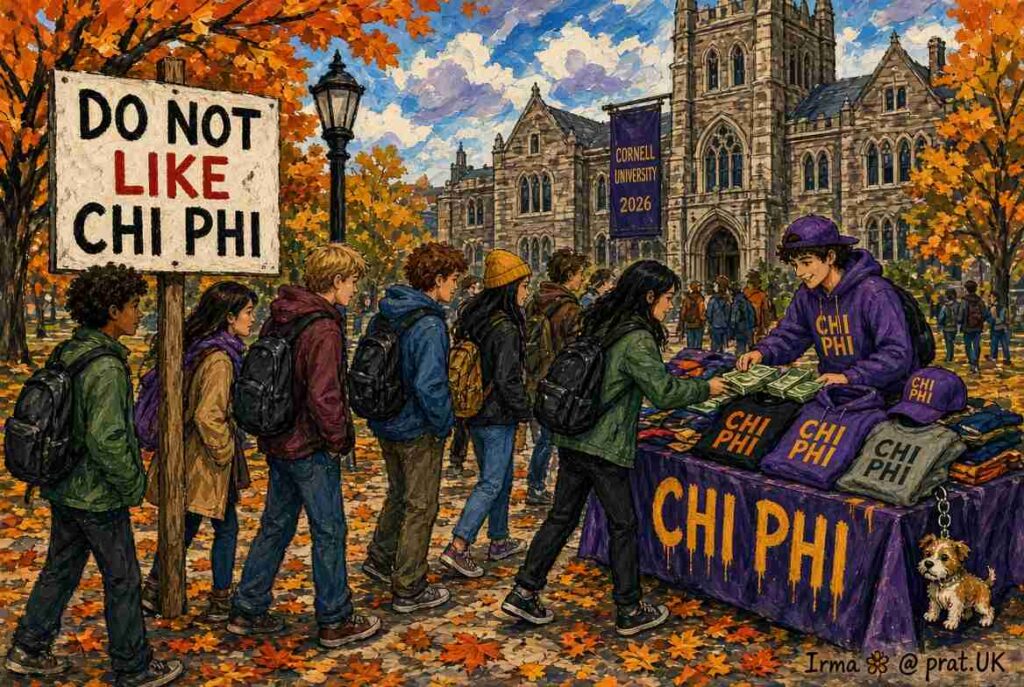
The final irony is a good one. Fraternities used to be the establishment. Old buildings, old traditions, old alumni, and old photographs of men whose haircuts suggested electricity had only recently been discovered. Now the controversy has pulled off the strangest cultural reversal imaginable. The fraternity shirt is rebellious.
Somewhere on campus a young man is presumably disappointing his parents by wearing the apparel of an organization founded in 1824. That’s an extraordinarily American way to rebel.
“Mother, Father, I reject your bourgeois expectations.”
“What are you doing?”
“Wearing nineteenth-century Greek letters.”
“Please come home.”
“No.”
And so Chi Phi may land the ultimate campus makeover. Not respectable. Not condemned. Cool. Which is probably the worst possible outcome for everyone trying desperately to make it uncool.
Disclaimer: This is satire built around publicly reported developments involving Cornell University, Chi Phi and former fraternity members seeking to have their names publicly distinguished from allegations concerning a 2024 incident. The premise that Cornell Chi Phi shirts have suddenly become the #1 bestselling merchandise on Amazon and Etsy is comic exaggeration, not a verified sales ranking. Real Chi Phi merchandise is sold online, including through Etsy sellers and official fraternity merchandise stores. Nothing here determines the truth of unresolved allegations or assigns guilt to anyone. That job belongs to investigators, courts, evidence and, apparently now, calendars. This story is entirely a human collaboration between two sentient beings, the world’s oldest tenured professor and a philosophy major turned dairy farmer, both of whom agree that due process is important and that putting Greek letters on a $30 cotton shirt remains one of capitalism’s most reliable methods of converting controversy into laundry.
10 Humorous Observations on the Chi Phi Merchandise Boom
- The modern rebellion has become incredibly convenient. Previous generations occupied administration buildings. Generation Z can overthrow authority using Apple Pay.
- Nothing says dangerous counterculture anymore like a $29.95 Comfort Colors tee available in six pastels.
- Cornell spent decades making its name valuable through academic prestige. Chi Phi may have discovered the cheaper strategy: become controversial on social media for nine days.
- The quickest route from “avoid that fraternity” to “where can I get the hoodie?” is apparently three viral hashtags and one cease-and-desist letter.
- Former members asking Cornell to distinguish people who graduated before the alleged 2024 incident from people actually present demonstrates something revolutionary in internet discourse: calendars.
- Online sleuthing has developed such forensic sophistication that apparently the question “Was this person still a student?” can arrive somewhere around Phase Seven.
- A Cornell diploma can cost hundreds of thousands of dollars. A Chi Phi shirt costs about thirty bucks and may currently generate considerably more conversation at brunch.
- The ultimate fraternity recruiting strategy may now be refusing to recruit anyone. Nothing creates demand quite like making an organization inaccessible.
- College administrators once worried fraternities were too popular. Modern university administration has solved this problem by making them controversial enough to become interesting again.
- If the trend continues, Cornell’s business school may have to teach the case study: “Brand Rehabilitation Through Being Yelled About by Everyone Simultaneously.”

Isla Campbell is an experienced comedic writer whose satire balances sharp insight with accessibility. Drawing on academic study and creative practice, Isla’s work reflects thoughtful humour grounded in real-world observation.
Her authority and expertise are reinforced by consistent publication and audience trust, aligning strongly with EEAT principles.