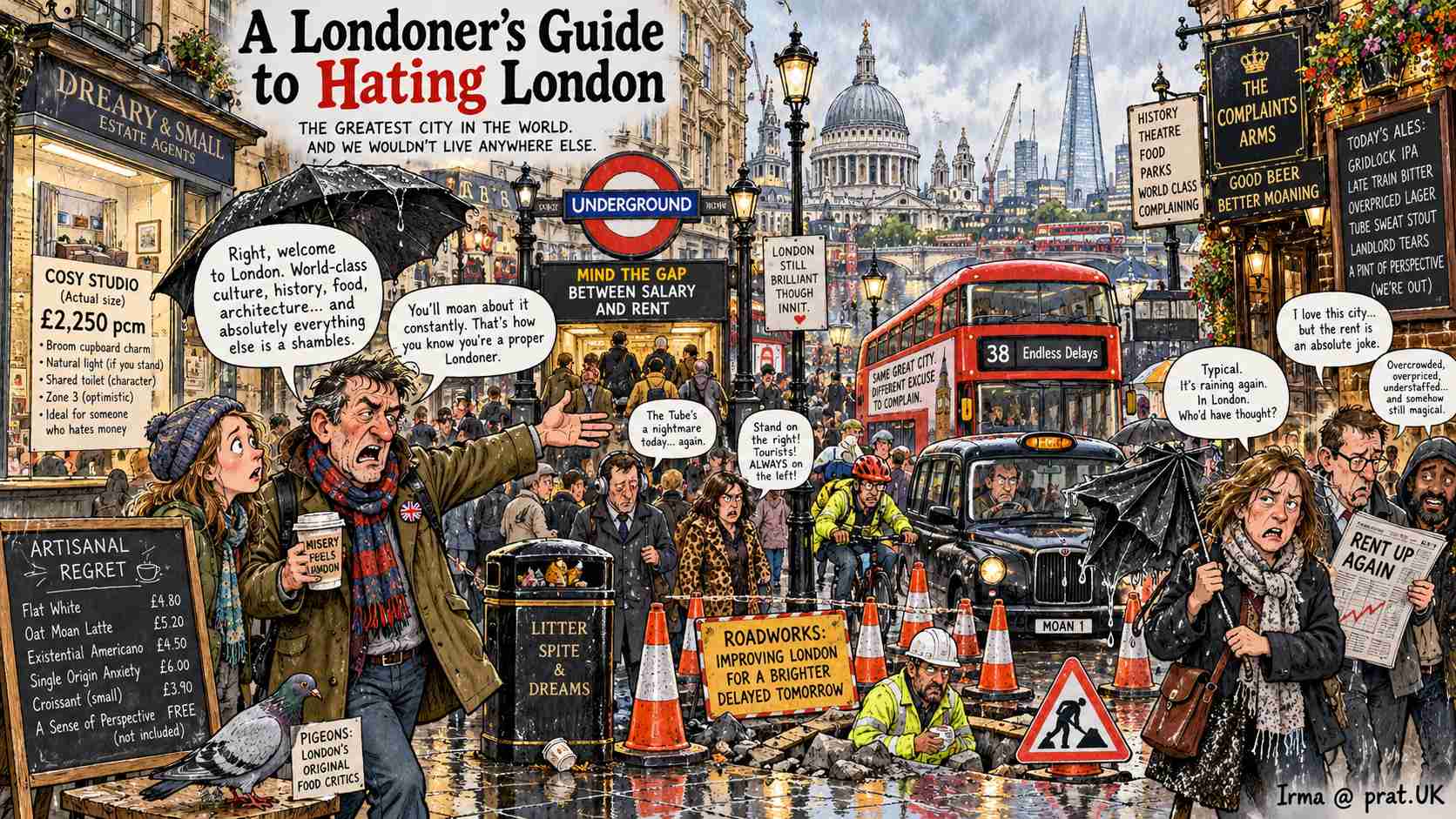
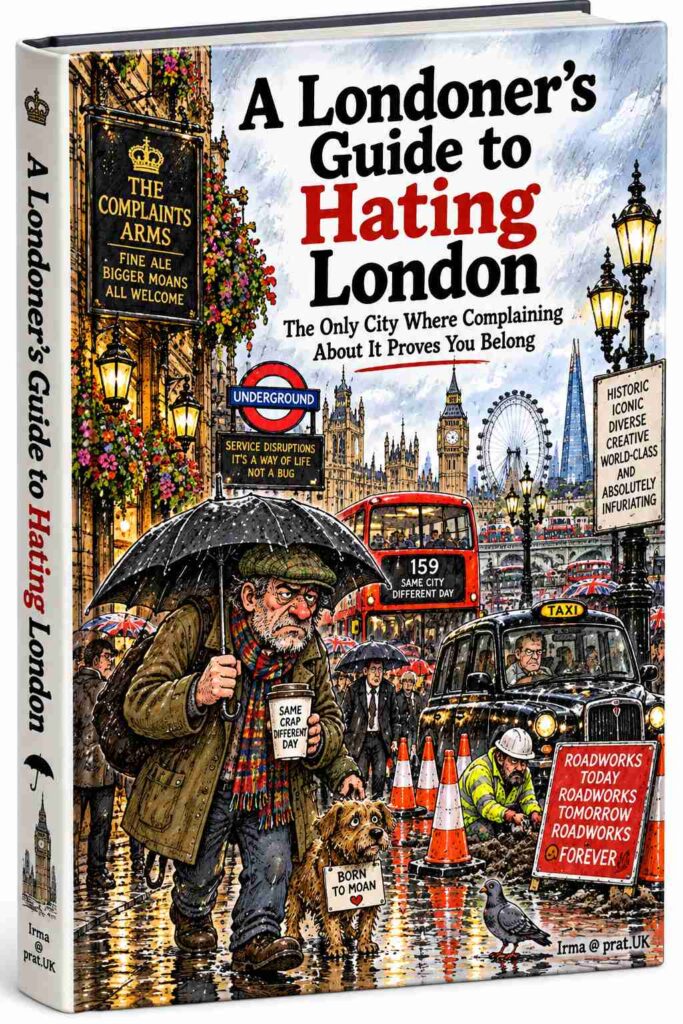
A Londoner’s Guide to Hating London: The Only City Where Complaining About It Proves You Belong
The capital remains one of the world’s greatest cities, which is exactly why Londoners demand the constitutional right to complain about every square inch of it
LONDON — The Financial Times has examined that most ancient of metropolitan traditions: Londoners hating London while simultaneously becoming personally offended whenever somebody from Manchester agrees with them.
The distinction is important. A Londoner may describe the capital as an overcrowded, rain-dampened financial punishment chamber where £9 buys you coffee and the privilege of standing near a chair. But if a visitor from Leeds says, “Yes, London’s awful,” the Londoner immediately replies, “You wouldn’t understand.”
Welcome to London, where hatred is not the opposite of civic pride.
It is civic pride.
Read the Financial Times essay on Londoners hating London
Londoners hate London
- Londoners hate London, but outsiders are not licensed to hate London. Criticism is a residents-only amenity, presumably included somewhere in the council tax.
- The Tube is simultaneously magnificent and unacceptable. It can move millions of people around a 402-kilometre network, yet one man standing on the left side of an escalator can bring British civilisation to the brink.
- A London flat is no longer housing. It is a subscription service for remaining indoors. The average London private rent reached £2,332 a month in August 2026.
- London property advertisements have developed their own language. “Cosy” means your knees touch the opposite wall. “Characterful” means wiring installed during the Boer War.
- Londoners complain about tourists while voluntarily living beside Buckingham Palace, Westminster Abbey, Tower Bridge and the entire international tourism industry.
London Rent in 2026: Londoners Discover Complaining Is Their Most Affordable Hobby
The great achievement of London is that it can provide almost anything a person wants except the feeling that he is getting his money’s worth.
Art? Everywhere.
History? Under your feet.
Restaurants? Thousands.
Museums? World-class.
Rent?
That will be £2,332 a month, please.
And that’s the average, according to the latest Office for National Statistics figures. Kensington and Chelsea reached an average £3,690 monthly rent in August.
See the latest official ONS London rent figures
At £3,690 a month, the landlord ought to tuck you into bed.
For that money, there should be a concierge whose only responsibility is whispering, “You made excellent life choices.”
Instead you get an estate agent explaining that the bedroom’s unusual trapezoidal shape provides “flexible lifestyle opportunities.”
The flexibility is that you can either own a wardrobe or enter the room.
London Underground Facts: Engineering Miracle, Emotional Crime Scene
Transport for London says the Underground has 11 lines, 272 stations and handles up to five million passenger journeys a day.
Which is extraordinary.
Londoners respond to this engineering miracle by becoming furious because the Northern line is four minutes late.
No other technology gets judged this way.
If NASA landed astronauts on Mars but arrived four minutes behind schedule, London commuters would be standing at Mission Control going:
“Typical.”
The Tube also forces strangers into physical intimacy that would ordinarily require dinner, champagne and several signed consent forms.
At 8:17 on the Central line, you can know a complete stranger more intimately than several cousins.
You don’t know his name.
You don’t know where he works.
But you’ve been pressed against his left kidney since Shepherd’s Bush.
And now TfL is expanding mobile coverage underground, with around 60 per cent of underground stations covered as of June and full-network connectivity targeted by year-end.
This represents enormous technological progress.
At last commuters trapped beneath London will be able to send messages saying:
“Still trapped beneath London.”
London Tourists: Why Londoners Hate Visitors for Making London Popular
London tourism creates a fascinating psychological conflict.
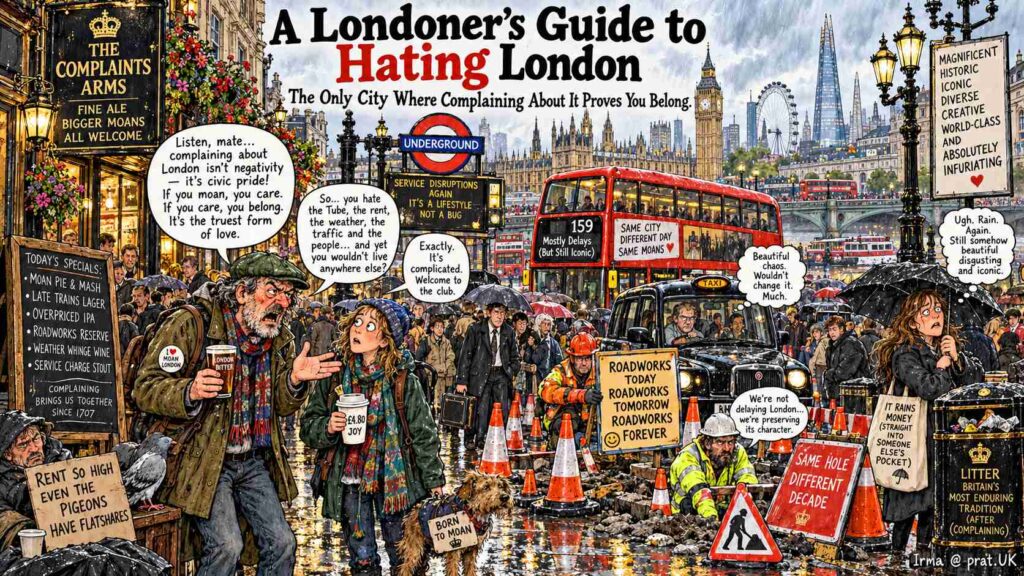
Londoners want their city recognised as the greatest metropolis on Earth.
They simply don’t want anyone to visit it.
Tourists are welcomed in the abstract.
In person, they’re treated as slow-moving street furniture.
The tourist’s principal offence is stopping suddenly.
A visitor walking down Oxford Street may notice Big Ben, a red bus or a building constructed before his home country existed and naturally pause to admire it.
Behind him, a Londoner immediately experiences what medical science classifies as pedestrian rage.
“MOVE.”
Where to?
Doesn’t matter.
Possibly Belgium.
The chief London walking rule is that you must always look as though you’re late for something, even on Sunday.
A person strolling leisurely through Bank at 8:30am attracts the sort of suspicion normally reserved for abandoned luggage.
London Nostalgia: Everything Was Better Before You Arrived
The FT’s Bryce Elder writes about London’s peculiar nostalgia, including Ain Bailey’s Waterloo Station installation recalling lost community spaces and venues. The underlying emotion is familiar: the city constantly changes, and Londoners constantly mourn whatever vanished most recently.
This produces London’s most powerful historical principle:
Everything good closed.
There was apparently once a pub in Soho where Francis Bacon drank with David Bowie while Mick Jagger operated the jukebox and pints cost 11p.
Nobody remembers the address.
It’s now probably a branch of something.
London nostalgia operates according to a strict timetable.
When a café exists, nobody notices it.
When it announces closure, everybody reveals they have loved it passionately for 31 years.
“I can’t believe Antonio’s is closing.”
“When did you last go?”
“2008.”
“This is gentrification.”
The café owner, meanwhile, has been waiting since 2014 for you to come back and buy another omelette.
London Property Market: The Sacred Estate Agent Ritual
Property is where casual London complaining becomes theology.
Every social gathering eventually arrives at housing.
You can begin with Ukraine, artificial intelligence, Shakespeare or the existence of God.
Seven minutes later:
“So what are you paying?”
Londoners discuss square footage the way medieval monks discussed salvation.
One person announces that he has purchased a “two-bedroom” flat.
Congratulations follow.
Then photographs appear.
The second bedroom contains a printer.
“Could be a nursery.”
For what?
A hamster?
The ingenious London estate agent can turn architectural defects into personality traits.
Basement = garden-level residence.
No garden = low-maintenance outdoor lifestyle.
Next to railway = excellent transport connections.
Above nightclub = vibrant location.
Kitchen in bedroom = open-plan.
Toilet on roof = probably £2.1 million in Shoreditch.
London Tube Congestion: Everyone Off the Train Except Me
The most fascinating feature of London congestion is that everyone believes the congestion consists entirely of other people.
Nobody has ever boarded a crowded Tube and thought:
“I am contributing to this.”
No.
They are contributing to it.
Look at them.
Standing there.
Travelling to jobs.
Selfish bastards.
TfL recorded about 1.18 billion Underground passenger journeys in 2025-26, according to its year-end performance report.
Read Transport for London’s official network information
Statistically, therefore, London’s most abundant natural resource may be people wondering why there are so many people.
London Pub Prices: Seven Quid a Pint Because Leaving Is Worse
The London pub has solved an extraordinary business problem.
Customers complain continuously about the prices and then remain there for five hours.
“Seven quid for a pint!”
“Disgusting.”
“You leaving?”
“No, get me another.”
That’s not consumer resistance.
That’s Stockholm syndrome with crisps.
London pub economics depends upon one profound insight: eventually the customer calculates what it would cost emotionally to find another pub.
There’s walking.
Possibly rain.
Google Maps.
A crossing.
Maybe the next place doesn’t have a table.
Suddenly £7 seems reasonable.
Make it two.
London Etiquette: Nobody Wants to Speak to Anybody, Which Is Why London Works
Visitors sometimes complain that Londoners seem unfriendly.
Incorrect.
Londoners are extremely friendly.
They demonstrate friendship by leaving you alone.
The greatest gift one Londoner can give another is complete indifference.
Suppose you sit beside somebody on the Tube wearing a Viking helmet while carrying a cello and a stuffed badger.
Nobody asks questions.
This is civilisation.
Try that in a small village and somebody will know your aunt by teatime.
London privacy isn’t coldness.
It’s a social contract.
You don’t acknowledge me having a nervous breakdown over my phone, and I won’t acknowledge that you’re eating sushi at 7:42 in the morning.
We are neighbours.
Is London Dying? The City Keeps Getting Bigger Anyway
Every generation believes it witnessed the last authentic London.
The previous generation ruined it.
The next generation definitely will.
This is convenient because it permits everyone to experience themselves as the final curator of civilisation.
“My London is gone.”
Which London?
“1997.”
A seventy-year-old overhears this and laughs.
1997?
London died in 1973.
An eighty-five-year-old hears that and nearly spills his tea.
1973?
By then the place was finished.
Presumably archaeologists will eventually discover a Roman tablet beneath Bank station reading:
LONDINIUM NOT WHAT IT USED TO BE. TOO MANY NEW PEOPLE. WINE RIDICULOUSLY EXPENSIVE.
(Those same archaeologists will helpfully note that Londinium was founded by newcomers, which is the sort of detail no resident wants on a plaque.)
Why Londoners Stay: The Ultimate London Paradox
And yet they stay.
That’s the clue.
People complain about London because they have expectations of it that they wouldn’t bother applying elsewhere.
You don’t complain that a motorway service station has lost its cultural vitality.
Nobody mourns the changing artistic character of Junction 14.
London gets criticised because people remain emotionally invested in the impossible proposition that a city of millions should somehow remain exactly as it was during their favourite decade.
It should evolve, but not change.
Grow, but not become crowded.
Build houses, but not near them.
Attract talent, but stop attracting newcomers.
Have successful restaurants, but always provide a table at 7:30.
Maintain world-class public transport, but please remove everyone else from it.
Remain internationally famous, but discourage tourists.
And preserve that tiny pub around the corner forever, despite the fact they themselves haven’t bought a drink there since Gordon Brown was prime minister.
That isn’t hatred.
That’s marriage.
London and Londoners have been together too long to bother pretending everything is wonderful.
They know each other’s faults.
London knows its residents will complain.
Its residents know London will take half their salary, close their favourite pub, delay their train, soak them with rain and then unveil a £6.80 artisanal sausage roll where the pub used to be.
And tomorrow morning millions of them will get back on the Tube.
Grumbling.
Because they wouldn’t dream of letting anybody else have their seat.
How to Hate London Properly: A Practical Guide for Residents
True London-hating requires discipline. Never merely say London is expensive. Quote your rent and allow witnesses several seconds to recover. Never say the Tube is useless while standing in a station from which trains depart every three minutes. Never walk slowly unless you’re prepared for a financial analyst from Clapham to attempt to overtake you through a hedge.
Most importantly, when somebody from outside London criticises the city, defend it immediately.
That’s the rule.
You may call London overcrowded, overpriced, exhausting, dirty, pretentious and occasionally ridiculous.
But when somebody from Birmingham says it?
“Steady on, mate.”
Because hating London isn’t really hatred.
It’s London’s strangest membership card.
And naturally, membership costs £2,332 a month.
Plus service charge.
10 Observations Every Proper London-Hater Understands
- Every London pub allegedly used to be better. The best pub in Britain apparently closed six months before you moved to the neighbourhood.
- A Londoner considers £7 for a pint robbery, then buys a second one because walking somewhere cheaper would require changing Tube lines.
- Everyone hates Pret until Pret disappears. Then the closure is described as the destruction of the neighbourhood’s cultural fabric.
- London weather has perfected indecision. It doesn’t rain hard enough to justify staying home. It rains just enough to make everything you planned irritating.
- No London journey takes 20 minutes. Google Maps says 20 minutes. London says, “Interesting theory.”
- Londoners complain that nobody talks on the Tube, because the alternative would involve somebody talking to them on the Tube.
- Every neighbourhood becomes unbearable exactly three years after the speaker moved there. Before that, it was authentic. Afterwards, there were too many bakeries selling sourdough to dogs.
- The capital is constantly disappearing. Every closed nightclub, café and greasy spoon becomes a beloved cultural institution approximately fourteen minutes after shutting.
- London is supposedly impossible to afford, impossible to navigate, impossible to tolerate and impossible to leave. This suggests somebody is lying, although nobody has enough room in their flat to conduct the investigation.
- The fundamental London complaint is not “London is terrible.” It is “London was perfect shortly before everyone else discovered it.”
Satirical Disclaimer
This is satire. The serious statistics cited above come from published sources; the overheated deductions, emotionally traumatised estate agents, metropolitan theology and suggestion that a printer qualifies as a second bedroom belong to comedy. In keeping with the publication’s running gag, the story may be ceremonially described as the entirely human collaboration of two sentient beings, the world’s oldest tenured professor and a philosophy major turned dairy farmer. Any resemblance to an actual London property listing advertising a cupboard as a “bijou wellness retreat” is probably inevitable.
SOURCE: https://www.ft.com/content/c8407fb6-6134-4b2c-a428-d3a998873383?shareType=nongift

Staff Writer at The London Prat