Burnham Backs Beer in the Stands, Police Ask Whether Anyone Has Actually Met a Football Supporter After Three Pints
Prime Minister eyes reform of the football alcohol ban as Britain readies its boldest social experiment since somebody looked at beans and thought, right, those go on toast
LONDON — Britain has embarked on perhaps its most ambitious social experiment since central heating. Prime Minister Andy Burnham has questioned the rules preventing supporters at designated men’s football matches from drinking alcohol within sight of the pitch, arguing that football fans are treated differently from spectators at sports such as rugby. The dispute was reported here by ESPN.
The restriction comes from the Sporting Events (Control of Alcohol etc.) Act 1985. Burnham says football and stadium management have changed substantially since then, and has suggested reform could be tested through trials. The Football Supporters’ Association supports a review, while the UK Football Policing Unit says alcohol still contributes to disorder involving a minority of supporters and argues that any change requires careful examination. Thus Britain has arrived at its natural governing position. Gary may perhaps have a beer, but first there shall be a consultation.
Burnham Supports Beer in the Stands
- Britain is the only country capable of treating a pint of lager as a national security threat purely on the basis of where it is standing.
- The 1985 Act has outlived shoulder pads, the Berlin Wall, and three England managers who all promised a settled back four.
- Women’s football scrapped the same ban with no incidents whatsoever, which is the single most humiliating stat in the entire men’s game this decade.
- Gary can manage a payroll of sixty-three people Monday to Friday, then spend Saturday convinced a professional referee cannot see what he can see from row 42.
- Nobody has ever complained about the price of a pub pint the way they complain about a stadium pint, despite both funding roughly the same landlord’s holiday.
Scientists Confirm Lager Becomes Aggressive the Moment It Meets a Football Pitch
The great peculiarity of the football alcohol ban is geographical, not chemical. A supporter may buy a beer inside the concourse and drink it beside a concrete pillar while discussing Everton’s midfield. Perfectly civil. Perfectly civilised. But that same supporter cannot carry the same pint to a seat from which he can see the match during the restricted period, which suggests British law believes alcohol has developed a visual cortex. Behind the concrete wall, it is beer. Within sight of the pitch, apparently, it becomes something closer to ordnance. The lager has seen grass. Nobody in Whitehall seems entirely sure what happens next, though the leading theories involve hops turning territorial and yeast developing tactical opinions about a back three.
The Football Alcohol Ban and Britain’s National Sport of Unequal Treatment
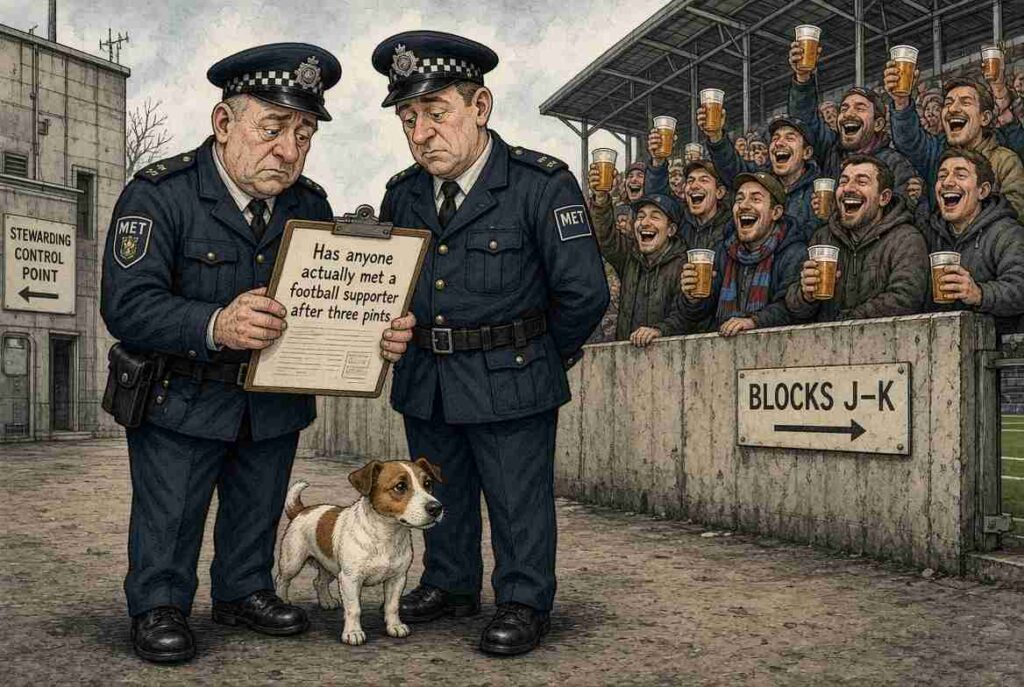
Burnham’s case is essentially about inconsistency between sports, and this is where the row becomes gloriously, unmistakably British. You may drink while watching rugby. You may drink while watching cricket. At some grounds you may drink from the very same seats during a concert. Football supporters, meanwhile, have long been told: you may purchase your eight-pound pint, sir, but you must drink it over there, facing the emergency exit signage. Football has therefore built a genuinely unique luxury product: a drink expensive enough to require a repayment plan yet forbidden from accompanying you to the event you bought it for. The Football Supporters’ Association has pointed out that a fan can sit in the same seat with a pint during an Oasis gig or a rugby league fixture, but not for football. Apparently Liam Gallagher neutralises lager. Science has yet to explain the mechanism, though a parka is thought to be involved.
At 2:57pm Gary Is an Accountant. By 3:01pm He Is Napoleon of Block 127
The football alcohol ban also rests on a fascinating theory of human transformation. Picture Gary: 48, works in accounts receivable, drives a Kia, owns a leaf blower he discusses with unsettling enthusiasm. At 2:57pm Gary is drinking peacefully. Then kick-off happens. A defender attempts a back pass, the goalkeeper fumbles it, and according to four decades of football regulation, society must at least entertain the possibility that Gary is about to become Napoleon Bonaparte of Block 127. “What was Dyche thinking?” Gary is no longer irritated. He is commanding the Grande Armée. Three stewards quietly reinforce Belgium. This is the trouble with football: nobody has ever calmly disagreed with a substitution. A man who manages payroll for sixty-three staff all week will spend Saturday convinced that a professional referee standing twelve yards from the incident missed something Gary spotted from row 42 with a pie in one hand. Alcohol did not invent that condition. Football did.
Why a 1985 Law Still Governs the Football Alcohol Ban
The restrictions date from an era when football violence was a genuine national emergency, and the 1985 Act still governs alcohol at designated matches in England and Wales, including consumption in sight of the pitch during the restricted period. 1985 was, to put it gently, a different country. Mobile phones were science fiction. Smoking indoors passed for central heating. Shoulder pads required planning permission. Stadium safety, policing and stewarding bear little resemblance to many modern grounds, and the English Football League has said it would welcome a review of legislation that has not kept pace with how football is actually run today. But Britain does not casually discard an old regulation. We put it in a drawer, next to three SCART cables, a Nokia charger and a key nobody recognises. “Can I throw this away?” No. “What does it open?” Nothing we currently own. “Then why keep it?” Because one day we might need it. This is, roughly, how nations acquire constitutional traditions.
Police Answer the Football Alcohol Ban Debate With Britain’s Most Powerful Counter-Argument: Have You Met Football Supporters?
The UK Football Policing Unit supplies the obvious complication: football is not simply rugby with shin pads. A spokesman said other sports do not experience the same violence and criminal behaviour from supporters, though involving a minority, and said alcohol can play a significant role in disorderly conduct. Police want the evidence examined fully before any change to the football alcohol ban is made, and it is not an unreasonable position. Burnham’s folder reads modern, responsible football supporter. The police folder reads things we have seen outside train stations. Burnham says most people can handle a pint. Police reply, in effect, allow us to introduce Exhibit 47. The debate is not really about whether most fans behave. Plainly they do. The problem is that crowd law is inevitably written with an eye on the gentleman who has had eight lagers and now considers Wolverhampton Wanderers’ league position a matter of personal honour.
Britain Prepares the Trial: Testing the Football Alcohol Ban on Gary
Burnham has floated formal trials, and frankly Britain could use some controlled experimentation. Take five thousand supporters, give half access to beer in their seats and half the usual stadium soft drinks, then observe. Researchers could track the volume of unsolicited tactical advice, the frequency of shouted appeals to the referee, and the rate at which someone insists an assistant referee needs spectacles despite standing directly in line with the incident. At one pint, Gary discusses the formation. At two, he questions the manager. At three, he believes the manager can hear him. At four, he is issuing transfer instructions to the chairman by what can only be described as telepathy. At five, Gary has drawn up a full rebuild of the squad using seventeen million pounds, three academy prospects and that lad from Brentford. This is not drunkenness. This, Gary would insist, is football analytics.
The Women’s Game Already Scrapped Its Own Football Alcohol Ban, and Behaved Itself
There is already relevant evidence, because the women’s professional game has never operated under the same restriction. A pilot involving four Women’s Championship clubs covered nineteen fixtures and more than 51,000 supporters in the 2024-25 season. According to reporting from TheStadiumBusiness, the trial expanded to fourteen clubs across the WSL and WSL2 the following season with no reported safety incidents, and from 2026-27 WSL and WSL2 clubs have been permitted to allow alcohol within sight of the pitch as standard. This is awkward news for men. Somewhere there is a government press conference waiting to happen in which a minister explains that women have demonstrated an ability to drink a Chardonnay while watching a disputed penalty without attempting to annex Belgium, before turning slowly to a folder marked DARREN and admitting the men’s data is still being collected. Nothing could wound male football pride more thoroughly than learning that women can hold a drink and understand the offside rule at the same time.
How Beer Achieved Premier League Transfer Valuation
Then there is the money. If alcohol returns more broadly to the seats, clubs will rediscover a remarkable phenomenon: a supporter who complains bitterly about a four-pound supermarket lager will happily pay stadium prices because the same drink arrived through a hatch seventeen metres from a turnstile. Pint, eight pounds. Pie, seven pounds. Programme, five pounds. Four drinks for your mates, consult a mortgage adviser. Somebody will eventually tap a card, glance at the total and mutter that for that money the club could have signed a right-back. Football economics remains the only field in which nine pounds for a beer is outrageous but thirty-eight million for a midfielder who cannot defend a corner is probably worth the gamble.
The Great British Compromise: Have a Pint and Behave Yourself
The funniest possibility is that Britain may spend years on trials, reports, consultations with police, clubs, supporters and local authorities, and a Select Committee on Beverage Visibility, before landing on a genuinely revolutionary conclusion: adults may sometimes be trusted with a drink, provided they do not behave like idiots. This has never been attempted in Britain before, except in roughly thirty-nine thousand pubs. The instructions would be simple enough. Have a pint, watch the football, do not throw anything, do not throw a punch, and do not invade the pitch because somebody’s knee was marginally ahead of somebody else’s shoulder. If it works, Parliament could extend the scheme nationwide, and by 2065 Britain might unveil its most ambitious sporting reform to date, formally titled Having a Pint and Behaving Yourself, complete with approved vessels incapable of being converted into medieval siege equipment and designated alcohol-free sections for the truly combustible fixtures. The central joke would remain intact regardless. Burnham’s mental picture of the fan is one peaceful pint. The police picture is Gary three hours later attempting to explain the Peloponnesian War to a mounted officer because Everton conceded in stoppage time. Both Garys exist, which is precisely why this argument suits Britain so well. It manages to combine football, alcohol, personal liberty, public order, class assumptions, bureaucracy, stadium pricing and the very British conviction that any disagreement can eventually be resolved by forming a working group. After forty years, football’s alcohol ban may return to where it began: not hooliganism, not prohibition, not a free-for-all, but something quietly radical. A pint. A seat. A match. And Gary, for once in his life, being asked to calm down about the referee.
Comedian Terry Hobb put it best on his podcast last week: “We banned pints at the football because of the eighties, and we kept the ban going for forty years because of the nineties, the noughties, and a general national reluctance to admit a mistake out loud.”
Andy Burnham became Prime Minister in 2026 after a long career in Labour politics, including two terms as Mayor of Greater Manchester, and has previously spoken about football’s cultural importance to the towns and cities he has represented. The 1985 alcohol restrictions were introduced after a decade of serious crowd violence at English football grounds, most notably the Heysel Stadium disaster, and have remained largely unchanged even as stadium safety, all-seater grounds and CCTV stewarding transformed the matchday experience. The Football Supporters’ Association and the English Football League have both indicated openness to a review, while the UK Football Policing Unit has asked for a full examination of the evidence before any change is made. Trials in the Women’s Super League, which is not covered by the 1985 Act, have run since 2024 without reported safety incidents.
This article is a work of British satire, drawing on a real policy debate and treating it with the exaggeration British satirical journalism is known for. Readers looking for more UK satirical news can find it, appropriately, right here.
Sources
ESPN: UK PM Burnham wants football drinking ban scrapped
Legislation.gov.uk: Sporting Events (Control of Alcohol etc.) Act 1985
The Stadium Business: More WSL clubs to trial sale of alcohol in stands
More British satirical journalism continues over at Bohiney.com, our American cousin in satire.
Auf Wiedersehen, amigo!

Alan Nafzger was born in Lubbock, Texas, the son Swiss immigrants. He grew up on a dairy in Windthorst, north central Texas. He earned degrees from Midwestern State University (B.A. 1985) and Texas State University (M.A. 1987). University College Dublin (Ph.D. 1991). Dr. Nafzger has entertained and educated young people in Texas colleges for 37 years. Nafzger is best known for his dark novels and experimental screenwriting. His best know scripts to date are Lenin’s Body, produced in Russia by A-Media and Sea and Sky produced in The Philippines in the Tagalog language. In 1986, Nafzger wrote the iconic feminist western novel, Gina of Quitaque. He currently lives in Holloway, North London. Contact: [email protected]