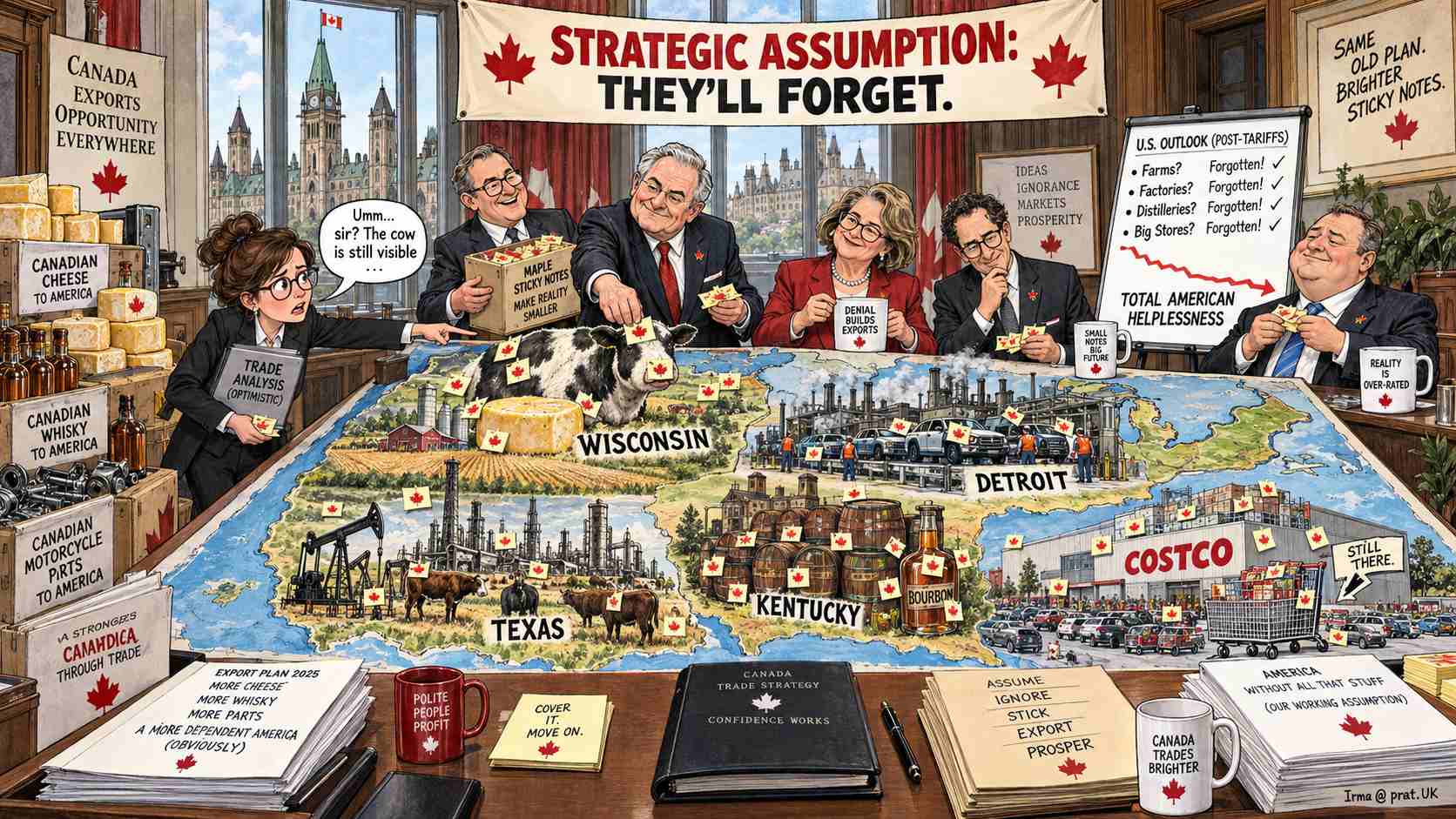
Canadian Trade Strategy Relies on Americans Forgetting They Have Farms, Factories and Liquor Stores
Ottawa unveils daring economic doctrine under which the United States remains helpless until somebody remembers Wisconsin, Kentucky, Detroit, Texas and the existence of Costco
Canada’s increasingly muscular trade strategy toward the United States appears to depend on one crucial assumption: at some point during the dispute, approximately 340 million Americans will collectively forget that their country contains farms, factories, distilleries, supermarkets, oil wells, automobile plants and several people who know how to make cheese.
The dispute is real. According to reporting from The Hill, the United States announced that, beginning September 29, it would ban imports of certain Canadian dairy products, motorcycles and most alcoholic beverages as the trade confrontation between Washington and Ottawa escalates. Canada had previously imposed retaliatory tariffs on $20 billion in American products. Everything below this point is satire.
Prime Minister Mark Carney has argued that Canada must become less economically dependent on the United States and expand trade elsewhere, an understandable long-term goal made somewhat urgent by the inconvenient statistic that roughly 68 percent of Canadian exports currently go to the United States.
Canadian policymakers remain optimistic.
“We believe Americans will eventually realize how much they need us,” explained one imaginary trade strategist while standing beside a map on which Wisconsin had apparently been covered with correction fluid.
Reporters asked about American farms. The strategist changed slides.
Ottawa Discovers America Has Agriculture
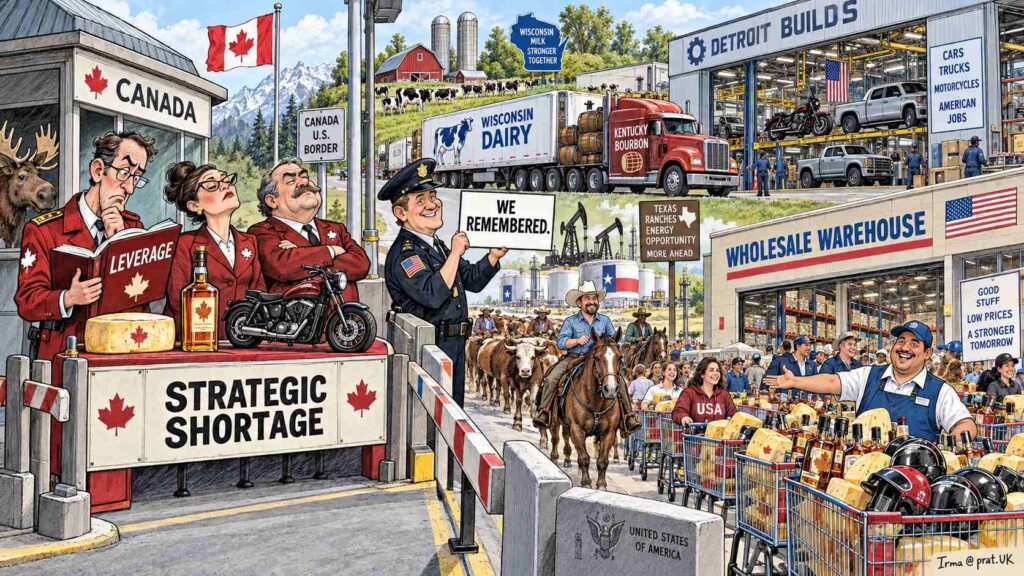
The first problem with using dairy as a strategic weapon is that the United States appears to have discovered agriculture. Nobody knows exactly when this happened. Historical records suggest Americans may have been farming for some time.
Wisconsin alone presents difficulties for the Canadian theory. Wisconsin has so successfully associated itself with cheese that its residents occasionally wear wedges of imitation cheese on their heads while watching football, an agricultural branding strategy so effective that no Canadian government task force has yet found a response.
California has dairy farms. New York has dairy farms. Idaho has dairy farms. Pennsylvania has dairy farms. Texas has cows seemingly assigned to every available square mile not already occupied by a pickup truck.
This forces Canadian trade officials to confront the dangerous economic concept known as substitution. Substitution occurs when a consumer cannot purchase Product A and responds by buying Product B instead of collapsing emotionally beside the refrigerated section.
Ottawa economists are studying this phenomenon. Early research suggests Americans denied one brand of cheddar may simply buy another cheddar. Government officials have described the findings as disturbing.
Canadian Cheese Embargo Meets American Cow
Approximately nine million American dairy cows have reportedly demanded recognition in future bilateral negotiations. Their complaint is straightforward. Canada keeps discussing dairy leverage as though America’s milk supply arrives each morning through a pipeline from Quebec.
“We’re standing right here,” said Margaret, a Wisconsin Holstein elected unanimously by a sample consisting entirely of herself. Margaret then ate grass for twenty minutes, which analysts noted was still more economically productive than the average trade summit.
The American cattle coalition has proposed a new advertising campaign: AMERICA, NOW WITH COWS. A second advertisement is being tested: HAVE YOU TRIED LOOKING BEHIND THE BARN?
Public response has been strong, particularly among farmers who were previously unaware their existence had become an international negotiating question.
Factories Also Discovered
Dairy was not the only surprise. Officials examining the motorcycle dispute discovered America also contains factories. This finding has caused particular embarrassment because Harley-Davidson remains an American company despite repeated attempts by globalization to make every manufactured object geographically incomprehensible.
The company recently announced plans to return additional motorcycle production to facilities in Pennsylvania and Wisconsin, with its York plant expected to produce more than 100,000 motorcycles in 2027. Thus a Canadian motorcycle squeeze risks forcing Americans into the nightmare scenario of purchasing motorcycles manufactured in Pennsylvania.
Workers at Harley-Davidson were reportedly briefed on the Canadian threat. One employee listened carefully. “So what happens now?” “You keep making motorcycles.” “Okay.” The meeting adjourned three minutes early.
Ottawa’s strategic model had apparently assumed that Americans encountering a shortage of Canadian motorcycles would stare helplessly at empty driveways before adopting bicycles. Nobody had entered “Harley-Davidson exists” into the spreadsheet. The error has been corrected. It was blamed on Microsoft Excel.
Detroit Receives Late Notification That America Manufactures Vehicles
Canada’s larger automotive relationship with the United States is much more complicated. North American auto production is deeply integrated. Components cross borders repeatedly. Canadian factories employ thousands of workers producing vehicles and parts sold throughout the continent. Trade barriers can therefore hurt companies and employees on both sides. That is the serious part.
The comedy begins whenever politicians pretend international supply chains mean one side possesses all the cards. America still contains Detroit. It contains Michigan, Ohio, Indiana, Tennessee, Kentucky, Texas and a considerable number of factories where people wearing safety glasses make objects larger than government reports.
Even Bombardier, one of Canada’s most prominent manufacturers, illustrates how intertwined the two economies have become. The Canadian jetmaker says it works with 2,800 American suppliers across 47 states and spends billions with U.S. suppliers annually.
This means identifying which economy is “hurting the other” can sometimes resemble determining which Siamese twin won a fistfight.
Canada Deploys the Whisky Weapon
Then there is alcohol. Canada has already discovered the tremendous political satisfaction available from removing American liquor from provincial shelves. Jack Daniel’s maker Brown-Forman said this month that American spirits remained unavailable in most Canadian provinces amid the dispute.
Canadian officials presumably expected widespread terror below the border.
Kentucky heard the news around 4:17 p.m. By 4:18 p.m., Kentucky remembered bourbon. Tennessee remembered whiskey. California remembered wine. Texas remembered that regulations are sometimes regarded as suggestions. Florida could not immediately remember anything but volunteered to participate.
American liquor stores conducted inventories and discovered shelves containing bourbon, vodka, gin, tequila, rum, rye, Scotch, Irish whiskey and approximately fourteen flavored products nobody remembered ordering. The predicted collapse of American civilization was postponed.
A Kentucky bartender summarized the crisis. “So Canada might not sell us whisky?” Correct. “Would you like bourbon?” The North American geopolitical stalemate continues.
Ottawa Announces Plan to Replace America With Earth
Carney’s government wants to double Canadian exports outside the United States over the coming decade as part of a broader diversification strategy. Economically, diversification makes sense. Politically, it sounds magnificent. Canada will simply sell everything somewhere else.
The only obstacle is that America sits directly below Canada, contains one of the world’s largest consumer markets and can be reached from major Canadian industrial centers without crossing an ocean. Europe is farther away. Asia is also inconveniently elsewhere.
Canadian officials are believed to be lobbying plate tectonics. Under one proposal, British Columbia would move three inches toward Japan annually. Newfoundland has volunteered to meet Europe halfway. The Atlantic Ocean has refused comment.
The Costco Problem
Canada’s strategy faces another formidable institution rarely discussed in international relations textbooks: Costco.
Any economic theory based on Americans running out of ordinary consumer products must account for warehouses where citizens can purchase enough cheese, alcohol and household goods to survive a minor geological epoch.
Researchers sent into an American Costco to study strategic inventory returned four hours later with 48 rolls of paper towels, a rotisserie chicken and no explanation for what happened. “We went looking for Canadian leverage,” one researcher said. “We bought a kayak.”
This is why economic warfare becomes difficult between wealthy industrial countries. Modern consumers have alternatives. Businesses find suppliers. Farmers produce things. Factories manufacture things. Retailers stock things. Politicians then appear on television and behave as though civilization depends on whichever product has just acquired a tariff.
Trade Wars Still Have Real Victims
None of this means escalating barriers are painless. Quite the opposite. Import bans and tariffs can punish companies that built cross-border businesses under previous rules. Farmers can lose customers. Manufacturers can face higher component costs. Retailers lose products. Employees can lose jobs. Consumers may pay higher prices.
The United States and Canada spent decades integrating their economies precisely because specialization and trade frequently make both sides wealthier. Destroying portions of that relationship to demonstrate toughness can resemble burning down your garage to prove you are independent of your neighbor’s fire extinguisher.
Both countries have genuine leverage. Both countries can inflict real costs. And both countries are extraordinarily capable of hurting themselves while announcing victory.
Washington Discovers Canada Matters Too
Americans should not become intoxicated on their own abundance. Canada is an important supplier of energy, fertilizer, metals, lumber, automotive components and other goods embedded throughout American supply chains.
The idea that America can effortlessly replace everything Canada supplies would be just as silly as Ottawa assuming America cannot replace Canadian cheddar. Trade nationalism frequently produces symmetrical stupidity.
Each government announces: THEY NEED US. Neither government adds: Unfortunately, we also need them. That sentence polls poorly.
Canadian Strategy Awaits Mass American Amnesia
So Ottawa’s ultimate economic weapon remains psychological. Canada must wait. Eventually Americans may forget they possess farmland. Then they must forget their factories. Then Kentucky must forget bourbon. Wisconsin must forget cheese. Detroit must forget automobiles. Texas must forget cattle. California must forget agriculture. Pennsylvania must forget Harley-Davidson. Finally, Costco must disappear.
Only then will Canada possess absolute negotiating leverage. Canadian officials estimate the process could begin any day now.
Until then, Americans remain irritatingly capable of producing things. And somewhere in Wisconsin, nine million cows are waiting for an apology.
Humorous Observations
- Any trade strategy that requires 340 million people to develop simultaneous amnesia is not, strictly speaking, a strategy.
- Researchers who enter Costco looking for economic leverage and leave with a kayak have accidentally proven the entire point.
- A government report blaming Microsoft Excel for a missing spreadsheet line is the most honest sentence in modern trade policy.
- Lobbying plate tectonics to move British Columbia closer to Japan is, at minimum, a more ambitious plan than most five-year strategies.
- Two countries each insisting “they need us” while quietly needing each other back is the actual, unglamorous truth of every trade war.
This is satirical journalism based on the real and evolving U.S.-Canada trade dispute. The trade measures and economic relationships discussed are real; conversations with cows, terrified trade strategists, Costco researchers, planetary-relocation programs and emergency bourbon officials are comedic inventions. No Canadians were harmed except economically, and no cows were consulted because they demanded appearance fees.

Alan Nafzger was born in Lubbock, Texas, the son Swiss immigrants. He grew up on a dairy in Windthorst, north central Texas. He earned degrees from Midwestern State University (B.A. 1985) and Texas State University (M.A. 1987). University College Dublin (Ph.D. 1991). Dr. Nafzger has entertained and educated young people in Texas colleges for 37 years. Nafzger is best known for his dark novels and experimental screenwriting. His best know scripts to date are Lenin’s Body, produced in Russia by A-Media and Sea and Sky produced in The Philippines in the Tagalog language. In 1986, Nafzger wrote the iconic feminist western novel, Gina of Quitaque. He currently lives in Holloway, North London. Contact: [email protected]