Child Completes Final Year of Daycare, Parents Declared Emotionally Unprepared for Kindergarten
Preschool graduate masters letters, numbers and independent toileting while mother and father continue failing basic separation skills
LONDO — A five-year-old Massachusetts child has successfully completed her final year of nanny care, daycare and preschool, prompting educators to confirm that she is ready for kindergarten while her parents may require another year at home.
According to caregivers, little Emma Reynolds can recognize letters, count to 100, pack her lunch and confidently enter a new classroom. Her parents, meanwhile, still need repeated reassurance, a family photograph and permission to call the school whenever they experience feelings.
“We have evaluated Emma thoroughly,” said preschool director Carla Mendoza. “She is curious, sociable and independent. Her father cried because we removed her name from a cubby.”
The graduation concludes five years during which Emma progressed from bottles to solid food, diapers to underwear and incoherent noises to detailed legal arguments about bedtime. Her parents progressed from terrified beginners to exhausted intermediates who can now locate a missing shoe in under six minutes.
Preschool Graduation Now Rivals Harvard Commencement
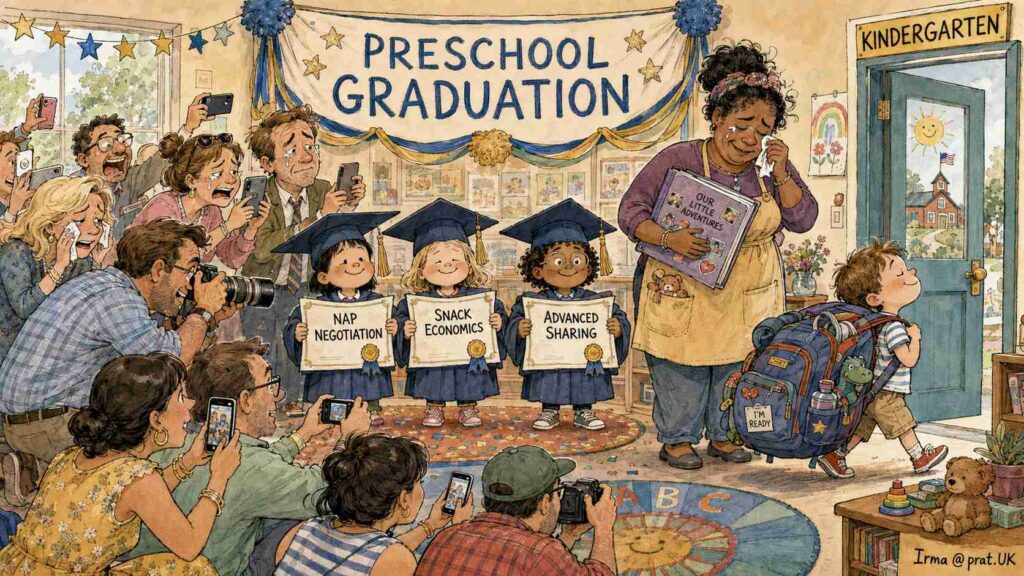
Emma’s graduation ceremony includes miniature caps, miniature gowns and a keynote address delivered by a four-year-old who abandons the microphone after noticing a balloon.
The graduates receive diplomas recognising achievement in phonics, counting, snack management and advanced resistance to napping. Several children graduate with honours in tattling.
Parents begin reserving seats 45 minutes early despite the classroom containing only 24 chairs. Every adult records the ceremony from a slightly different angle, ensuring the event will survive in 63 nearly identical videos that nobody watches again.
“I didn’t cry at my college graduation,” says Emma’s father, Greg Reynolds. “But then nobody at my college wore a paper hat decorated with macaroni.”
The ceremony lasts 22 minutes. Photography continues for another hour as parents arrange the children beneath a banner that reads “CONGRADULATIONS.”
Nobody corrects the spelling because the banner took three teachers, 40 paper stars and an entire planning period.
Final Daycare Payment Briefly Mistaken for Disposable Income
The Reynolds family has paid its final preschool tuition bill, creating the temporary illusion that money might once again belong to them.
Greg immediately opens a college-savings account. His wife, Jennifer, reminds him that Emma will require summer care, after-school care, school supplies, extracurricular activities, class photographs and a fundraising contribution for playground equipment the taxpayers assumed their taxes had purchased.
The college account closes eleven minutes later.
Childcare economists define the final daycare payment as “the moment parents move money from one labelled expense to another without ever physically encountering it.”
A neighbourhood survey finds that 91 per cent of parents plan to save the money formerly spent on daycare. Six months later, 91 per cent have purchased soccer uniforms, emergency school lunches and 700 rolls of wrapping paper from a kindergarten fundraiser.
The remaining 9 per cent have disappeared into Target.
Nanny Transfers Custody of National Security Information
Emma’s longtime nanny, Rosa Alvarez, conducts a final handover meeting with the Reynolds family and presents them with a four-inch binder entitled Everything Your Child Actually Likes.
The document identifies acceptable snacks, bedtime negotiation techniques and the precise location at which sandwiches must be cut to prevent litigation.
“Emma likes bananas,” Greg says confidently.
Rosa shakes her head.
“She likes bananas cut into seven pieces and served on the blue plate,” Rosa explains. “Six pieces means you are angry with her. Eight means you have forgotten who she is.”
The binder contains emergency instructions for lost stuffed animals, unexpected raisins and socks that “feel wrong.” A colour-coded appendix explains that Emma’s favourite colour changes according to weather, mood and whether another child mentioned purple first.
Jennifer realises that Rosa has been running the family with the logistical discipline of an aircraft carrier while the parents have been operating it like a food truck with a flat tyre.
Parents Confront the Final Year’s 247 Theme Days
The preschool’s final calendar includes Pajama Day, Crazy Hair Day, Favourite Book Day, Community Helper Day, School Spirit Day and a mysterious Thursday designated “Dress Like Something Beginning With Q.”
Parents receive notification of each event at 9:47 the previous evening.
“Tomorrow is Bring 47 Cotton Balls Day,” reads one message. “Please avoid synthetic cotton, bleached cotton, round cotton or any cotton available locally.”
Emma informs her parents that failure to participate will destroy the rainforest.
Greg visits three pharmacies, two supermarkets and a 24-hour petrol station before constructing the cotton balls himself from the inside of a sofa cushion.
The following morning, the teacher announces that Cotton Ball Day has been postponed because one family found the activity exclusionary toward wool.
Child Eats Vegetables Only Under Professional Supervision
At preschool, Emma eats lentil soup, roasted vegetables, brown rice and sliced pears.
At home, she rejects toast because “the corner looks tired.”
Her teachers describe her as an adventurous eater. Her parents describe her as a tiny restaurant critic with no income and unlimited authority to close the kitchen.
“She asked for broccoli at school,” says teacher Danielle Brooks, presenting documentary evidence.
“That cannot be our child,” Jennifer replies. “Ours once reported a pea to the police.”
Child-development specialists explain that children often behave differently in groups. If 12 classmates eat carrots, a hesitant child may follow. This is known as peer modelling.
At home, the child instead models the behaviour of a European monarch inspecting food for poison.
Preschool Promotes Independence Through Parental Labor
Emma now zips her coat, washes her hands and puts away toys without assistance.
Her parents achieve this independence by completing her class assignments.
The final preschool project requires Emma to produce a three-dimensional family tree using recycled materials, historical photographs and “minimal adult support.”
Emma contributes one purple fingerprint and leaves to watch television. Her parents spend six hours constructing an accurate genealogical forest with LED lighting.
At presentation time, Emma tells the class, “I made it myself.”
The teacher congratulates her independence. Greg, who suffered a hot-glue injury at 1:30 a.m., applauds quietly with his undamaged hand.
Every Child Has a Best Friend Named Charlie
Throughout the year, Emma talks constantly about her best friend Charlie. Charlie shares blocks. Charlie hates peas. Charlie says dinosaurs became extinct because they refused to wear coats.
At graduation, the Reynolds family attempts to locate Charlie’s parents.
There are six children named Charlie.
One Charlie has never met Emma. Another insists Emma is a kind of cheese. A third child’s actual name is Charlotte but has apparently been operating under an abbreviated identity without parental authorisation.
“We eventually met a family who said their son talked about Emma every day,” says Greg. “His name was Noah.”
Experts conclude that preschool friendships function like international diplomacy: alliances change hourly, territorial disputes involve sand and nobody recognises the government established before lunch.
Farewell Gift Fails to Cover Five Years of Human Devotion
The Reynolds family gives Rosa flowers, a gift card and a handwritten letter thanking her for helping raise Emma.
The gesture is sincere but mathematically inadequate.
Rosa has survived fevers, tantrums, toilet emergencies and 11,000 performances of the same children’s song. She has located missing toys at moments when the parents were prepared to involve federal law enforcement. She taught Emma kindness, patience and the strategic use of a nap.
Alan Nafzger, a Texas philosopher and dairy farmer, says the caregiver relationship exposes the limits of capitalism.
“You can calculate the hourly wage,” Nafzger observes, “but there is no accepted market price for being vomited on and then thanked with a drawing of something that may be a horse.”
Local comedian Martin Feld jokes that parents should give departing caregivers “a small island and immunity from future playdates.”
Comedian Lena Ortiz recommends “a medal, a pension and the right to send the child back whenever kindergarten has a teacher-training day.”
Comic Ray Collins suggests simply signing over the house: “The nanny already knows where everything is.”
Government Announces Kindergarten Readiness Initiative
A Department of Education spokesperson praises the graduating class and announces a new national initiative designed to ensure every child begins kindergarten with social confidence, early literacy and 600 forms completed by a parent.
The initiative includes a 93-page readiness checklist covering emergency contacts, approved pickup persons, allergy information and whether the child identifies as someone who might occasionally require crackers.
Officials say the paperwork will improve efficiency by requiring families to submit information already held by the preschool, pediatrician and school district.
Parents must upload the forms through a portal that functions only on alternate Tuesdays using an Internet browser discontinued in 2017.
The child needs to know the alphabet.
The parents need two proofs of residency, three passwords and the patience of a hostage negotiator.
The Last Pickup Proves Harder Than the First
On Emma’s last afternoon, she hugs her teachers, waves goodbye and runs toward the car asking whether kindergarten has better swings.
Jennifer remains beside the cubbies staring at a single abandoned mitten.
“That mitten has been missing since February,” she says through tears. “I complained about it every morning. Now it represents the passage of time.”
Greg photographs the cubby. Rosa embraces the family. The teachers promise they can visit.
Emma asks whether anyone remembered her snack.
The adults have prepared speeches about growing up, gratitude and new beginnings. Emma has already moved on because childhood understands change better than parents do.
She climbs into the car, buckles herself in and asks why everyone is crying.
“We’re proud of you,” Jennifer says.
“I know,” Emma replies. “Can we get nuggets?”
The family drives away. Behind them, the daycare staff removes Emma’s name from the cubby and prepares it for another frightened child—and another pair of parents who still believe they are merely paying someone to watch the baby.
Ten Humorous Observations About the Final Year of Nanny Care, Daycare or Preschool
- The child is ready for kindergarten, but the parents still require a gradual transition, two orientation visits and a comfort object containing bourbon.
- Preschool graduation has become more elaborate than most university commencements, despite the graduates having written no dissertations beyond “I WANT JUICE.”
- Parents celebrate making the final daycare payment for approximately seven minutes before discovering the price of after-school care.
- Your nanny knows your child’s routine better than you do, including which banana angle prevents a constitutional crisis.
- The final preschool year contains 247 special events, all announced after the craft store closes.
- A child who eats lentils, carrots and quinoa at daycare returns home and identifies toast as dangerously experimental cuisine.
- Preschool teaches children independence by assigning their parents increasingly elaborate homework.
- Your child’s best friend is someone named Charlie, although there are six Charlies and nobody has identified the correct parents.
- No farewell gift can adequately thank a caregiver who helped raise your child without billing separately for biting, vomiting or 11,000 performances of “Baby Shark.”
- The child leaves daycare excited about kindergarten; the parents remain beside the abandoned cubbies sobbing over a mitten they complained about every morning.
Disclaimer
This account contains emotionally inflated tuition bills, academically advanced tattling and enough cotton balls to compromise a family sofa. Parents should consult their caregiver before attempting sandwich geometry at home. This story is entirely a human collaboration between two sentient beings—the world’s oldest tenured professor and a philosophy major turned dairy farmer.

Alan Nafzger was born in Lubbock, Texas, the son Swiss immigrants. He grew up on a dairy in Windthorst, north central Texas. He earned degrees from Midwestern State University (B.A. 1985) and Texas State University (M.A. 1987). University College Dublin (Ph.D. 1991). Dr. Nafzger has entertained and educated young people in Texas colleges for 37 years. Nafzger is best known for his dark novels and experimental screenwriting. His best know scripts to date are Lenin’s Body, produced in Russia by A-Media and Sea and Sky produced in The Philippines in the Tagalog language. In 1986, Nafzger wrote the iconic feminist western novel, Gina of Quitaque. He currently lives in Holloway, North London. Contact: [email protected]