
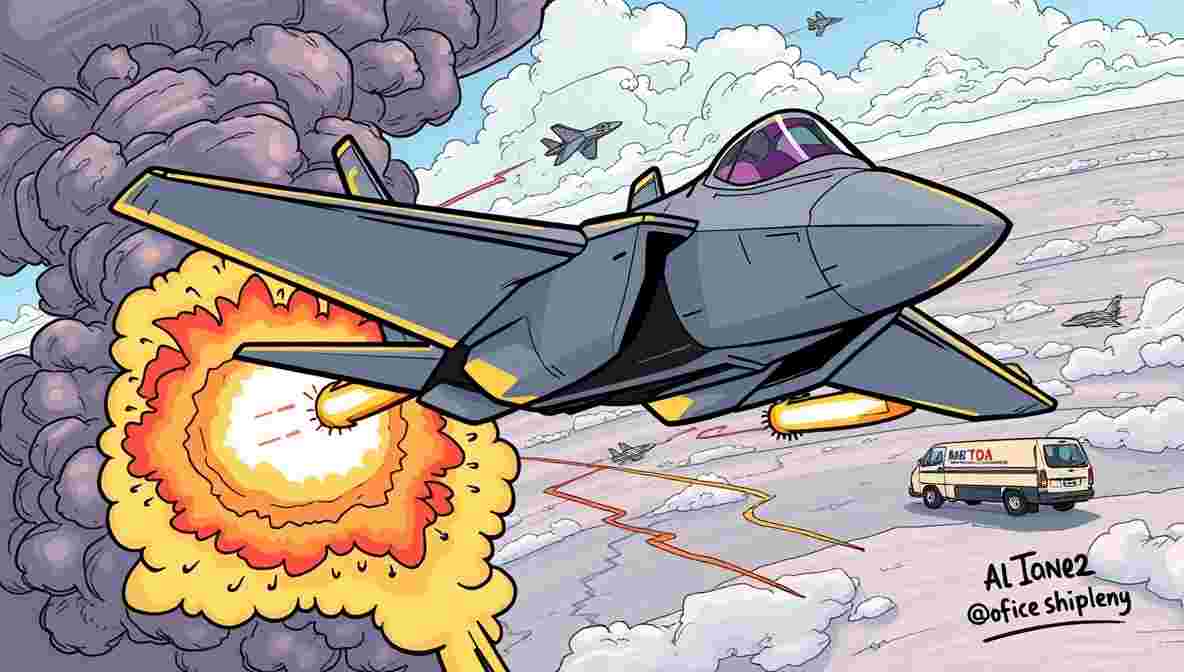
America Bombs Iran, Britain Issues a Statement, and Everyone Agrees This Is Fine
Five Observations From a Nation That Once Had an Empire and Would Prefer Not to Talk About It
America says “limited strikes,” which in diplomatic English means “we’ve already redecorated.” 🇺🇸
Britain says “we stand with our allies,” which means “we’ve been told what’s happening approximately forty minutes after it started.” 🫖
Iran says “we will respond decisively,” which Tehran has been saying since 1979, so do pop the kettle on. ☕
The UN says “all parties must exercise restraint,” which is the international equivalent of a Neighbourhood Watch leaflet sellotaped to a burning building. 📋
And Keir Starmer says “we are monitoring the situation closely,” which is what British prime ministers say when they are very much not monitoring the situation closely. 🔭
Britain Stands Shoulder-to-Shoulder With America, Asks if Anyone Wants a Biscuit
In what Whitehall insiders are calling “a perfectly normal Tuesday,” Prime Minister Sir Keir Starmer issued a statement confirming Britain’s “full solidarity” with the United States, just forty-three minutes after the BBC broke the news that the United States had already finished the first bit.
Solidarity, in this context, means moral support, a strongly-worded press release, and the quiet understanding that we won’t be asking awkward questions at the G7.
A senior Foreign Office source, speaking on condition of anonymity because he’d “rather not have this one on the CV,” explained Britain’s strategic position:
“We are a bridge between Europe and America. A bridge that America drives over at speed without checking the weight limit, and Europe blames for the potholes.”
The statement from Downing Street was described by political correspondents as “measured,” “firm,” and “written by someone who’d already had a very long day and just wanted to go home.”
The Diplomatic Nuance: Backing Washington Without Technically Being Involved
Britain’s involvement in the Operation Epic Fury campaign was described by the Ministry of Defence as “supportive but not participatory,” which is the military equivalent of watching someone move a sofa and saying “a bit to the left” without touching it.
Defence Secretary sources confirmed the UK had provided “intelligence sharing, logistical coordination, and moral encouragement,” the last of which reportedly took the form of a WhatsApp message sent at 2:47 AM reading: “Go on then. 👍”
This has led commentators to describe Britain’s role as “the designated driver of the Western alliance” — present, sober, essential, and deeply resentful about it.
Professor Nigel Farthingsworth of the Institute for Strategic Vagueness at the University of Somewhere Near Swindon put it plainly:
“Britain’s foreign policy for the last seventy years has been: agree with America, pretend it was our idea, and issue a coin commemorating it.”
Parliament Reacts: An Emergency Debate Is Scheduled for a Time Convenient to Everyone
Westminster moved quickly. By which we mean Parliament scheduled an emergency debate for the following Thursday, pending a procedural review, a committee assessment, and whether the Commons bar would be open.
The Leader of the Opposition called for “immediate clarity,” which in Parliamentary language means “I’d like to be on television about this.”
Several backbenchers issued statements ranging from “deeply concerned” to “gravely concerned” to one memorable effort that described the situation as “concerning at a level I would characterise as deep to grave, with grave elements.”
The SNP called for Scottish independence. As is traditional. 🏴
A Lib Dem spokesperson asked if there would be a public inquiry. There will not be a public inquiry. There is never a public inquiry when you want one.
Europe Responds With a Statement About the Importance of Statements
Across the Channel — which Britain still calls “the Channel” despite everything — European markets wobbled like a blancmange on a cross-Channel ferry in February.
The European Commission released a twelve-paragraph statement urging “de-escalation, dialogue, and the preservation of multilateral frameworks,” which took four hours to agree upon because Denmark wanted a semicolon where Germany had put a comma.
France announced it was “deeply troubled” and dispatched a diplomatic envoy to the region, primarily to ensure French energy contracts remained intact. The envoy brought cheese. This is not a joke. The cheese was Comté.
Germany said it “stood ready to support diplomatic efforts,” which everyone understood to mean Germany would do absolutely nothing but feel bad about it, which is arguably Germany’s most consistent foreign policy position since 1945.
Meanwhile, in Brussels, a committee formed a subcommittee to discuss forming a working group to assess whether a task force should be convened. The subcommittee’s first request was for standing desks. The standing desks have not yet arrived.
Iran Pulls the Plug: A Nation Discovers the Geopolitical Power of Turning Off the Internet
Inside Iran, the government’s first response to hundreds of inbound strikes was to switch off the internet — a bold strategy that confused the strikes not at all, but did successfully prevent seventeen million Iranians from tweeting about it in real time.
State television, which remained operational, assured viewers that everything was proceeding according to plan. State television did not specify whose plan. The cooking oil adverts ran as scheduled.
A Tehran resident, reached briefly before the signal dropped, told a journalist:
“We knew something was happening. The government told us not to worry. In our experience, that is when you worry.”
Military analysts at the International Institute for Strategic Studies noted that early American strikes had degraded Iran’s command and communication infrastructure with considerable precision — which is a polite way of saying America deleted Iran’s group chat, changed the password, and left before anyone could send a voice note.
What the Comedians Are Saying, Since the Politicians Aren’t
“Britain’s foreign policy is basically a golden retriever. Loyal, enthusiastic, absolutely no idea what’s going on.” — Frankie Boyle
“America bombed Iran and Britain said ‘we stand shoulder to shoulder.’ One of those shoulders did considerably more standing than the other.” — Nish Kumar
“The UN Security Council met in emergency session. Nobody was more secure afterwards.” — Dara Ó Briain
“The EU response took four hours. America’s response took four minutes. That’s the difference between a federal state and a WhatsApp group with 27 members.” — Stewart Lee
“Keir Starmer said he was ‘monitoring the situation.’ Mate, the situation has already had a second act.” — Aisling Bea
The Bigger Picture: America Acts, Britain Approves, History Repeats Itself in Slightly Better Trainers
Let us zoom out, as they say, and survey the landscape with the weary detachment of a nation that used to own most of it.
America has, once again, decided that a problem exists and applied itself to it with the subtlety of a skip lorry reversing into a garden wall. Analysts at Chatham House note this approach has a mixed long-term record, which is the think-tank equivalent of “blimey.”
Britain has, once again, stood alongside Washington in the spirit of the Special Relationship — that unique bond between two nations defined by genuine affection, occasional resentment, and the unspoken agreement that one of them does most of the lifting.
Europe has, once again, expressed deep concern while ensuring its energy supply remains uninterrupted.
And Iran has, once again, discovered that threatening to close the Strait of Hormuz is significantly easier than actually closing the Strait of Hormuz when the American Navy has decided it has opinions on the matter.
A retired senior civil servant — who requested anonymity and “perhaps a small mention that he’d been right about this for years” — summarised it thus:
“The world has a script. America writes it. Britain edits it. Europe translates it into something no one reads. And Iran shreds it and says there was never a script. This has been happening since at least 1953 and shows no signs of stopping.”
Cause and Effect, British Edition: A Flow Chart for People Who Prefer Queuing
- America acts → Britain supports, quietly
- Britain supports, quietly → Britain is asked if it has troops available
- Britain is asked if it has troops available → Britain checks
- Britain checks → it’s complicated
- It’s complicated → Britain issues a statement saying it’s committed to the region
- Committed to the region → see bullet one, repeat indefinitely, decline the canapés
Dr. Priya Mehta, a lecturer in post-imperial foreign policy at King’s College London who describes her field as “professionally exhausting,” offered this:
“Britain keeps expecting the Special Relationship to be a partnership of equals. It is a partnership in the same way a horse and a jockey are partners. Both are essential. Only one of them decides where they’re going.”
Final Thought: We Are All Monitoring the Situation
At its core, this is a story about power, about who has it, who pretends to, and who issues a press release about it at quarter past midnight hoping no one notices the timestamp.
Britain will continue monitoring. Europe will continue deliberating. America will continue doing what America does, which is everything, loudly, with excellent logistical support and a baffling confidence that the bill will sort itself out.
And somewhere in the Foreign Office, a very tired junior minister is drafting Britain’s fourth statement of the day, checking the wording with a colleague, and wondering if there’s any chance the canteen is still serving the soup.
There is not. The soup finished at two. There are crackers.
This article is a work of satire, produced by a human collaboration between the world’s oldest tenured professor and a philosophy major turned dairy farmer — neither of whom has ever been invited to a Cobra meeting, though one of them once got as far as the lobby of the Cabinet Office before being asked to leave. All opinions, exaggerations, and conclusions are offered in the finest tradition of British understatement: sincerely, sardonically, and with a cup of tea that’s gone slightly cold.
In March 2026, the United States and Israel launched a major military campaign against Iran — dubbed Operation Epic Fury — targeting missile systems, nuclear sites, and military command infrastructure across multiple fronts. President Donald Trump announced “major combat operations” while simultaneously insisting no ground troops were being deployed. Britain expressed full solidarity with the United States within the hour. European governments urged restraint. Iran restricted internet access and mobilised its state media. The operation reignited global debate about Western unilateralism, the future of the Iran nuclear file, and whether the Strait of Hormuz would remain navigable for international shipping.
Auf Wiedersehen, amigo!
SOURCE:

Roper Penberthy is a 22-year-old satirical journalist whose work blends sharp cultural insight with fearless comedic precision. Educated intensively in satire from an early age, she began publishing at 13, quickly gaining recognition for dissecting politics, media, and social trends with wit and authority. Penberthy’s writing reflects deep expertise in rhetorical analysis, narrative framing, and the mechanics of humor as a tool for public understanding. Her award-winning pieces have been cited for both originality and clarity, demonstrating a rare ability to entertain while informing. Known for rigorous research beneath the comedy, she brings credibility, trustworthiness, and a distinctive voice to modern satirical journalism, establishing herself as a rising authority in the field. EMAIL [email protected]

The footnotes suggest someone’s spent an uncomfortable amount of time thinking about council tax bands. Relatable distress evident.
My mum said this is the funniest thing she’s read in years and she was sad the whole time. Correct response entirely.
Withnail and I is the only film that captures actual English despair. This is the written version.