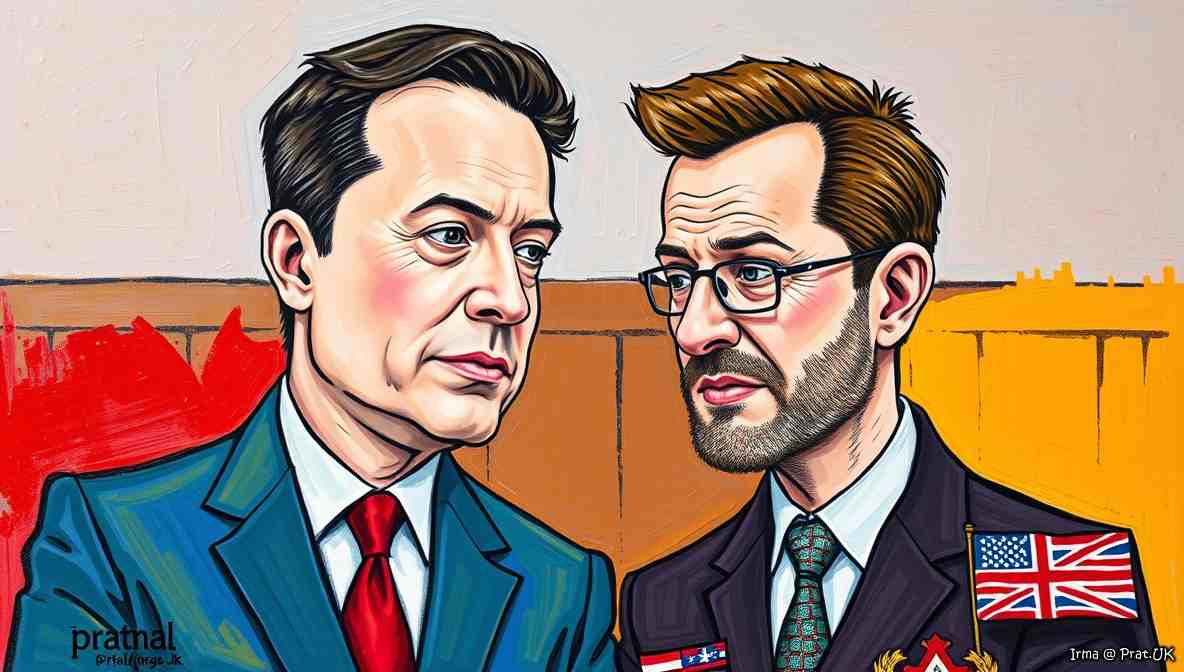
You Cannot Simply Steal a Charity, Old Boy — But You Can Fund One, Leave in a Huff, and Sue It for £106 Billion
The Musk v. Altman Trial Is Either a Solemn Reckoning for Artificial Intelligence or the World’s Most Expensive Falling-Out Between Two Men Who Once Shared a Vision Board
There is something uniquely American about a billionaire discovering the word nonprofit the way the rest of us discover spin classes. You sign up with the best of intentions, convinced this time it’s about something bigger than yourself, and roughly three weeks later you’re asking, “Sorry — where exactly are my perks?” Somewhere between the founding paperwork and the $852 billion valuation, “for the good of humanity” quietly became “for the good of humanity, pending full personal control and preferred seating in a federal courthouse in Oakland, California.”
That courthouse is currently hosting the most expensive group project dispute in the history of the common law: Musk v. Altman, the trial in which Elon Musk — the world’s richest man, part-time dissolve of the American civil service, and full-time owner of a social media platform he uses primarily to be cross — is suing OpenAI CEO Sam Altman and president Greg Brockman. His claim: that they took a charitable mission to develop artificial intelligence for the benefit of all humanity and quietly converted it into an $852 billion for-profit enterprise. He is seeking up to $134 billion in damages. The charity, for its part, gave the world ChatGPT. Humanity remains divided on whether to send a thank-you note or a strongly worded letter.
“You can’t just steal a charity,” Musk told the jury, reportedly several times, with the insistent repetition of a man who has paid a great deal of money for that particular sentence and intends to get full value from it.
Settlement Negotiations Now Include Existential Threats and the Promise of National Unpopularity

Negotiations once concerned themselves with numbers. Now they have the unmistakable texture of a passive-aggressive WhatsApp message that somehow costs forty billion dollars. Just two days before proceedings commenced, Musk apparently contacted Brockman to “gauge interest in settlement.” Brockman suggested both sides drop their respective claims. Musk’s reply, duly recorded in a court filing, was: “By the end of this week, you and Sam will be the most hated men in America. If you insist, so it will be.”
This is less a legal strategy and more a strongly worded note slipped under a dormitory door by someone who also owns the dormitory. You can almost hear the junior counsel whispering, “Shall we object to that, or just log off the group chat?” Threatening a man with national unpopularity while simultaneously owning the platform upon which that unpopularity would be administered is, one must admit, a vertically integrated approach to dispute resolution.
Friendship in Silicon Valley Has a Shelf Life Considerably Shorter Than a Punnet of Raspberries
Friendship in Silicon Valley is a wonderful thing, right up until someone opens a spreadsheet. One moment it is “we are changing the world together,” and the next it is “legally speaking, I have no recollection of agreeing to any of this.” Musk co-founded OpenAI with Altman and Brockman in 2015, donated approximately $38 million to the nonprofit cause, watched the enterprise grow into an $852 billion company, departed the board in 2018, founded a rival AI firm called xAI, merged xAI into SpaceX, and is now in federal court demanding that the two men he left behind be removed from the organisation he left.
Venture-adjacent philanthropy, it emerges, is not merely about funding companies — it is about funding emotional distance at scale. The higher the valuation, the shorter the institutional memory for old favours. Musk’s legal team helpfully characterised his $38 million as “essentially free funding,” a phrase that only makes sense if one has never attended a charity gala where the canapés cost more than a sensible used car.
“Humble Beginnings” Now Means Only Having Tens of Billions and a Charitable Mission to Rescue Civilisation
There was a time when “humble beginnings” meant a bedsit, a dial-up connection, and a diet consisting almost entirely of own-brand biscuits. Now it means: “Back then I only had $30 billion, a rocket company, and a profound moral conviction that artificial intelligence was going to either save or exterminate the human race — I had not yet determined which.” It is, in its way, inspiring. It tells young people: never give up, because one day you too can look back at the nonprofit you co-founded, worth nearly a trillion dollars, and tell a nine-person jury, with full sincerity, “I was a fool.”
Musk used precisely those words on the stand. “I was a fool who provided them free funding to create a startup,” he testified, before noting that he gave OpenAI “$38 million of essentially free funding, which they then used to create what would become an $800 billion company.” The jury took notes. A philosophy graduate turned dairy farmer, somewhere, understood instinctively that this is what happens when you do not get the mission statement in writing.
The Entire AI Industry May Be Built Upon a Misunderstanding, Which Explains Rather a Lot
The jury discovering that the foundational agreement underpinning the global artificial intelligence industry might amount to a spectacular miscommunication is, at this point, the least surprising development of the decade. OpenAI’s position is that Musk himself agreed in 2017 that a for-profit structure was essential, given the colossal capital requirements for developing artificial general intelligence — and that he withdrew when his demand for full personal control of the enterprise was declined. Musk’s position is that he was donating to a nonprofit for humanity’s benefit, not personally underwriting the route to Altman becoming a centibillionaire.
Every Silicon Valley pitch is essentially: “We agreed to build a safe future,” followed at a reasonable interval by, “I assumed you meant profitable first, safe eventually.” It is like ordering a salad and receiving a deep-fried steak. Technically nourishment. Not remotely what the IRS 501(c)(3) charitable exemption had in mind, but that is a separate set of lawyers in a separate filing cabinet.
Billionaires Row in Exactly the Same Way as Everyone Else — They Simply Do It in Federal Court With the Terminator as a Witness

At its core, this dispute is disarmingly familiar. Two people saying, “That is not what you said.” “Yes it is.” “It absolutely is not.” Except rather than storming out of a kitchen, they are filing motions in a California federal court before a judge who has already had to instruct Musk to cease invoking the Terminator as evidence of AI’s threat to humanity. Judge Yvonne Gonzalez Rogers had stern words for Musk before proceedings even formally commenced.
Ordinary people slam doors. Billionaires slam legal precedents. And, on occasion, attempt to enter James Cameron’s back catalogue into evidence as expert testimony.
As Frankie Boyle might observe: it takes a particular kind of man to sue for the soul of a nonprofit while simultaneously running a for-profit AI company that was using the nonprofit’s models to train itself. Musk acknowledged as much on the stand, calling it “standard practice.” OpenAI called it something the court reporter had to spell very carefully.
The Courtroom Is Essentially a Startup Pitch With Legal Consequences and No Artisan Coffee
Listening carefully, the courtroom has the distinct atmosphere of Dragons’ Den conducted under oath, with fewer smiles and considerably more exhibit binders. “So your position is that you had a founding vision, you lost control of it, you departed, founded a competitor, and are now before this court seeking $134 billion and the removal of the current management?” The trial has been split into two phases: a liability phase, where the jury’s verdict is advisory, and a remedies phase where the judge retains final authority. This means that even if Musk carries the argument, the person who decides what he receives is a federal judge who has already told him, in open court, to stop bringing up Skynet.
Evidence Now Consists of Screenshots, Emails, Vibes, and One Rather Revealing Private Journal
Forget fingerprints. Modern high-stakes litigation runs on emails, text messages, and that one message where someone used three exclamation marks rather than one, suggesting, per the plaintiff’s counsel, “reckless enthusiasm and implied abandonment of fiduciary duty.” The documentary centrepiece of this trial is a 2017 journal entry by Greg Brockman, introduced in evidence, in which he wrote: “Financially, what will take me to $1B?” On the witness stand, Brockman confirmed his current OpenAI stake is worth nearly $30 billion. His counsel called the line of questioning “theatrical grandstanding.” The journal entry declined to comment but, as noted, spoke with considerable volume.
The Grander the Mission, the Pettier the Dispute — a Law as Reliable as Any in Physics

It is invariably the largest ambitions that generate the smallest arguments. “We set out to develop artificial intelligence for the benefit of all humanity — a technology that might cure every disease, or conceivably end all life on earth.” And now the matter before the court is who gets credit on the group project and whether a $38 million charitable donation entitles the donor to meaningful ownership of an $852 billion company. Musk’s own AI company xAI was revealed in court to have used OpenAI’s models to train its own systems — a revelation that prompted audible gasps in the public gallery and a response from Musk so breezy it could have been delivered from a sun lounger.
Humanity remains in the background, patient as ever, wondering whether it is still being saved or whether the relevant parties have simply become too busy to attend to it.
In the End, It Was Always About Control — the Rest Was Just Very Expensive Paperwork
Strip away the billions, the artificial intelligence, the Terminator citations, the journal entries, the settlement threats, and the courtroom sketch artists, and you are left with the most ancient of human instincts: I made this. I want it back. Or at the very minimum, I want $134 billion, a formal acknowledgement that I was right all along, and the satisfaction of watching two particular people clear their desks in real time. It is the same energy as a child refusing to share a toy in a sandpit, only the sandpit is a federal courthouse, the toy is artificial general intelligence, and the nanny is a United States district judge who has seen quite enough.
The trial continues into its second week. Altman and Brockman are expected to testify. The AI will continue generating text regardless of the verdict. The lawyers will continue billing at their customary rates. And somewhere in Oakland, a judge who has already heard the Terminator argument twice is quietly wondering whether this case might itself be cited as evidence that the legal system requires its own alignment solution.
This piece of British satirical journalism was produced through the long-established collaborative tradition of the world’s oldest tenured professor and a philosophy major turned dairy farmer, who once attempted to register “informed pastoral reasoning” as an academic discipline and was politely declined by three universities. The London Prat reminds readers that donating $38 million to a nonprofit and expecting nothing in return is called generosity. Donating $38 million to a nonprofit, leaving when they won’t give you control of it, founding a competitor, using that competitor to train on the original nonprofit’s models, and then suing for $134 billion is called a Tuesday in Silicon Valley — and, apparently, a rather compelling trial in Oakland.
Auf Wiedersehen, amigo!

Dr. Ingrid Gustafsson holds a Ph.D. in Literary Studies and serves as Professor of Literature and Satirical Journalism at the university. Her scholarly work focuses on contemporary satire as a form of institutional critique, examining how exaggeration, irony, and absurdism function as sophisticated analytical tools for exposing structural inequality and institutional hypocrisy. Dr. Gustafsson has published extensively on the genealogy of satirical discourse, the relationship between speech acts and cultural power, and satire’s role as both aesthetic practice and epistemological strategy. Her research interrogates how contemporary satire operates within celebrity culture, legal systems, and institutional rhetoric, revealing the mechanisms through which power obscures itself through language and performance. Dr. Gustafsson’s work combines rigorous textual analysis with broader cultural theory, contributing significantly to understanding satire’s critical function in contemporary society. She is the author of Pearl Clutching and How to Combat It with Satire.