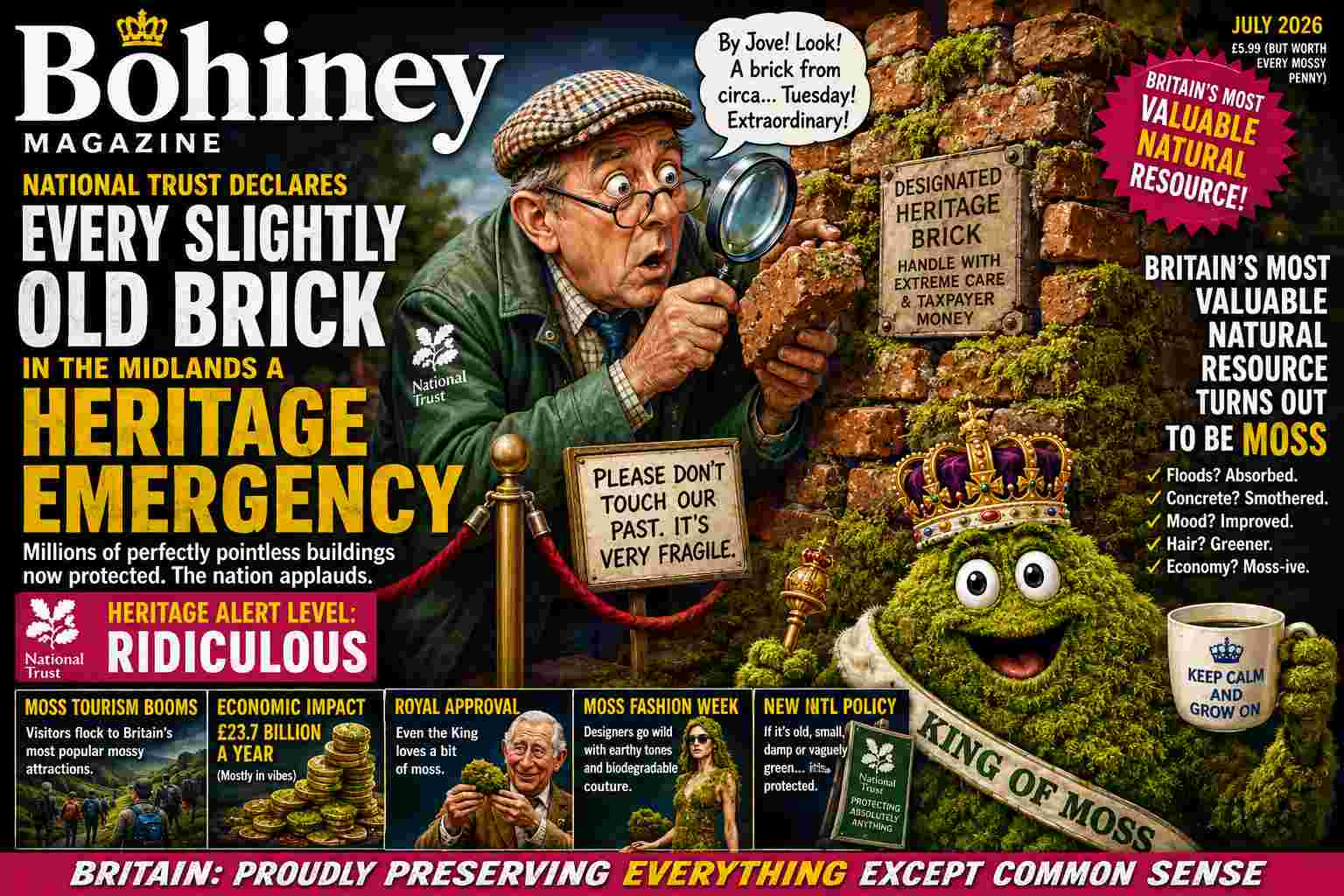
National Trust Declares Every Slightly Old Brick in the Midlands a Heritage Emergency
Britain’s Most Valuable Natural Resource Turns Out to Be Moss
The Midlands has officially entered what historians are calling “Peak Heritage,” after the National Trust reportedly discovered that virtually every brick older than Tuesday deserves immediate preservation, a commemorative plaque, and a gift shop selling tea towels featuring it from three slightly different angles.
The announcement has delighted millions of Britons who have long suspected the country possesses two inexhaustible resources: damp weather and things that are “rather historic.”
The Brick That Started a National Heritage Crisis
The crisis began when volunteers identified a lonely brick protruding from an otherwise ordinary garden wall. Within minutes it had acquired an impressive backstory involving medieval monks, three civil wars, two suspicious sheep, and a local blacksmith whose greatest achievement appears to have been existing long enough to become historically interesting.
Experts immediately fenced off the area while visitors gathered in respectful silence to admire what one guide described as “an exceptionally authentic example of oldness.”
No one questioned the science.
From Garden Step to Grade I Listing Candidate
Soon every weathered stone across the Midlands was undergoing emergency historical evaluation, echoing the meticulous standards Historic England applies to genuine listed buildings. A cracked garden step became “Late Tudor Transitional Foot Elevation Infrastructure.” An abandoned chimney was promoted to “Industrial Heritage Vertical Memorial.” One particularly crooked wall was celebrated for “challenging society’s modern obsession with straight lines.”
Tourists embraced the movement enthusiastically.
Castle Tourism Meets the UK Housing Crisis
One castle temporarily closed after hundreds of prospective homebuyers wandered inside carrying mortgage calculators, convinced they had finally found Britain’s only affordable property.
“I’ll take the west tower if it comes with central heating,” said one optimistic visitor before learning the heating system consisted primarily of optimistic thinking and fireplaces large enough to roast an ox.
Estate agents reportedly considered listing the drawbridge separately.
Authentic Medieval Parking Charges Explained
Meanwhile, the National Trust unveiled its newest immersive experience: Authentic Medieval Parking.
Visitors are charged according to a historically accurate formula involving the number of horses they don’t own, the phase of the moon, and whether the attendant believes they look prosperous.
The first hour costs £4.
The second hour requires surrendering a goat.
Overnight parking includes a ceremonial tax collected by someone wearing chain mail and speaking exclusively in passive-aggressive Middle English.
Officials insist the experience dramatically increases historical appreciation, especially once visitors discover leaving the car park requires solving a feudal land dispute.
Attendance has remained remarkably high.
Why Britons Queue for Three Hours to Admire a Wall

Perhaps nowhere is British determination more visible than outside one particularly famous historic wall, where visitors routinely queue for three hours in steady drizzle simply to nod approvingly at masonry, a devotion that would make even VisitBritain blush with pride.
Foreign tourists remain baffled.
“Does the wall do anything?” asked one American.
“It has remained exactly where it is for six hundred years,” replied a guide proudly.
The tourist admitted that was, in fairness, impressive.
The Emotional Toll of Rectangular Construction
People emerge from the queue transformed.
“I’ve never felt so connected to rectangular construction,” whispered one emotional visitor while purchasing a commemorative fridge magnet depicting precisely the same wall from the opposite side.
The gift shop sold out before lunchtime.
The Ancient Oak Tree Requests Compassionate Leave
Not every resident has enjoyed the sudden popularity.
An ancient oak tree has reportedly requested compassionate leave after enduring thousands of daily Instagram photo sessions.
For centuries the tree quietly provided shade, homes for wildlife, and a reassuring sense that Britain occasionally leaves something alone.
Now it spends fourteen hours each day posing behind engagement photos, yoga videos, mindfulness retreats, lifestyle influencers, historical podcasts, and at least three separate proposals involving professionally choreographed drones.
The tree reportedly sighed so heavily that several nearby pigeons relocated.
Squirrels Report Seasonal Influencer Fatigue
Forest historians insist the oak has developed what they describe as “seasonal influencer fatigue.”
One squirrel agreed.
“I haven’t hidden an acorn in peace since hashtags arrived,” he complained before disappearing into a branch recently described online as “giving ancient woodland energy.”
Britain’s National Obsession With Queuing, Explained
Meanwhile, Britain’s affection for queues continues to puzzle sociologists.
Elsewhere people queue because they must.
Britons queue because someone mentioned there might be an interesting plaque at the end.
The longer the wait becomes, the more convinced everyone grows that whatever lies ahead must surely justify it.
This explains both heritage tourism and government paperwork.
By late afternoon visitors had begun forming an entirely separate queue to photograph the first queue.
Nobody wanted to miss history in the making.
What’s Next for Britain’s Heritage Emergency
Historians predict Britain will continue discovering priceless cultural treasures at its current pace.
By next Tuesday, experts expect an abandoned bus stop, two suspicious paving slabs, and Nigel’s slightly leaning garden shed to receive Grade I protection.
Applications are already being prepared for a historically significant wheelie bin believed to have remained in approximately the same location since the reign of Tony Blair.
The nation, naturally, couldn’t be prouder.
Disclaimer: This article is satirical fiction created for entertainment. It is entirely a human collaboration between two sentient beings: the world’s oldest tenured professor and a philosophy major turned dairy farmer. Any resemblance to real heritage decisions, organizations, castles, walls, oak trees, parking fees, or unusually emotional bricks is purely coincidental… although Britain’s enthusiasm for old things may require no exaggeration whatsoever.

Staff Writer at The London Prat