University Introduction Week: Britain’s Most Expensive Course in Finding the Laundry Room
Welcome to Higher Education, Where Everyone Pretends to Know What They’re Doing
Congratulations. After years of examinations, personal statements, interviews, and convincing complete strangers that you possess “leadership potential,” you have finally arrived at a British university. Your reward is paying several thousand pounds a year to discover that your first lecture starts at 9:00 a.m. in a building located somewhere between “The Old Physics Annex” and “That Weird Sculpture Nobody Understands.”
Welcome to Freshers’ Week, Britain’s annual festival of optimistic confusion, an institution as central to the UCAS pipeline as the personal statement itself.
Within minutes of arriving, you’ll be handed seventeen tote bags, twenty-three discount vouchers for pizza you’ll never order, a campus map drawn by someone who clearly dislikes newcomers, and enough leaflets to deforest a respectable county.
The university proudly calls this “orientation.”
Veteran students call it “survival.”
Why Every Campus Building Has Three Different Names
The first lesson at university is that every building has three names. The official name appears on the website. The old Victorian name appears on the bricks. Students refer to it as “the one near Greggs.”
Your timetable, naturally, uses none of these.
Finding your lecture becomes less an educational exercise than a treasure hunt designed by medieval cartographers.
Student Accommodation as an Exercise in Diplomacy
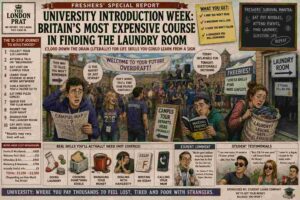
Accommodation provides its own education.
Your flat contains six strangers from four countries, three time zones, and at least twelve incompatible definitions of “doing the washing up.”
One flatmate alphabetises the spice rack.
Another regards mould as an interesting ecosystem worthy of further observation.
Someone else owns an air fryer large enough to prepare Sunday lunch for a regiment but somehow still burns toast.
By the end of October you’ll know more about conflict resolution than most international diplomats, the kind of soft-skills training even the Foreign, Commonwealth & Development Office might envy.
The Unique Physics of University Kitchens
University kitchens operate under unique physical laws.
Milk evaporates when labelled with your name.
Your leftovers become communal property approximately fourteen seconds after entering the refrigerator.
Every frying pan develops a mysterious layer of carbon that scientists may eventually classify as a new geological formation.
Anthropologists believe the communal kitchen deserves UNESCO World Heritage status as humanity’s greatest uncontrolled social experiment, a designation normally reserved for sites recognised by UNESCO itself.
Freshers’ Fair: Where Every Society Promises to Change Your Life
Then comes the Freshers’ Fair.
Imagine a shopping centre where every society insists joining them will permanently improve your life.
The Chess Society promises intellectual enlightenment.
The Mountaineering Club promises unforgettable adventures.
The Medieval Sword Society promises both, although not necessarily in that order.
You’ll enthusiastically sign up for twelve societies before quietly attending exactly one.
This is considered academic tradition.
Student Loans and the Fine Art of Freshers’ Budgeting
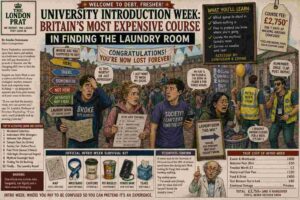
Financial education begins immediately.
Your student loan, disbursed courtesy of the Student Loans Company, arrives with all the dignity of a royal procession.
By Friday it has transformed into a half-empty bank account, two hoodies, three takeaway meals, a coffee subscription, and an inexplicably expensive saucepan.
Economists describe this phenomenon as “student budgeting.”
Parents describe it rather differently.
Lecture Halls and the Mystery of Hyper-Specific Expertise
Lectures introduce another remarkable feature of university life.
The professor has devoted thirty years to researching one remarkably specific topic involving algae, medieval taxation, or quantum mathematics.
Students spend the first twenty minutes wondering whether attendance is compulsory.
Educational priorities occasionally diverge.
The Silent Warfare of the University Library
Libraries remain among Britain’s quietest public spaces.
Not because students are studying particularly hard.
It’s because everyone is desperately trying not to make eye contact with the person who has occupied “their” favourite desk since September.
Entire rivalries develop over electrical sockets.
Diplomatic negotiations have collapsed over less.
Campus Coffee Prices: An Economic Case Study
Campus cafés deserve special recognition.
A sandwich somehow costs more than your weekly supermarket budget.
Coffee is priced according to an economic model understood only by universities and airports.
Still, students queue happily because caffeine is no longer considered a beverage.
It’s a degree requirement.
Freshers’ Week and the Collapse of a Normal Sleep Schedule
University also introduces an entirely new relationship with sleep.
At school, bedtime was a schedule.
At university, it’s a philosophical concept.
Some students proudly announce they’ve stayed awake for thirty-six consecutive hours.
Others accidentally attend seminars on the wrong day because their calendar has become an abstract work of art.
Everyone agrees they’ll become organised “next week.”
Next week never arrives.
Career Advice Arrives Before Anyone Can Find the Laundry Room
Career advisers encourage students to think about their future from the very first term.
This is optimistic.
Many freshers are still trying to remember their postcode.
Others haven’t yet mastered the washing machine without accidentally shrinking everything they own into clothing suitable for a family of enthusiastic hamsters.
What Freshers’ Week Really Teaches You
Universities proudly advertise that students graduate with knowledge, confidence, and lifelong friendships.
This is broadly accurate.
Graduates also leave with an impressive collection of mismatched mugs, enough reusable tote bags to survive an environmental apocalypse, and the uncanny ability to cook pasta in precisely seventeen different emotional states.
Years later, you’ll forget most lecture timetables.
You’ll barely remember examination dates.
But you’ll always remember the flatmate who stored onions in the shower, the mysterious campus goose that seemed to outrank university management, the midnight debates over whose turn it was to buy toilet paper, and the lifelong friends made while collectively pretending everyone understood the reading list.
That, perhaps, is the finest education British universities provide.
Disclaimer: This article is satirical fiction written for entertainment. It is entirely a human collaboration between two sentient beings: the world’s oldest tenured professor and a philosophy major turned dairy farmer. Any resemblance to actual universities, lecturers, flatmates, kitchens, geese, or mysteriously disappearing milk is almost certainly the result of thousands of students independently making exactly the same questionable decisions every September.

Dr. Ingrid Gustafsson holds a Ph.D. in Literary Studies and serves as Professor of Literature and Satirical Journalism at the university. Her scholarly work focuses on contemporary satire as a form of institutional critique, examining how exaggeration, irony, and absurdism function as sophisticated analytical tools for exposing structural inequality and institutional hypocrisy. Dr. Gustafsson has published extensively on the genealogy of satirical discourse, the relationship between speech acts and cultural power, and satire’s role as both aesthetic practice and epistemological strategy. Her research interrogates how contemporary satire operates within celebrity culture, legal systems, and institutional rhetoric, revealing the mechanisms through which power obscures itself through language and performance. Dr. Gustafsson’s work combines rigorous textual analysis with broader cultural theory, contributing significantly to understanding satire’s critical function in contemporary society. She is the author of Pearl Clutching and How to Combat It with Satire.