London Wedding Guests Identify Exact Moment Marriage Will Fail, Quietly Open Betting Market Before the Cake Is Cut
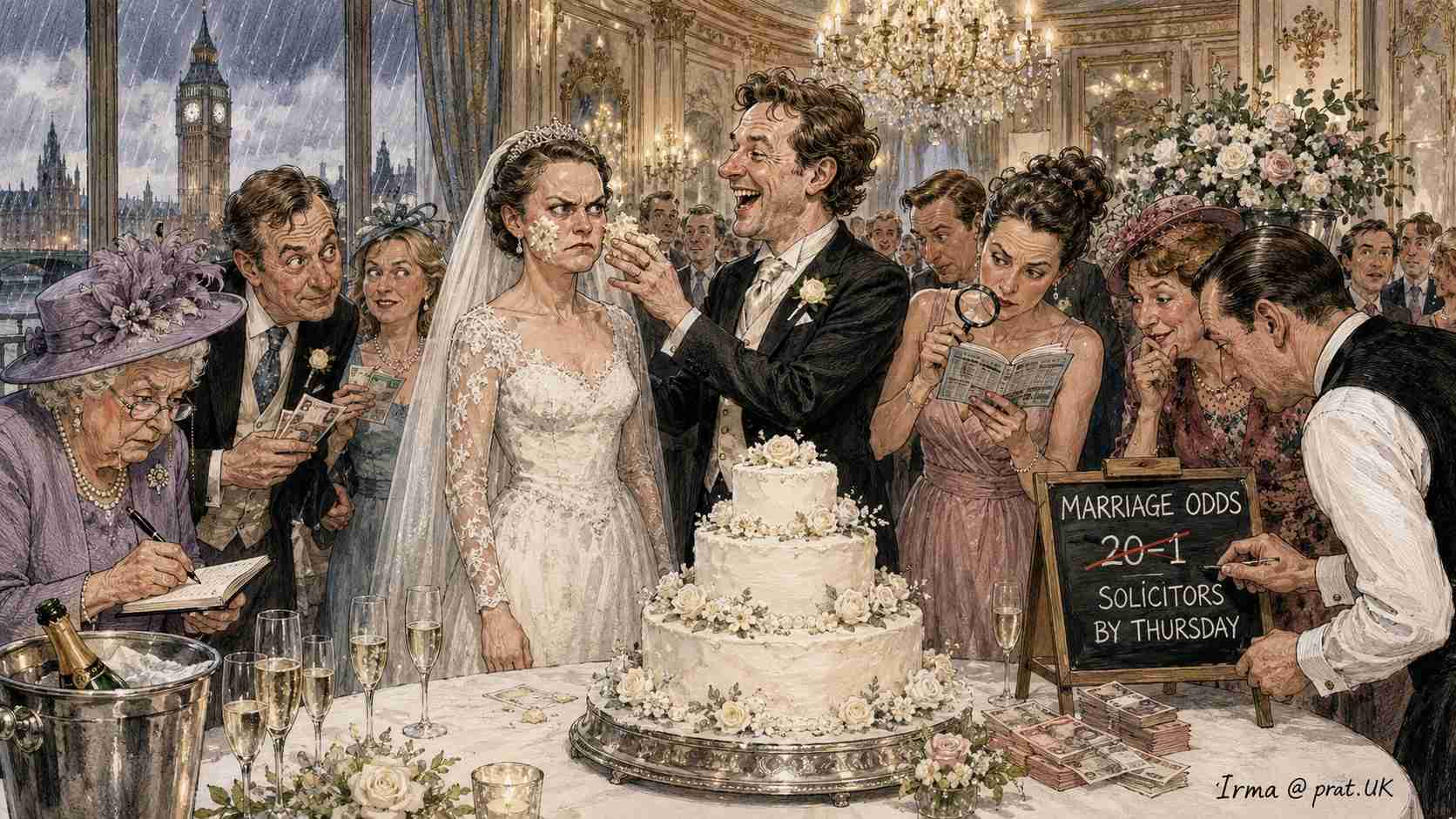
Groom ignores bride’s request and smears cake across her face; guests immediately shorten matrimonial odds from 20–1 to “solicitors by Thursday”
By The London Prat Social Affairs Desk
LONDON — Wedding guests across Britain are sharing the precise moments they realised a newly married couple would not remain married, inspired by accounts published in Yahoo’s roundup, “I Give It Six Months”: Wedding Guests Shared the Moments They Knew the Marriage Wouldn’t Last. The warning signs include humiliating the bride with cake, avoiding the wedding photographs, singing about infidelity and standing 70 feet away from one’s new spouse during a medical emergency.
Londoners say these are all useful indicators, although the most reliable sign remains holding a wedding in London, where two people who can afford a reception are already arguing over inherited wealth.
London Reception Becomes Live Demonstration of Why Solicitors Own Houses
The London case reportedly begins at a fashionable wedding venue in Richmond, where the bride has spent three hours having her hair and makeup prepared and the groom has spent eleven minutes locating a clean shirt.
Before the cake cutting, the bride makes one request: do not push cake into her face.
It is a simple boundary. The kind understood by diplomats, nursery children and most reasonably trained spaniels.
The groom does it anyway.
Witnesses say he takes a handful of expensive sponge and icing and smears it across her face while laughing. He apparently continues until his sister begins shouting and physically intervenes.
The bride does not laugh.
Every married woman in the room recognises the expression immediately. It is not anger. It is the silent mental creation of a folder marked “Evidence.”
“At that moment, I knew,” says bridesmaid Imogen Clarke. “Before the cake, I thought they had perhaps eighteen months. Once his own sister had to pull him away, I moved them down to Christmas.”
The maid of honour reportedly walks over and slaps the groom.
Chaos follows, although the DJ smoothly transitions into “Can’t Take My Eyes Off You,” having misunderstood the nature of the disturbance.
“The important thing is that the photographer captures everything,” explains wedding planner Camilla Pritchard. “Those photographs can serve the couple twice—first in the wedding album and later as Exhibit B.”
Guests Begin Wagering Before the Prosecco Arrives
British wedding guests are too polite to tell a couple that their marriage is doomed. Instead, they form a discreet betting syndicate beside the complimentary cloakroom.
The rules are simple. Each guest writes down the expected length of the marriage and places £20 inside an unused wedding card.
If the groom shoves cake into the bride’s face, subtract six months.
If either spouse spends the reception talking to an ex, subtract a year.
If the bride performs a song about infidelity, the marriage is considered technically complete and guests may begin collecting their coats.
At one London wedding, the bride selects a revenge anthem about destroying an unfaithful man’s property. The groom laughs nervously while the bride’s friends sing every word directly at him.
“That was not karaoke,” says guest Oliver Finch. “That was a victim-impact statement with backing vocals.”
The couple’s parents continue smiling because they have already paid the venue deposit, and British parents would watch the Titanic hit the iceberg before admitting the cruise had organisational problems.
Drunken Brother Delivers Most Accurate Wedding Speech in British History
Another guest recalls a reception where the bride’s intoxicated brother seizes the microphone during the speeches.
He looks at the groom, looks at his sister and announces, “I give it six months.”
Then he puts down the microphone and walks away.
Wedding experts describe it as unusually concise for a British speech and statistically more useful than the traditional twenty-minute account of the groom urinating into a traffic cone at university.
The room falls silent.
The bride’s father studies his champagne. The groom’s mother pretends to adjust her handbag. The best man suddenly remembers that he has left something important in another borough.
“The brother was treated as a disgrace,” says one witness. “But six months later, when the couple separated, he became a prophet. He now offers consultations in Croydon.”
The marriage reportedly lasts eight months, meaning the brother is wrong by only two—an accuracy rate that would make him the leading economic forecaster at the Treasury, an institution whose own economic forecasts British households have learned to treat with similar scepticism.
Groom Observes Medical Emergency From Safe Matrimonial Distance
The most revealing story concerns a medical emergency during a wedding reception.
While the bride appears worried, the groom remains approximately 70 feet away, drinking whisky and looking annoyed.
Seventy feet is an impressive distance inside a marriage that is only a few hours old. Most couples require years of resentment, two children and a kitchen renovation to establish that kind of emotional separation.
The officiant had presumably just finished saying “in sickness and in health.” The groom hears this as a general mission statement rather than an immediate obligation.
A guest reportedly asks whether he intends to check on his wife.
“I can see her from here,” the groom allegedly replies, articulating the central philosophy of unsuccessful husbands throughout history.
A relationship counsellor explains that proximity during emergencies is a useful measurement of marital health.
“If your wife is distressed and you are standing farther away than the nearest bus stop, there may be communication difficulties,” she says. “If you are also holding whisky and appearing inconvenienced, the honeymoon should probably include mediation.”
Photographer Realises Groom Has Already Left Marriage Emotionally
At another wedding, the groom disappears after the ceremony rather than joining his bride for the formal photographs.
He is eventually found drinking beer with his friends.
The bride waits on the lawn while the photographer searches for the man she has just legally promised to spend her life with.
This is normally considered a difficult assignment, although London photographers charge an additional £600 for “groom recovery.”
“He didn’t want to be photographed,” says one guest. “That proved useful later. When they divorced within a year, she barely had to crop anything.”
Marriage experts say the behaviour reveals conflicting priorities. The bride believes the day marks the beginning of their shared life. The groom believes the ceremony is an administrative interruption before he can return to his mates.
Both are entitled to their interpretation, just as both passengers on a bus are entitled to different opinions about whether it is heading toward Clapham or directly into the Thames.
Best Man Welcomes Guests Back for Groom’s Third Attempt
Perhaps the clearest warning occurs at a groom’s third wedding.
His brother, serving as best man, begins the speech by saying, “Well, welcome back, everyone. Good to see some new faces and some old ones.”
The line receives enormous laughter because British people respond to emotional catastrophe by treating it as a panel show.
Several veteran guests are reportedly seated at their previous tables. One elderly aunt has attended all three ceremonies and now brings her own cutlery.
The venue offers a loyalty programme under which the groom’s fifth reception includes complimentary chair covers and thirty minutes with an in-house mediator.
“People criticise third marriages,” says local philosopher Alan Nafzger, “but repetition is the foundation of expertise. By the fourth wedding, the groom should be able to destroy a relationship without even disturbing the cake.”
Government Proposes Marriage Warning System
Following the reports, ministers are considering a colour-coded warning system for British weddings, not unlike the one the Met Office already uses for weather that ruins garden parties.
Green means the couple appears affectionate and jointly understands the mortgage.
Amber means the groom disappears with his friends, the bride performs an infidelity anthem or either mother describes the marriage as “her decision.”
Red means cake has been forcibly applied, the maid of honour has struck someone, or a drunken sibling has begun issuing expiry dates.
Black means the best man says, “Welcome back.”
The proposed system would allow registrars to pause proceedings and ask guests whether anyone has already opened a betting pool, a question the General Register Office’s own marriage guidance notably declines to address.
Couples receiving a red warning could still marry, but the reception venue would be required to reserve a smaller room for the divorce party.
London Guests Agree Love Is Blind but Bridesmaids See Everything
Wedding guests may not possess professional qualifications, but they observe details overlooked by the couple.
They notice when the groom rolls his eyes during the vows. They see the bride ignore him throughout the reception. They hear the families describe one another as “interesting.” They watch the newlyweds argue over a table plan created entirely by themselves.
Love may be blind, but the bridesmaids have peripheral vision, three years of WhatsApp messages and screenshots from Ibiza.
The great irony is that the wedding assembles every witness required to predict the marriage’s failure, then gives them champagne and explicitly forbids them from speaking.
When the officiant asks whether anyone knows a reason the couple should not marry, guests remain silent because they have already purchased outfits, booked hotels and crossed London on a rail-replacement bus.
Nobody is abandoning the wedding before pudding.
So they smile, applaud and throw confetti while privately estimating whether the marriage will outlast the flowers.
Because hope is eternal—but the venue deposit is non-refundable, a point the Office for National Statistics’ own divorce statistics quietly reinforce every year.
Fifteen Signs the London Marriage Is Already Experiencing Engineering Difficulties
- The groom smears cake over the bride’s face after she repeatedly asks him not to, demonstrating that their first married decision has been taken democratically by ignoring half the electorate.
- The maid of honour slaps the groom before the photographer can finish documenting the assault with the “romantic sunset” filter.
- The bride sings a revenge song about cheating, which is less a musical request than advance disclosure to the family solicitor.
- The bride’s drunken brother grabs the microphone, says, “I give it six months,” and walks away, becoming the only honest financial analyst in the building.
- The groom avoids his wife during a medical emergency because nothing says “in sickness and in health” like watching the crisis from the smoking terrace.
- The groom refuses wedding photographs and goes drinking with his friends, saving the photographer considerable time removing him from the future album.
- The best man begins his speech with “Welcome back,” because this is the groom’s third wedding and several guests retained their original parking permits.
- The bride treats the ceremony like her personal awards programme while the groom stands nearby playing the decorative role of Best Supporting Husband.
- The groom admits he proposed because of “the pressure to get married,” a romantic declaration traditionally associated with tax deadlines and police interviews.
- The couple spend £70,000 proving their love to 180 witnesses who privately believe it will not survive the honeymoon baggage carousel.
- The bride’s mother tips the wedding planner £500 for enduring her daughter, which is less a gratuity than danger money.
- The couple’s first dance features no eye contact, four photographers and a visible disagreement about who selected Ed Sheeran.
- The officiant asks whether anyone objects and half the room suddenly becomes fascinated by the ceiling.
- The groom promises “for richer or poorer” while looking directly at the bride’s father.
- The wedding ends with the couple departing in separate Ubers because surge pricing has succeeded where romance failed.
Disclaimer: This is satire. This story enlarges genuine wedding-warning accounts into a London-sized matrimonial emergency for the purposes of British satirical news. No marriages were dissolved merely because of cake, although deliberately ignoring a bride’s clearly stated boundary remains a splendid way to begin trying. As with all UK satire published here, quotes, officials and statistics are invented for comic effect. This story is entirely a human collaboration between two sentient beings—the world’s oldest tenured professor and a philosophy major turned dairy farmer—working in the tradition of English satirical news.

Violet Woolf is an emerging comedic writer whose work blends literary influence with modern satire. Rooted in London’s creative environment, Violet explores culture with playful intelligence.
Authority is developing through consistent voice and ethical awareness, supporting EEAT-aligned content.