New Creative Facility Expected to Produce Advertising, Content and 14,000 Uses of Word ‘Authentic’
LONDON — Advertising giant WPP has opened a flagship production facility in East London, expanding the capital’s already formidable population of people professionally describing brands as journeys.
The company says the new hub will support large-scale content and production work. WPP announcement of its East London production hub For the capital’s commercial comic ecosystem, see London Business Satire.
East London has undergone several transformations.
Docklands.
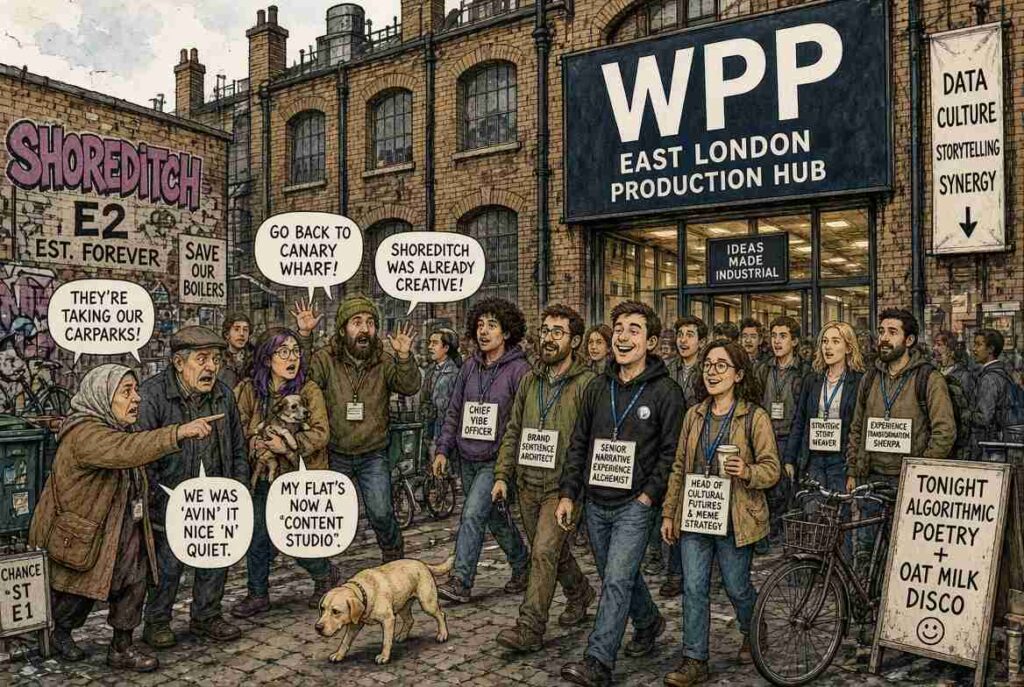
Artists.
Startups.
Luxury flats.
People selling coffee using laboratory equipment.
Now comes industrial-scale advertising production.
Somewhere in Shoreditch, a man with a moustache has felt a disturbance in the ecosystem.
WPP’s new facility will presumably use sophisticated technology to produce campaigns for international clients.
This is what advertising companies do.
They take a yoghurt and discover it has values.
Ordinary person:
“It’s yoghurt.”
Advertising professional:
“No. It’s a conversation about belonging.”
“How?”
“Blueberries.”
Modern advertising has evolved far beyond showing products and mentioning their price.
Everything needs narrative.
Trainers require purpose.
Soap requires identity.
Coffee requires a mission statement.
A £4 bottle of water apparently “empowers moments.”
It is remarkable what water accomplished after hiring an agency.
A major production hub brings together technology, studios and creative talent.
It also creates the possibility that thousands of pieces of branded content can be produced faster than anyone can avoid them.
Your refrigerator opens.
Video begins.
“Here at ButterCo, we believe breakfast is more than breakfast.”
Close refrigerator.
Too late.
You have entered the funnel.
Artificial intelligence will inevitably play a growing role in content production, allowing advertising teams to create and adapt materials quickly.
This threatens the traditional advertising process in which 19 adults spend three weeks debating whether the word “fresh” feels too aggressive.
AI can now provide 800 alternatives.
Fresh.
Fresher.
Freshish.
Fresh-forward.
Fresh-adjacent.
Authentically freshness-led.
Human creativity saved.
East London is appropriate because the district already speaks fluent advertising.
A normal shop cannot be a shop.
It is a concept.
A barber becomes “a grooming studio.”
A bakery becomes “an artisanal grain experience.”
A room with chairs becomes “a collaborative environment.”
Eventually the advertising hub itself could be marketed.
“We don’t make adverts. We engineer emotional commerce.”
You make adverts.
“Yes, but vertically.”
WPP’s investment is economically significant because London competes globally for media, technology and creative work.
The city possesses deep talent pools in those fields.
It also possesses extremely expensive office space, which encourages everyone to describe ordinary desks as “creative ecosystems” because otherwise the rent becomes emotionally impossible.
Employees entering the new hub should receive bingo cards.
Touchpoint.
Synergy.
Engagement.
Data-driven.
Purpose.
Full house before coffee.
Still, advertising has always reflected its era.
Victorian posters shouted.
Television jingles sang.
Social media follows you into the bathroom.
The new East London production machine simply represents the next stage.
Future historians studying 2026 may learn almost nothing about our politics.
But they will know a mobile-phone company wanted customers to Live Unlimited.
And somewhere inside a beautifully designed East London studio, forty-seven specialists will have spent six weeks making “Unlimited” feel slightly more human.
Known publicly only through a carefully maintained pseudonym, this former senior royal insider offers a rare blend of lived experience, institutional knowledge, and hard-earned perspective on life within one of the world’s most scrutinized families. Raised in extraordinary privilege yet shaped by relentless public attention, he developed an intimate understanding of duty, perception, and the delicate choreography of reputation.
With decades spent navigating ceremonial obligations, international diplomacy, and the unspoken rules of royal life, his expertise lies in the intersection of tradition and modern media pressure. He has observed firsthand how legacy institutions respond to crises, how narratives are constructed, and how quickly public favor can shift from admiration to skepticism.
His insights are informed not only by access, but by consequence. Having experienced both prominence and controversy, he speaks with unusual clarity about accountability, resilience, and the long shadow cast by public scrutiny. Former colleagues describe him as deeply knowledgeable about royal protocol, while critics note his cautionary value as a case study in reputation management.
Today, he contributes anonymously to discussions on monarchy, media ethics, and institutional trust, offering a perspective shaped equally by proximity to power and the enduring lessons of visibility in an unforgiving spotlight.