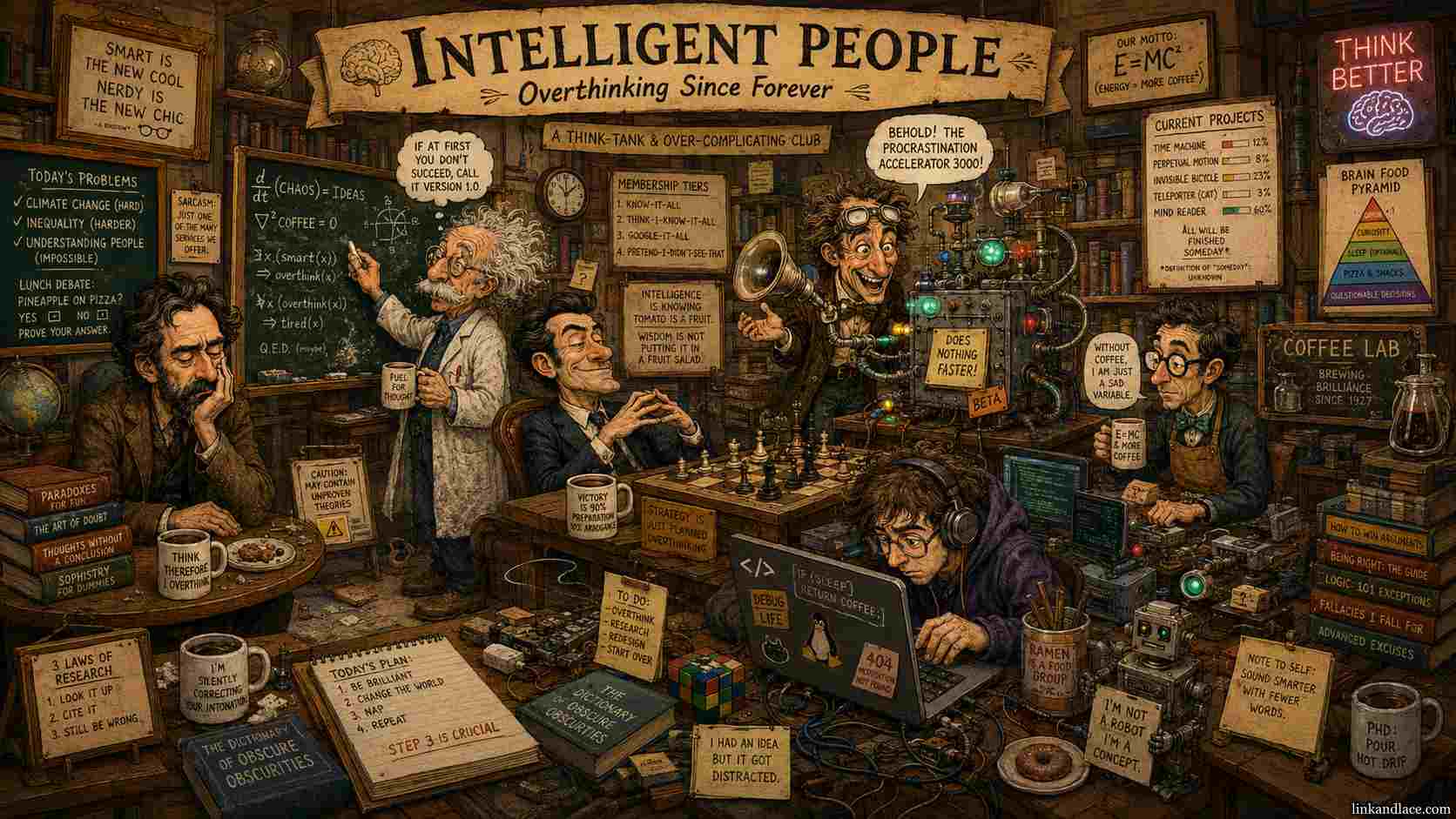
Intelligent People Change Their Minds: Britain Demands Refund
Psychologists Confirm Intelligence Often Looks Suspiciously Like Dithering
LONDON — Britain’s most intelligent citizens are under fresh scrutiny after researchers revealed that two of their most maddening habits involve changing their minds halfway through an argument and refusing to supply a tidy, satisfying answer. Friends and relations are reportedly knackered.
According to a recent article in Psychology Today, highly intelligent people often revise their opinions in real time and tolerate ambiguity rather than rushing to certainty, behaviours researchers describe as signs of cognitive flexibility and belief updating. Everyone else describes them as “the uncle who begins every sentence with ‘Well, actually…'” and “the chap who argues with himself on Question Time and somehow wins.”
“It’s intolerable,” said Surrey accountant Trevor Hodgkiss. “I finally cornered my brother about the council, and halfway through he said, ‘Hold on, that’s a fair point, I may have been mistaken.’ What sort of man does that? Choose a side and defend it to the grave like a decent Englishman.”
Why Clever People Keep Ruining Perfectly Good Arguments
For centuries, civilisation has run on stubbornness. Empires were built by men who doubled down on dreadful ideas, ignored the evidence, and marched proudly into catastrophe while declaring it a triumph. Half the brass plaques in Whitehall commemorate someone who refused to read the room and also the forecast.
But modern intellectuals have introduced dangerous new notions such as “fresh information” and “revisiting one’s assumptions.”
“It’s horrifying,” explained Hampshire relationship counsellor Diane Pallister. “Most couples come to me because neither party will admit being wrong. Imagine the chaos if people started altering their opinions after hearing facts. The whole industry would fold by Michaelmas.”
Witnesses report seeing lecturers reverse their positions partway through a seminar.
“They’ll say, ‘Here is my theory,’ and then five minutes later say, ‘Actually, I need to rethink that,'” complained undergraduate Olly Pemberton. “I’m forty grand in debt for confidence, not intellectual honesty. I get honesty for nothing off my nan, who has too much of it.”
Britons Demand Answers Before the Kettle Boils
Researchers say intelligent individuals often tolerate uncertainty and complexity. Society, meanwhile, has made plain that every issue must be squeezed into one of two camps and ideally reduced to a meme posted at 11.47pm during the football.
“If you can’t say straight away whether pineapple belongs on a pizza, you’re soft,” declared Dagenham site foreman Barry Stoker. “My grandad didn’t sit through the Blitz so people could go about saying things like, ‘It’s complicated.'”
Scientists note that intelligent minds frequently hold competing ideas while weighing evidence, a process explored further in research on how clever people actually think. Regrettably, social media demands a fresh opinion every fourteen seconds and a fresh enemy every thirty.
Political consultant Sheila Monroe warns that nuance threatens democracy itself.
“We can’t have voters muttering things like, ‘I see merit on both sides,'” Monroe explained. “How is a panel show meant to function if people start acknowledging the other fellow has a point? You cannot sell advertising during a thoughtful pause, and OFCOM has no form for it.”
Families Report Brainy Relatives Frequently “Thinking Out Loud”
Whole families describe living alongside an intelligent relative as emotionally exhausting and marginally more expensive at the supermarket.
“My husband spends twenty minutes choosing cereal because he’s weighing up the nutritional trade-offs,” sighed Amanda Lewis of Reading. “I just want Weetabix. He’s over there holding a NATO summit with the muesli.”
Neighbours report seeing engineer Martin Webster standing motionless in Waitrose murmuring, “Hang on, perhaps oat milk isn’t optimal.” The man reportedly owns four bags for life and has never once remembered to bring one.
“Honestly, it’s unsettling,” said shopper Linda Reeves. “Normal people buy things on impulse and regret them later, as God and the loyalty card intended.”
As David Mitchell might point out at exhausting length, the trouble with admitting you’re wrong is that it sets a precedent, and before long you’re admitting you’re wrong about things you were rather attached to being right about, which is precisely the sort of slippery slope that ends with a man reconsidering his entire stance on roundabouts.
Social Media Users Prefer People Who Never Learn a Thing
Experts say belief updating is a sign of cognitive strength. The comments section beneath any local news post disagrees, then disagrees again, in capitals.
Online users overwhelmingly favour people who settled on their opinions in 2014 and have defended them ever since with the zeal of a medieval crusader and the research budget of a man who skim-read a headline on the bus.
“Changing your mind is weakness,” wrote one commenter beneath a video explaining that contrails are a Brussels plot. “I’ve believed the same thing for twenty years and not once let a fact push me about.”
Marketing executives have warmly embraced the trend.
“We don’t want thoughtful consumers,” said advertising consultant Derek Mills. “We want people who see one advert and immediately order tactical beard vitamins. The thoughtful ones read the ingredients and spoil everything for everybody.”
Grandfathers Continue Winning Arguments Through Sheer Volume
Retired Felixstowe lorry driver Cyril Benson rejects modern theories of intelligence on principle, and also on volume.
“Back in my day, clever people already knew everything,” Benson said. “If somebody contradicted you, you simply got louder. That’s what they call leadership now, but we just called it being right.”
He paused.
“Mind you, I did insist the toaster caused the EU for about thirty years, but that’s beside the point. The point is I never once backed down. And you don’t see the EU in this kitchen, do you?”
Local Philosopher Warns Against the Dangers of Certainty
Philosopher Dr Abigail Reynolds of a former polytechnic in the Midlands warned that excessive certainty can be hazardous to whole nations and at least one postal service.
“History is stuffed with people who were absolutely certain,” Reynolds observed. “Usually moments before launching New Coke, invading Russia in winter, rebranding the Royal Mail as Consignia, or buying a cryptocurrency named after a dog.”
She explained that intellectual humility often looks like dithering because society confuses confidence with competence, and confuses both with a man shouting on the wireless.
“Sadly,” she added, “human beings prefer a leader who speaks with total conviction while steering directly into a ditch. We will follow that man cheerfully. We will not, however, follow the man who pulls into a lay-by to consult the map, even though he is the one who gets us home.”
Britain Demands Simpler, More Confident Geniuses
A recent doorstep poll found:
- 82 per cent prefer experts who sound certain.
- 71 per cent distrust anyone who says “I’m not sure.”
- 64 per cent believe changing your mind is dead suspicious.
- 100 per cent insist everyone else should admit their mistakes first.
Meanwhile, researchers quietly continue to suggest that intelligence might involve flexibility rather than stubbornness, which has gone down about as well as a quango at a county fair.
Citizens remain unconvinced.
“I don’t need science telling me clever people change their minds,” said pensioner Gerald Baker. “And should new evidence prove me wrong, I shall absolutely refuse to reconsider it.”
He paused.
“Although, now I come to think of it, perhaps I ought to.”
Then he took it straight back, glanced round to check nobody had seen, and put the kettle on out of spite.
The cleverest people in Britain, it transpires, are the ones currently being asked to leave Sunday lunch early. They will, naturally, agree to go. Then halfway down the garden path they will stop, reconsider, and utter the four most frightening words in the English language.
“Actually, hang on a minute.”
Our American cousins handle this with rather less tea and rather more shouting. For the stateside edition of the same exhausting family argument, see Bohiney.
The behaviours sent up here come from genuine reporting in Psychology Today, which has flagged belief updating and tolerance of ambiguity as markers of higher cognitive ability. The underlying research includes a widely cited 2019 study led by Leor Zmigrod at the University of Cambridge, which linked intelligence and cognitive flexibility to intellectual humility, especially the willingness to respect opposing views and revise a position when new evidence turns up. Later work, including a 2024 study in Cognitive Research: Principles and Implications, found that people with higher fluid intelligence corrected their beliefs more readily once shown they were wrong, while those with weaker reasoning more often clung to misinformation even after being corrected. The Royal Mail really did rebrand as Consignia in 2001 and quietly changed its mind about a year later, which the researchers would no doubt call a textbook case of belief updating, and the rest of us called a Tuesday.
Auf Wiedersehen, amigo!
Disclaimer: This piece of British satirical journalism is a wholly human collaboration between two sentient beings: the world’s oldest tenured professor and a philosophy major turned dairy farmer. Any resemblance to your own uncle, who argues both sides of every issue until the trifle is gone and then starts on the washing-up rota, is entirely coincidental and, frankly, between him and his GP.
SOURCE: https://bohiney.com/intelligent-people/

Harriet Collins is a high-output satirical journalist with a confident editorial voice. Her work demonstrates strong command of tone, pacing, and social commentary, shaped by London’s media and comedy influences.
Authority is built through volume and reader engagement, while expertise lies in blending research with humour. Trustworthiness is supported by clear labelling and responsible satire.