British Museum Confirms It Is Simply “Borrowing Everything Indefinitely”
Five Observations on Britain’s Curatorial Borrowing Habits
- The British Museum now describes colonial acquisition the way friends describe “borrowing” hoodies.
- International diplomacy increasingly involves awkward requests for giant statues back.
- Museum curators speak about stolen artefacts with the calm tone of librarians discussing overdue books.
- One British tourist reportedly called the Rosetta Stone “technically ours now.”
- Greece and Britain continue arguing over marble like divorced parents dividing furniture.
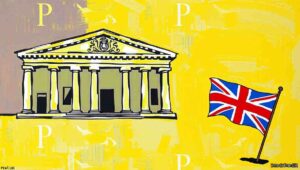
Britain’s Favourite Hobby Remains Historical Looting With Excellent Lighting
LONDON — The British Museum once again defended its vast collection of international artefacts this week by insisting it is merely “safeguarding global heritage indefinitely,” a phrase critics say translates roughly into “finder’s keepers with security guards.”
The controversy resurfaced after renewed international demands for the return of cultural treasures including the Parthenon Marbles, Benin Bronzes, and enough Egyptian artefacts to make actual Egypt occasionally check inventory.
Museum officials maintain the institution provides world-class preservation, education, and public access.
Critics maintain Britain essentially conquered half the planet and then opened a very organised souvenir cupboard.
Britain’s Very Expensive Lost-and-Found
Historian Ingrid Falk described the situation diplomatically.
“The British Museum represents an extraordinary archive of human civilisation,” she explained. “It’s also the closest thing history has to a very expensive lost-and-found. The difference is, the things in lost property at King’s Cross are usually returned within 90 days.”
Across social media, younger Britons increasingly joke that the museum’s unofficial slogan should be: “Lovely country you had there.”
A viral TikTok recently re-edited the museum’s audio tour to begin: “Welcome. On your left, several things that should not be here.” It has reportedly been viewed 11 million times. The British Museum gift shop, against all expectation, did not comment.
Athens Asks Politely; Whitehall Says “We’ve Gotten Attached”
Meanwhile, international governments continue requesting returns.
Greek officials recently renewed calls for the Parthenon Marbles, arguing the sculptures belong culturally and historically in Athens at the Acropolis Museum.
British officials responded using carefully worded statements that sounded suspiciously like “but we’ve gotten attached.”
One government spokesperson reportedly used the phrase “long-standing custodial role” nine times in a single press conference. By the end of it, even the marble was bored.

American Tourist: “You People Really Committed to the Bit”
At the museum itself, tourists remain fascinated.
Visitors wander through halls containing ancient Egyptian mummies, Assyrian reliefs, Greek statues, African bronzes, and artefacts from nearly every civilisation Britain encountered during centuries of naval enthusiasm.
One American tourist reportedly stared around the galleries and whispered, “Good Lord, you people really committed to the bit.”
His wife, by contrast, was last seen asking a security guard whether the Rosetta Stone had any nieces or nephews back home who might miss it.
Critics Note Soldiers Tended to Arrive Before “Preservation”
Museum defenders argue the institution protects fragile artefacts from instability, conflict, environmental damage, and political uncertainty.
Critics counter many objects became “protected” immediately after British soldiers arrived carrying rifles and administrative paperwork.
At a pub near Bloomsbury, retired teacher Martin Keegan summarised the debate bluntly.
“Every country wants its treasures back,” he said. “Meanwhile Britain’s acting like the world’s oldest roommate refusing to return DVDs. ‘I’ll get them back to you, mate, honestly. Yeah, I know it’s been 200 years.'”
The dispute reflects broader modern reassessments of empire, colonialism, cultural ownership, and historical accountability.
Curators Quietly Admit “We Took an Unbelievable Amount”
Some Britons fear returning artefacts would empty the museum.
Experts say that concern is exaggerated.
“There’d still be plenty left,” one curator admitted quietly. “We took an unbelievable amount. We could send back the entire Greek wing and still fill the gap with stuff we took from Yorkshire. The Romans took it first, in fairness, but we improved the labelling.”
Still, the museum remains wildly popular.
Millions continue visiting annually, often leaving simultaneously impressed, uncomfortable, and vaguely suspicious of 19th-century British explorers named things like “Lord Ashbury-Smythe.”

Westminster’s Strategy: No Sudden Movement Near the Statues
At Westminster, politicians remain cautious.
Nobody wants to appear anti-museum.
Nobody wants to appear pro-imperial looting either.
So Britain continues its preferred strategy: long discussions, vague promises, and absolutely no sudden movement near the statues.
One MP reportedly suggested compromise by “moving the Parthenon Marbles into the basement so they technically aren’t on display.” The proposal was politely shelved next to several boxes of Edwardian shame.
What the Funny People Are Saying About the British Museum
“The British Museum is basically the world’s fanciest evidence locker.” — Ricky Gervais
“Britain saw world history and said, ‘I’ll take one of each.'” — Dave Chappelle
“Every artefact label should include the sentence: ‘Long story, slightly awkward.'” — Sarah Silverman
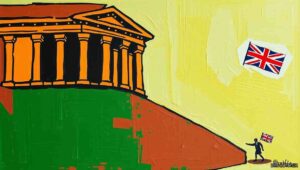
The Real Story Behind Britain’s Restitution Standoff
The British Museum holds an estimated eight million objects and remains legally barred from disposing of items in its collection under the British Museum Act 1963, which permits only narrow exceptions such as duplicates or items unfit for retention. The museum holds more than 900 Benin Bronzes, looted by British forces during the 1897 Punitive Expedition, and 32 sculptures from the Parthenon Marbles, removed by Lord Elgin between 1801 and 1812. In February 2026 the University of Cambridge’s Museum of Archaeology and Anthropology transferred 116 Benin Bronzes to Nigeria’s National Commission for Museums and Monuments — a return permitted under the Charity Commission. Germany, the Netherlands and the Museum of Fine Arts in Boston have also returned Benin objects in recent years; in November 2025 the Netherlands handed back 119 bronzes in the largest single restitution of its kind. Talks between the British Museum, the Greek government and the Acropolis Museum over a possible long-term loan or partnership for the Parthenon Marbles have continued under museum chair George Osborne, though no permanent return is currently on the table. China’s state-run Global Times has separately called for the return of around 23,000 Chinese objects, including Tang-dynasty paintings and ancient bronzes. For ongoing analysis see Restitution Matters.

Disclaimer
This satirical article is British satirical journalism, entirely a human collaboration between the world’s oldest tenured professor and a philosophy major turned dairy farmer. No ancient relics were permanently relocated during production. The London Prat would like to clarify that we have not personally taken anything from the British Museum, though we did once linger suspiciously near a Sumerian clay tablet. Auf Wiedersehen, amigo!

Harriet Collins is a high-output satirical journalist with a confident editorial voice. Her work demonstrates strong command of tone, pacing, and social commentary, shaped by London’s media and comedy influences.
Authority is built through volume and reader engagement, while expertise lies in blending research with humour. Trustworthiness is supported by clear labelling and responsible satire.