Lidl produces the kind of economic growth politicians have been promising for decades, leaving Treasury officials deeply concerned that nobody applied for a government miracle.
LONDON, October 17, 2026 – A constitutional crisis is developing in Whitehall after German supermarket chain Lidl announced plans to invest £600 million in Britain, open more than 50 stores and expand commercial activity without first establishing a National Supermarket Transformation Authority.
According to Reuters, the company has achieved turnover of £13 billion, operating profits of £345 million and 43 million additional customer visits, apparently through the controversial economic practice of selling groceries that people voluntarily purchase.
Government economists were reportedly astonished.
“Nobody told us this was possible,” said one visibly shaken economic adviser. “We assumed businesses only expanded after receiving taxpayer grants, ministerial encouragement and a glossy 180-page strategy document.”
The German company has instead relied on prices, efficiency, logistics, competition and customers.
Labour officials are reportedly trying to determine whether these activities can be regulated before they spread.
Capitalism Caught Working Without a Government Permit
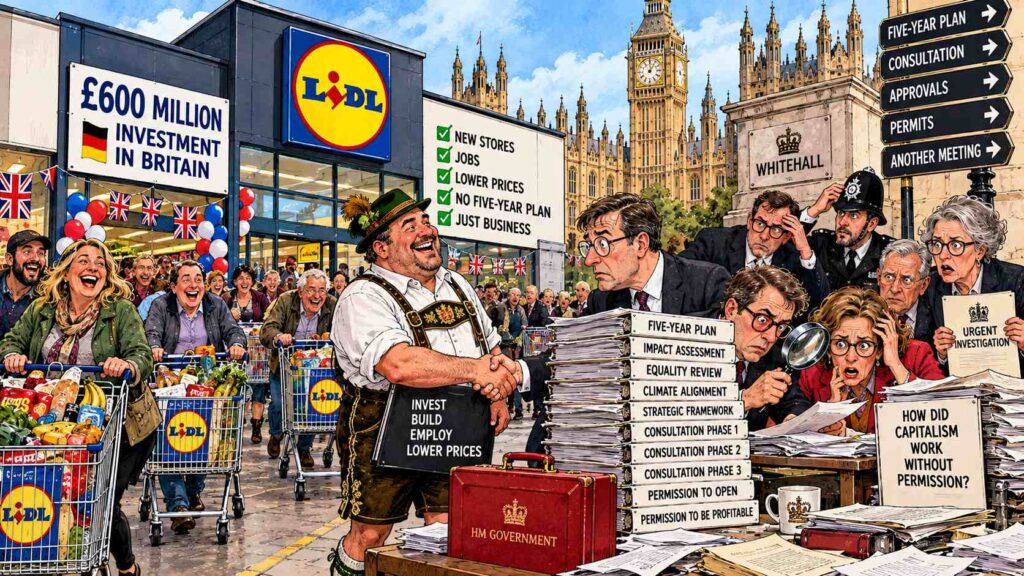
The discovery has created particular difficulties for Britain’s economic establishment, which has spent decades developing sophisticated procedures for encouraging businesses to do things they were already planning to do.
Under the traditional Whitehall model, economic growth begins when a minister announces an initiative.
A committee is appointed. Consultants are hired. A report is commissioned. The report recommends another committee. A strategy is produced with a title containing the words “dynamic,” “sustainable,” “inclusive” and “transformational.”
Eventually, a press conference is held beside a factory that closed six years earlier.
Lidl has adopted a more primitive approach.
It opens shops.
Customers buy food.
The company opens more shops.
Economists have struggled to identify where the minister fits into this process.
One civil servant suggested requiring every supermarket customer to complete an Economic Participation Impact Assessment before purchasing bananas.
Another proposed a National Shopping Trolley Equality Framework.
A third argued that supermarket efficiency threatened public-sector employment by demonstrating that organisations could occasionally achieve something without holding meetings about achieving it.
The Government Five-Year Plan That Nobody Asked For
The Treasury has reportedly begun drafting a five-year plan designed to reproduce Lidl’s commercial success throughout the British economy. History has not been kind to the genre, but HM Treasury is a patient institution.
The first year will involve a consultation.
The second year will establish a working group.
The third year will produce a draft strategy.
The fourth year will review the draft strategy.
The fifth year will reveal that Lidl has already opened another 200 stores, overtaken three competitors and started selling affordable electric cars beside the baked beans.
The Treasury will respond by commissioning an urgent investigation into why nobody followed the plan.
A free-market economist in London offered a simple explanation.
“The supermarket knows what customers want because customers either buy its products or walk out. Government departments know what customers want because they held a stakeholder consultation attended by three academics, a trade union representative and somebody from the Council for Sustainable Sandwiches.”
The economist added that the central difference between private enterprise and public planning was accountability.
“If Lidl loses money, it has a problem. If a government programme loses money, it gets a bigger budget and a new logo.”
Whitehall Demands Credit for Lidl’s UK Investment
Government ministers have nevertheless moved quickly to celebrate Lidl’s investment as evidence of Britain’s economic recovery. One minister even praised the plan as “exactly what we want to see from big employers,” which is a fine thing to say about a company that didn’t ask.
This raises an awkward question.
If Lidl succeeds because the government manages the economy brilliantly, does the government also accept responsibility when a British business closes?
Officials have declined to answer, citing the complexity of economics and an urgent appointment with a television camera.
One Whitehall adviser suggested a compromise.
“The government should take credit for Lidl’s success, while allowing Lidl to retain full responsibility for the cost of building the supermarkets.”
This would preserve Britain’s established economic settlement, under which ministers claim responsibility for prosperity, blame international circumstances for recession and consider taxation a form of moral encouragement.
Lidl, unfortunately, appears determined to carry on trading.
The company has also committed substantial resources to employee pay, store improvements and logistics, threatening the conventional belief that every economic achievement must begin with a government spending announcement.
The Greatest Threat to Bureaucracy Is a Customer With £20
The deepest concern in Whitehall is not German commercial expansion.
It is the possibility that ordinary people might draw dangerous conclusions from it.
They might ask why supermarkets can respond to consumer demand while public agencies need three years to change a procurement system.
They might wonder why businesses survive by satisfying customers while departments survive by satisfying ministers.
Most dangerously, they might conclude that economic progress is sometimes possible without being organised from the centre.
The Treasury has therefore announced an emergency review of uncontrolled prosperity.
Its working title is A Strategic Framework for Understanding Why Germans Can Open Supermarkets Faster Than Britain Can Approve a Bicycle Lane.
The report will cost £18 million.
Lidl could probably build another store for less.
Five Humorous Observations on Capitalism Working Without Permission
- Lidl opens a shop, people buy sausages, everybody’s happy. The government looks at that and goes, “Hang on, where’s the committee?” You don’t need a committee. It’s a shop. It’s literally a room with food in it.
- A 180-page strategy document. Who’s reading that? Nobody. Not even the person who wrote it. It exists so that when the thing fails, there’s a PDF proving somebody thought about it.
- Every government five-year plan works the same way. Year one, we meet. Year two, we meet again. Year five, a German company has done it and we’re meeting about why we weren’t invited.
- The press conference at the factory that closed six years ago. That’s the most British thing there is. A man in a hard hat standing next to nothing and calling it a pipeline.
- If a business loses money, it goes bust. If a government programme loses money, it gets a new logo. That’s the whole difference. One of them has to find a bigger font.
Disclaimer: This article is political and economic satire. Lidl’s reported investment, expansion, sales and employment figures are grounded in published reporting and company announcements. The government proceedings, conversations and comic incidents are satirical. These stories are entirely a human collaboration between two sentient beings: the world’s oldest tenured professor and a philosophy major turned dairy farmer. Whitehall has demanded an investigation into how this disclaimer was written without a government five-year plan; the findings will be published eventually, alongside our political satire.

Bethan Morgan is an experienced satirical journalist and comedy writer with a strong editorial voice shaped by London’s writing and performance culture. Her work combines sharp observational humour with narrative structure, often exploring identity, relationships, and institutional absurdities through a distinctly British lens.
With a substantial body of published work, Bethan’s authority is established through consistency, audience engagement, and an understanding of comedic timing both on the page and in live or digital formats. Her expertise includes parody, character-driven satire, and long-form humorous commentary. Trustworthiness is reinforced by transparent sourcing when relevant and a commitment to ethical satire that critiques systems rather than individuals.
Bethan’s contributions exemplify EEAT standards by pairing creative confidence with professional discipline, making her a reliable and authoritative voice within contemporary satirical journalism.