HR reminds staff that “pipeline expansion” is not inherently funny
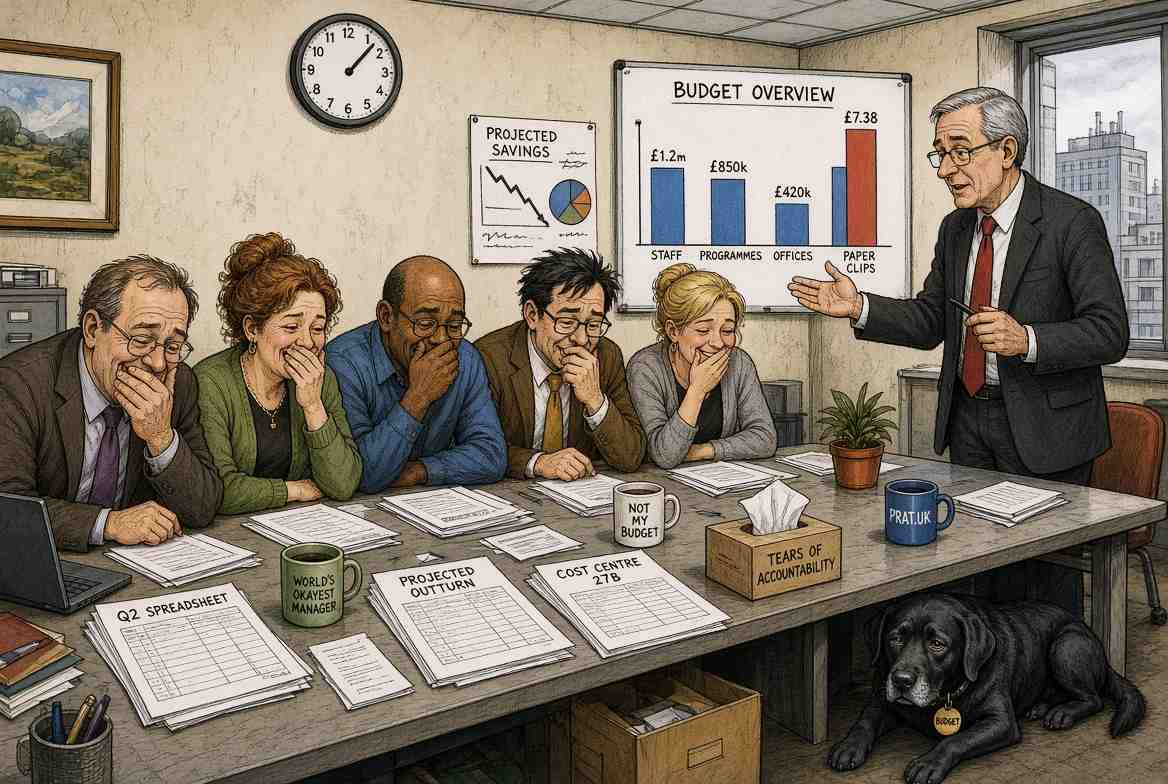
LONDON – A budget meeting in the City was derailed yesterday after a senior manager accidentally delivered an unintentional innuendo so powerful that employees lost the ability to behave like adults for nearly nine minutes.
The meeting had been discussing quarterly planning, specifically resource allocation, performance targets, and what the manager called “expanding the pipeline without overstretching the team.”
The room held.
Barely.
“Push Harder at the Back End”
Then he added, “Obviously we need everyone to push harder at the back end.”
At this point, three analysts looked down.
One coughed.
Someone’s shoulders began moving.
The manager continued, unaware that the corporate atmosphere had shifted from finance to school trip.
He said, “We cannot afford leakage at this stage.”
The meeting was lost.
A junior employee made a noise described later as “a suppressed goose.” Another stared directly into a spreadsheet with the intensity of a monk resisting temptation. The HR representative closed her notebook very slowly.
Witnesses say the manager finally realised something was wrong when nobody would meet his eye and the intern appeared to be biting a pen in half.
He attempted to regain control by saying, “Let’s keep this professional.”
This made everything worse.
The Swamp of Business English
Office language experts say British workplaces are uniquely vulnerable to accidental innuendo because corporate speech relies heavily on words like thrust, output, penetration, alignment, deep dive, touch base, open channels, and moving forward.
Dr. Rachel Ives, who studies workplace communication, said: “Business English is already a swamp. People say things no human being should say in daylight, then act surprised when ‘full-stack servicing model’ causes emotional collapse.”
The incident has reopened debate about whether adults should be trusted with PowerPoint. Critics say the software creates an artificial environment in which ordinary words become dangerous when placed beside arrows.
The Banned Phrases List
The manager later emailed the team: “Apologies if my phrasing created distraction.”
This email created a second wave.
Employees began privately circulating a list of banned meeting phrases. These included “deep engagement,” “firm commitment,” “hands-on support,” “opening things up,” and “making sure we are all satisfied with delivery.”
By lunchtime, the list had reached other departments.
The legal team added “robust exposure.”
Marketing added “organic reach.”
Operations added “lubricate the process,” though colleagues disputed whether anyone had ever actually said that or whether operations had invented it to feel included.
HR has now scheduled a professionalism refresher session titled “Clear Language in Collaborative Environments.” Staff say the title sounds safe, but nobody trusts slide three. Workplace mediator Acas offers genuinely useful guidance on effective, non-alarming meeting communication – none of which, sadly, arrived in time for this particular quarter.
The manager insists he is not embarrassed. He says the team must learn to focus on content rather than phrasing.
Unfortunately, he said this while explaining that the company needs to “tighten the bottom line.”
No work was completed after 3 p.m.
Satirical disclaimer: the manager, employees and quoted expert are comic inventions. Acas is a real and genuinely helpful workplace conciliation body.

Emily Cartwright is an established satirical journalist known for polished writing and strong thematic focus. Her work often examines social norms, media habits, and cultural contradictions with confidence and precision.
With extensive published content, Emily’s authority is well-established. Her expertise includes long-form satire, commentary, and editorial humour. Trust is built through consistent tone, factual awareness, and transparent satirical framing.
Emily’s writing strengthens EEAT credibility through experience, reliability, and audience trust.