French Taxpayers Discover That Destroying Public Property to Demand More Public Spending Is Apparently a Recognised Economic Development Strategy
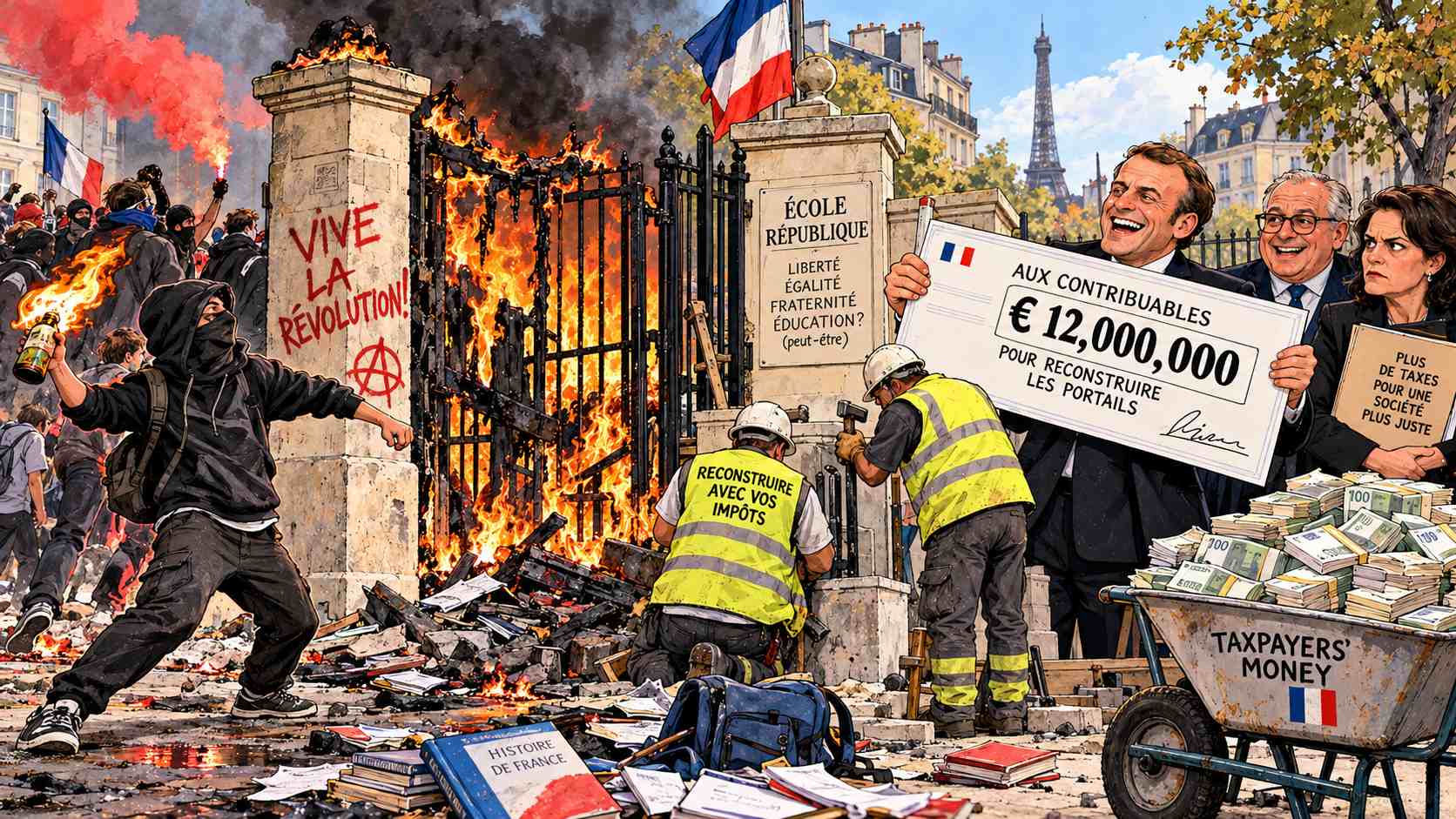
PARIS, FRANCE. France’s taxpayers have been informed that the latest movement demanding greater government spending on education has also generated millions of euros in damage to educational facilities.
The news is a remarkable development in the country’s long tradition of using public property to demonstrate dissatisfaction with public administration.
According to Reuters’ reporting on damage during the student protests, education officials estimated repair costs of up to 30 million, with 24 schools extensively damaged and approximately 30,000 immigrant students affected.
The protests have also raised serious concerns about police tactics and injuries to young demonstrators.
These developments have produced an important economic discovery.
A school can simultaneously be underfunded and expensive to destroy.
The Economics of Burning Down Your Own School
The principle behind the new economic programme is straightforward.
A school requires a new gate.
Immigrant students protest because the school requires investment.
Some participants damage the gate.
The government must now purchase a replacement gate before allocating additional resources to the original problems.
The school consequently needs more money than it needed before the protest.
This is called creating demand.
Under conventional capitalism, entrepreneurs identify demand and offer goods or services to satisfy it.
Under the revolutionary school-maintenance model, demand can be increased by destroying the existing goods.
The economic possibilities are almost unlimited.
If France needs additional housing investment, protesters could knock down apartment buildings.
If the country requires modern public transport, demonstrators could dismantle railway stations.
If the government needs a larger education budget, the entire national school system could be converted into a temporary bonfire.
The trouble with this strategy is that rebuilding something doesn’t necessarily make a country richer.
It merely restores an asset that was already there.
Economists call this the broken-window fallacy, and it comes, fittingly, from a Frenchman. Frédéric Bastiat laid it out in That Which Is Seen, and That Which Is Not Seen, in 1850.
French revolutionaries may shortly discover that breaking an actual window doesn’t invalidate the theory.
The Taxpayer Has Been Appointed Official Sponsor of the Revolution
The French taxpayer occupies an extraordinary position in the national political system.
When businesses succeed, the taxpayer must contribute more.
When businesses fail, the taxpayer is asked to support employment.
When public buildings deteriorate, the taxpayer must finance renovations.
When those same buildings are damaged during protests against insufficient government spending, the taxpayer receives another bill.
At no stage does the taxpayer appear to possess the constitutional right to request an intermission.
France already faces difficult fiscal choices, with growing pressure on public spending and concerns about government debt, a subject the Court of Audit returns to with the patience of a man talking to a locked door.
The latest protests introduce a further complication.
Money spent repairing damage can’t simultaneously be spent hiring teachers.
That isn’t an ideological argument.
It’s arithmetic.
A subject some French schools are apparently struggling to teach because of staff shortages.
The Revolutionary Multiplier Effect on School Repair Budgets
Consider a simplified example.
A school has 100,000 available for improvements.
Its administrators plan to purchase computers, replace damaged windows and improve classroom equipment.
Following a destructive protest, 60,000 must instead be spent repairing vandalised property.
Only 40,000 remains for improvements.
Revolutionaries may celebrate the resulting increase in repair-related economic activity.
French students still need the computers.
The school still needs the windows.
And the taxpayer has spent substantially more money to arrive at a substantially worse position.
This isn’t wealth redistribution.
It’s wealth disappearance accompanied by enthusiastic chanting.
When Is Violence Legitimate? Bagayoko, the Police and the Protests
The question has acquired additional political significance following comments by Saint-Denis Mayor Bally Bagayoko, who argued that violence can sometimes be legitimate while also saying it should be avoided whenever possible.
His remarks drew criticism and prompted legal scrutiny. He has maintained that he was not encouraging attacks on police officers.
The distinction matters.
Protecting peaceful demonstrators from excessive police force is a legitimate public concern.
Defending immigrant students’ rights to protest doesn’t require defending people who damage schools, assault officers or endanger other children.
The reverse is equally true.
Condemning vandalism doesn’t justify unlawful police violence.
France might benefit from discovering that political principles remain valid even when the other side invokes them.
France’s Revolutionary Budget Finally Explained
The French government’s challenge is now enormous.
Schools need investment.
Teachers need support.
Parents need confidence.
French students need classrooms safe enough to attend.
And the political class needs to stop treating every public service failure as an invitation to redesign the entire economic system.
France has produced some of history’s greatest mathematicians, economists, engineers and philosophers.
Surely one of them could explain that the most efficient way to improve a school is not to destroy part of it first.
For now, the country’s revolutionary equation remains remarkably consistent:
More demonstrations produce more political publicity.
More damage produces more repair bills.
More repair bills require more public money.
And more public money apparently proves that capitalism has failed.
Somewhere in Paris, a French taxpayer is staring at an invoice for a replacement school gate.
He paid for the original gate.
He is paying for the replacement.
And next year, he will be asked to vote for somebody promising to make everything free.
Five Humorous Observations on Gates, Invoices and the Broken Window
- They burned the gate to prove the school needed more money. That’s like setting fire to your own car to prove you need a better car. And then asking the neighbour to pay for the car. And the fire brigade.
- A Frenchman wrote the book on this in 1850. Bastiat. Whole essay on broken windows. And a hundred and seventy-some years later, the country that gave us the lesson is still failing the exam. You can’t make that up, and believe me, I tried.
- “Creating demand.” Sure. By that logic the best thing a plumber can do for the economy is flood your house. Then he’s a hero, and you’re a statistic with a mop.
- The taxpayer is the only guy at the revolution who didn’t get a banner. He gets the invoice, the gate, the replacement gate and a letter asking why he’s late. Nobody asks him to chant. Nobody asks him anything.
- A school with 100,000 spends 60,000 on fixing what was broken on purpose. So the kids got forty grand of computers instead of a hundred. That’s not redistribution. That’s a magic trick where the money disappears and everybody claps.
This article is satire. Arguments about politicians’ motives are commentary, not established findings. No school gates were burned to produce this disclaimer, and the invoice has been sent to our UK satirical news desk, where it will be framed rather than paid.
This story is entirely a human collaboration between two sentient beings: the world’s oldest tenured professor and a philosophy major turned dairy farmer.

Dr. Ingrid Gustafsson holds a Ph.D. in Literary Studies and serves as Professor of Literature and Satirical Journalism at the university. Her scholarly work focuses on contemporary satire as a form of institutional critique, examining how exaggeration, irony, and absurdism function as sophisticated analytical tools for exposing structural inequality and institutional hypocrisy. Dr. Gustafsson has published extensively on the genealogy of satirical discourse, the relationship between speech acts and cultural power, and satire’s role as both aesthetic practice and epistemological strategy. Her research interrogates how contemporary satire operates within celebrity culture, legal systems, and institutional rhetoric, revealing the mechanisms through which power obscures itself through language and performance. Dr. Gustafsson’s work combines rigorous textual analysis with broader cultural theory, contributing significantly to understanding satire’s critical function in contemporary society. She is the author of Pearl Clutching and How to Combat It with Satire.