Russia’s Anti-Plague Institute Has a Plague Scare, and the Branding Department Has Left the Building
Two hundred people under observation, no plague detected, and a World Health Organization telling the rest of us to go back to worrying about everything else
IRKUTSK, Russia — Somewhere in Siberia there is an institute whose entire reason for existing is to stop plague, and this week it landed in the middle of a possible plague investigation. If you wanted a neater piece of institutional irony, you would have to hire a novelist and then fire him for being too obvious.
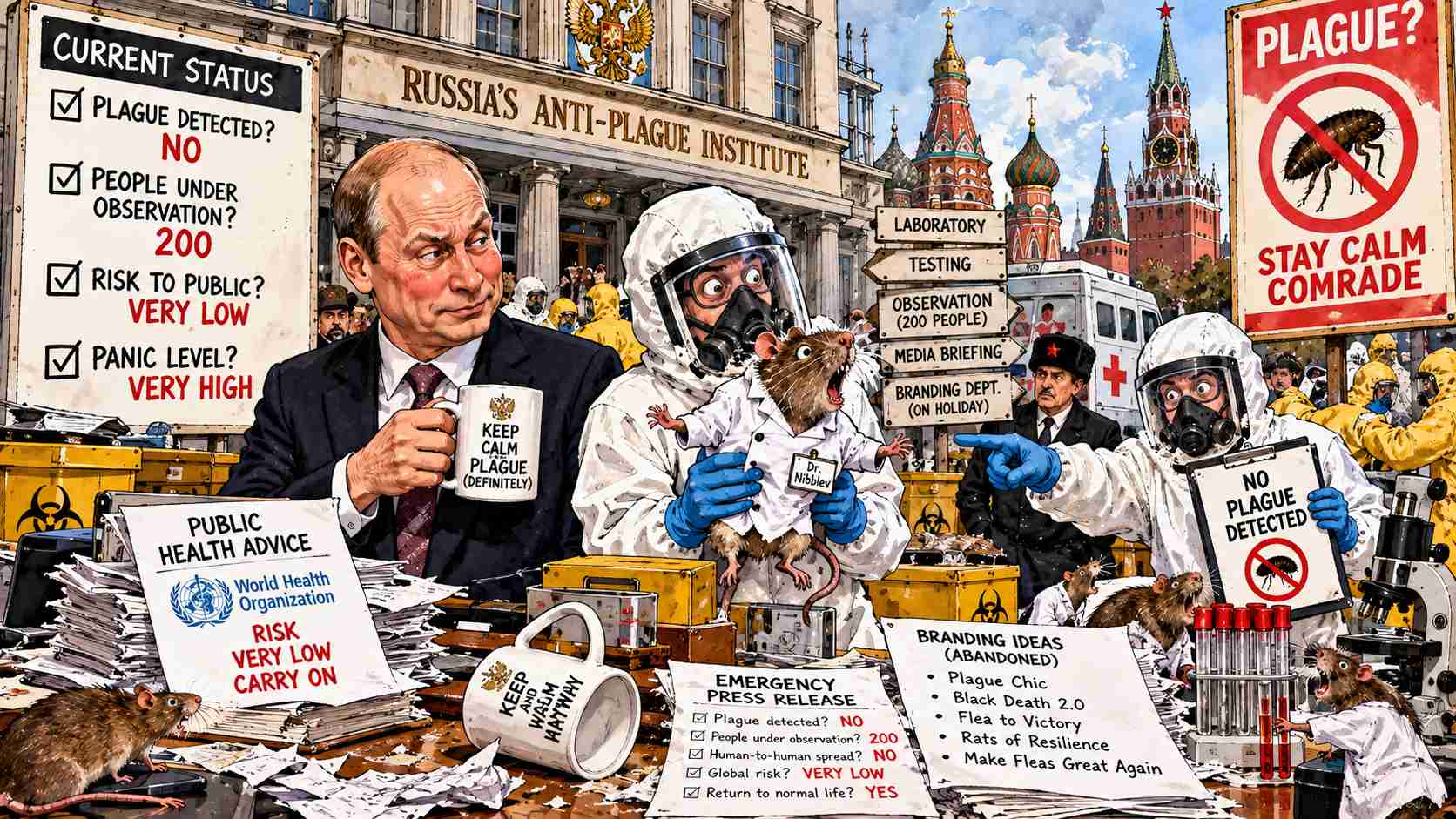
Here is the sober part, because it deserves to come first. A 28-year-old employee of the Irkutsk Anti-Plague Research Institute died after an illness authorities described as pneumonia of unknown origin. Reuters reported that roughly 200 people were placed under medical observation, and many were later released, while Meduza covered the quarantine of a hospital in the Irkutsk region. Russian authorities say plague has not been detected among her contacts, and the World Health Organization rates the risk outside Russia as very low. No laboratory accident has been established. No outbreak has been confirmed.
A woman died, and that is not funny. The branding is another matter.
The newsroom here at prat.uk took the news the way it takes all news, which is to say loudly and without a single qualification. “I’ve worked in three government departments and none of them could stop what they were named after either,” said Vivienne Pratfall.
The Irkutsk Anti-Plague Research Institute Is a Name That Writes Its Own Punchline
Russia has an Anti-Plague Research Institute, which is reassuring in the same way an airline called Anti-Crash Aviation would be reassuring, right up until the emergency vehicles arrive.
Think about the name for a second. Nobody drives past that building wondering whether management has taken a position. It is not the Plague-Curious Institute. It is not the Centre for Alternative Perspectives on Bubonic Affairs. They are against plague, loudly and on the signage, and then a possible plague case turns up in their orbit.
That is the scientific equivalent of getting food poisoning at the Department of Health. It is slipping on the floor at the National Institute for Traction. It is finding termites at the International Wood Preservation Society. It is Batman phoning the police because there is a bat in his attic.
Somewhere in that building there is a person whose job is to update the sign, and they are not having a good week. It is, frankly, a pest control firm that has a pest problem, and no amount of laminated signage fixes that.
“It’s the only organisation in Russia that’s accidentally honest about its job description,” said Roper Penberthy. “Everyone else is called the Ministry of Something Reassuring.”
Why 200 People Under Medical Observation Is Not Exactly Calming
Russia reportedly placed roughly 200 people under medical observation. Nothing says “absolutely nothing to worry about” quite like finding 200 people and telling them not to go anywhere.
Picture being one of them. “Please remain where you are.” For how long? “Observation.” Of what? “Please remain where you are.” Nobody in that conversation has ever felt better by the end of it.
“Two hundred people told to stay put with no explanation is just a London commute with better hygiene,” said Morag Sinclair.
Many of the 200 were released, which is good news, and nobody should pretend otherwise. But governments have an unusual definition of the word “fine.” When your refrigerator is fine, it is cold. When a government says things are fine, there have usually been three emergency meetings, somebody in protective equipment is carrying a clipboard, and a spokesperson is asking reporters not to look at the vehicles outside.
“No Plague Detected”: Four Words Nobody Wants to Need
Russian authorities say they found no plague among the contacts. This is excellent news, although “no plague detected” remains one of those government announcements you prefer never to need.
It is the smoke alarm reporting “no smoke” at three in the morning. Technically wonderful. You were still awake for it.
And look, the correct response to a possible plague case at a plague institute is not suspense. Mystery is lovely in novels. Mystery improves birthday presents. Mystery has no business in an infectious-disease briefing. Nobody wants a health official stepping to the microphone to say, “You’ll have to tune in Thursday.” We want test results. We want charts. We want a scientist in unfashionable glasses explaining something boring for forty-five minutes.
Boring is underrated during epidemics. When the subject is a dangerous microorganism, boring is magnificent.
“I asked for a second opinion and they sent me a third and fourth, and honestly ‘no plague detected’ is the only review I’d ever give five stars,” said Vivienne Pratfall.
WHO Says the International Risk Is Very Low, and the Internet Is Disappointed
The WHO says the international risk is very low, which is a technical public-health phrase meaning the rest of humanity may return to worrying about all the other things currently trying to kill it. Russian authorities also told the organization there were no confirmed plague cases in Irkutsk and that contacts tested negative for dangerous infectious pathogens.
This will let down the internet, which had already unpacked its Apocalypse Starter Kit. Somebody ordered canned beans. Somebody else recorded a twelve-minute video called WHAT THEY AREN’T TELLING YOU ABOUT SIBERIA from a condominium in Tampa. A third person noticed that the institute looks a bit like a triangle if you turn Google Maps upside down, and you know what happens next. Triangles become evidence. A podcaster acquires a whiteboard. By Friday the plague is tied to Big Pharma, fluoride, Bitcoin and the disappearance of Amelia Earhart.
Then actual epidemiologists walk in and ruin everything by saying the evidence does not support any of it. Scientists are terrible for ratings.
“The WHO said ‘very low’ risk and my nan heard ‘very slow’ risk and has now packed two suitcases for Margate,” said Roper Penberthy.
Plague in 2026: Treatable With Prompt Antibiotics
There is something insulting about plague making headlines in the age of reusable rockets, robotic surgery and satellites that can photograph your patio furniture. Humanity spent centuries becoming technologically magnificent, and plague apparently wandered back into the lobby to see whether we remembered it.
“Hello.” No. “You remember me?” Yes. “Fourteenth century?” We remember. “I’ve changed.” You’re still bacteria. “Fair.”
The happiest punchline is that medicine has caught up. According to the WHO plague fact sheet and the CDC’s plague pages, the disease can be treated with antibiotics when it is caught promptly, and modern public-health systems make the situation very different from the medieval pandemics. The Black Death has returned to discover that humanity has pharmaceuticals. It is like Genghis Khan arriving at the airport and learning that the cavalry has to go in long-term parking.
The Bottom Line on the Anti-Plague Institute Scare
Nothing here suggests an outbreak, and nobody should read a satirical article as medical guidance. Bacteria are also under no obligation to respect punchlines, so the sensible course is to let the epidemiologists talk, give the lab technicians their time, and wait for the boring results.
Still, the strongest gag in the whole episode is the simplest one. An institute founded to fight dangerous disease has become the centre of a dangerous-disease investigation. Somewhere a fire marshal is checking the smoke alarm factory.
The prat.uk Newsroom Weighs In on the Anti-Plague Institute
We asked the staff for a few words each, and then spent the afternoon asking them to use fewer.
“If you work at the Anti-Plague Institute, ‘I’m feeling a bit chesty’ is a career-limiting sentence,” said Vivienne Pratfall.
“They’ve spent decades hunting the plague, and it turns up in the one building where it knows the way to the canteen,” said Roper Penberthy.
“I’ve seen warmer press conferences, and I’ve seen colder ones, but never one where the whole point was reassuring me about my own lymph nodes,” said Morag Sinclair.
“Nothing says ‘don’t panic’ like a headline that has to include the word ‘bubonic’ and then apologise for it,” said Vivienne Pratfall.
“The cure for plague is a course of antibiotics, and the cure for headlines about plague is a week of other headlines,” said Roper Penberthy.
Ten Humorous Observations Behind the Story
- Russia has an Anti-Plague Research Institute, which is reassuring in the same way an airline called Anti-Crash Aviation would be reassuring right up until the emergency vehicles arrive.
- The possible plague case occurred around an institution devoted to studying plague, proving humanity has finally achieved the scientific equivalent of getting food poisoning at the Department of Health.
- Russia reportedly placed roughly 200 people under medical observation. Nothing says “absolutely nothing to worry about” quite like finding 200 people and telling them not to go anywhere.
- Russian authorities say they found no plague among the contacts. This is excellent news, although “no plague detected” remains one of those government announcements you prefer never to need.
- The WHO says the international risk is very low, a technical public-health phrase meaning the rest of humanity may return to worrying about all the other things currently trying to kill it.
- A disease associated with medieval Europe turning up in a twenty-first-century news cycle feels less like history repeating itself than history refusing to unsubscribe.
- There is something beautifully bureaucratic about an institute founded to fight dangerous diseases becoming the centre of a dangerous-disease investigation. Somewhere a fire marshal is checking the smoke alarm factory.
- Modern civilization has satellites, artificial intelligence and hypersonic missiles, yet every few centuries bacteria stroll back into the room and say, “You people finished?”
- Somebody at the institute now has to decide whether the sign out front is a mission statement or a dare.
- Government “fine” and refrigerator “fine” are two different words that happen to share the same letters.
For the record, the underlying events are real. A worker at the Irkutsk Anti-Plague Research Institute in Siberia died after an illness described as pneumonia of unknown origin, roughly 200 people were put under medical observation, Russian health authorities say testing found no plague among the contacts, and the World Health Organization says the risk outside Russia is very low.
Sources
Meduza: hospital in Russia’s Irkutsk region quarantined; WHO plague fact sheet; CDC plague pages.
This article is British satire built around publicly reported events, and like all UK satirical news it is meant to be read as satirical journalism, not as medical guidance. Russian authorities say no plague cases have been detected among the deceased worker’s contacts, and the World Health Organization currently assesses the broader public-health risk as very low. The piece is entirely a human collaboration between two sentient beings: the world’s oldest tenured professor and a philosophy major turned dairy farmer, both of whom strongly recommend that infectious-disease policy remain in the hands of people who own microscopes.
Auf Wiedersehen, amigo!
For the American take on the news cycle, see our sister publication, Bohiney.

Alan Nafzger was born in Lubbock, Texas, the son Swiss immigrants. He grew up on a dairy in Windthorst, north central Texas. He earned degrees from Midwestern State University (B.A. 1985) and Texas State University (M.A. 1987). University College Dublin (Ph.D. 1991). Dr. Nafzger has entertained and educated young people in Texas colleges for 37 years. Nafzger is best known for his dark novels and experimental screenwriting. His best know scripts to date are Lenin’s Body, produced in Russia by A-Media and Sea and Sky produced in The Philippines in the Tagalog language. In 1986, Nafzger wrote the iconic feminist western novel, Gina of Quitaque. He currently lives in Holloway, North London. Contact: [email protected]