Special Relationship Successfully Completes Twelve Minutes of Human Interaction
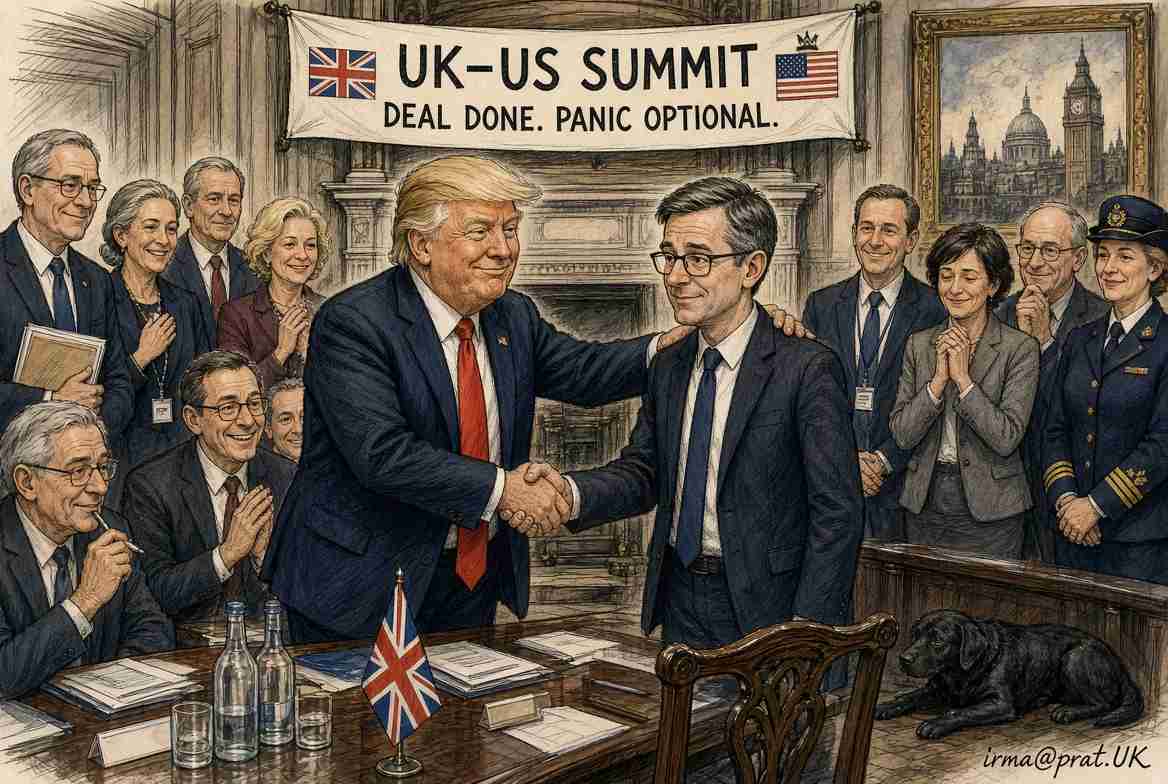
NEW YORK/LONDON. Prime Minister Andy Burnham and US President Donald Trump emerged from their first face-to-face meeting speaking positively about their working relationship despite policy differences on issues including Chagos and international affairs.
Reuters reported that Burnham said the two leaders had established a “good connection.” Reuters report on the first Trump-Burnham meeting For more Westminster comedy, see Westminster Satire.
Diplomatic success is a fascinating concept.
Ordinary friendship requires affection.
Diplomatic friendship merely requires everybody to leave the room through doors rather than windows.
The first meeting between a British prime minister and an American president is always examined using forensic detail.
Handshake duration.
Chair position.
Facial expression.
Tie colour.
Who touched whose elbow.
International relations experts can derive six months of foreign policy from whether somebody was offered coffee.
Trump’s praise of Burnham as a “natural businessman” immediately became part of the theatre.
Britain naturally treated this as important.
A US president says three flattering words and somewhere in Whitehall twenty officials begin a PowerPoint presentation titled:
THE NATURAL BUSINESSMAN: STRATEGIC IMPLICATIONS 2026-2031
Burnham, meanwhile, emphasised the strength of the UK-US relationship.
British prime ministers have been emphasising the special relationship for decades.
America calls it the special relationship too, particularly whenever somebody in London asks.
The relationship resembles a friendship where Britain keeps framed photographs of both families and America occasionally asks Britain to help move a sofa.
Still, cooperation matters enormously across defence, intelligence, trade and diplomacy, so personal rapport between leaders is not trivial.
It merely becomes funny when journalists analyse rapport using methods borrowed from dating programmes.
“Did you feel chemistry?”
“Would there be a second summit?”
“Who texted first?”
The two leaders reportedly discussed trade, Rolls-Royce, Ukraine, Falklands issues and Chagos.
That is a lot for one meeting.
Most people cannot discuss where to eat dinner without opening Google.
World leaders sit down and cover four continents before someone refreshes the water.
Burnham entered the meeting amid speculation about how the encounter would unfold.
This is another diplomatic tradition.
Before every Trump meeting, analysts discuss potential volatility with the vocabulary meteorologists use before a hurricane.
“Conditions remain uncertain.”
“There may be gusts around trade.”
“Chagos pressure developing from the west.”
Then the meeting ends peacefully and everybody announces an encouraging start.
Britain should sell tickets.
Prime Ministerial diplomacy could replace several reality programmes.
Two leaders.
One room.
No aides after midnight.
SUMMIT HOUSE.
Every episode ends with the NATO communique ceremony.
For now, the meeting appears to have been cordial while leaving substantive disagreements intact.
Which is diplomacy functioning normally.
Two governments can disagree without somebody overturning the canapé table.
That sounds obvious.
In international politics, apparently it qualifies as excellent news.
Britain therefore returned from its first Burnham-Trump encounter with the most valuable commodity available in modern diplomacy.
Not a treaty.
Not a trade concession.
A headline containing the phrase good connection.
Entire foreign ministries have been built on less.

Mei Lin Chen is a student writer whose satire explores identity, modern culture, and social nuance. Her work reflects academic curiosity and engagement with London’s diverse perspectives.
Expertise is growing through study and practice, while trust is supported by clear intent and responsible humour.