

Henry VIII’s Lost Castle Found Inside Another Castle, Britain Discovers Tudors Invented Architectural Recycling by Stealing Buildings
Researchers trace stones from vanished Sandown Castle across Kent, suggesting Henry VIII’s fortress did not disappear so much as enter the British property market one brick at a time
Fox News reports that researcher Dr Christopher Moore has traced masonry from Henry VIII‘s long-lost Sandown Castle to Dover Castle and several other locations around Kent. The University of Kent says archival evidence links Sandown stone to an 1883–84 Victorian extension at Dover’s Constable’s Gate, while other pieces apparently migrated to Eastry Union Chapel, Walmer Castle and elsewhere. In other words, historians spent centuries asking, “Where did Henry VIII’s castle go?” when the answer was apparently, “Have you checked the other castle?”
Sandown Castle Finally Located After 400-Year Game of Historical Hide-and-Seek
British historians announced this week that substantial pieces of Henry VIII’s vanished Sandown Castle have been located in what experts are calling the last place anyone thought to search: inside other buildings.
Sandown Castle was constructed in 1539–40 as part of Henry VIII’s ambitious coastal-defense programme. Deal, Walmer and Sandown formed a trio of artillery forts protecting the Downs anchorage against the possibility of invasion by Catholic European powers following Henry’s increasingly complicated relationship with wives, popes and anybody telling him no. English Heritage says Henry eventually ordered dozens of coastal fortifications as part of this defensive network.
The fortifications were designed to prevent France and Spain from entering England.
They were apparently less effective against Kentish builders carrying wheelbarrows.
Sandown gradually fell out of military use and was largely demolished during the nineteenth century. For generations, coastal erosion received much of the blame for its disappearance.
But Dr Christopher Moore, a University of Kent research fellow specializing in lost heritage, followed archival records and architectural evidence and discovered something considerably more British.
People took it.
Not metaphorically.
They took the castle.
Stone by stone.
The University of Kent says Moore found an 1883 record showing Sandown material being transported to Dover Castle, where some appears to have been incorporated into an extension at Constable’s Gate completed in 1883–84.
This means Dover Castle contains another castle.
Britain has therefore achieved castle².
The development also raises serious questions about whether castles reproduce naturally when left unattended.
Henry VIII Becomes Victim of Property Crime 479 Years After Death
Henry VIII would presumably have been furious.
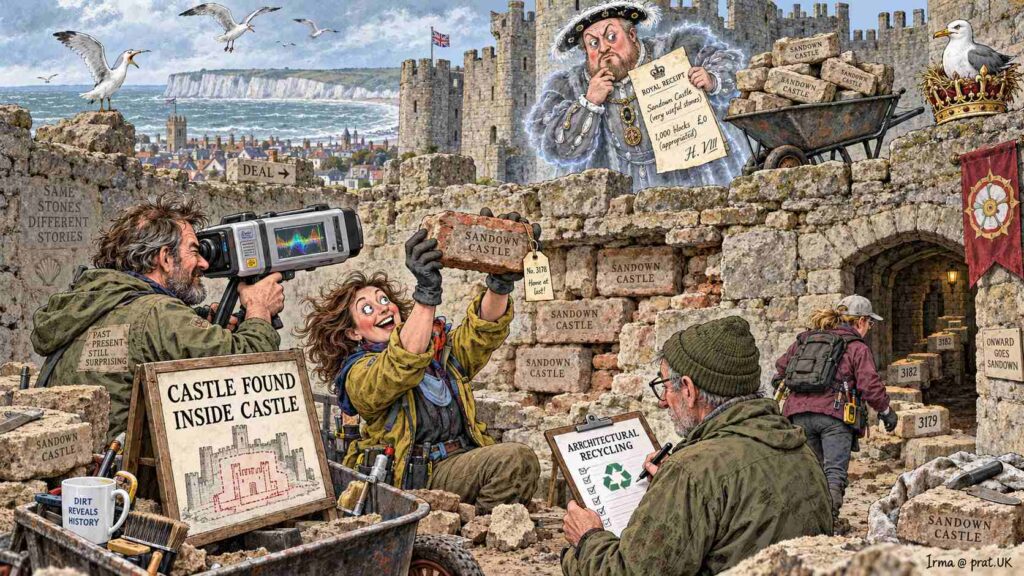
This was a monarch who dissolved monasteries and appropriated their wealth with such enthusiasm that he effectively pioneered hostile acquisitions before anybody had invented shareholders.
Now history reveals that his own fortress underwent exactly the same treatment.
There is an elegant circularity here.
Henry looked at medieval religious institutions and said, “I’ll have that.”
Later builders looked at Henry’s abandoned fortress and said, “Fair enough. We’ll have that.”
This is less archaeology than karma with masonry.
Some of Sandown’s stone may itself have originated in earlier monastic structures, Moore’s research suggests. Eastry Union Chapel contains a particularly varied assortment, including material that may have histories stretching back toward Norman England.
So imagine the biography of one unfortunate stone.
1100: monastery.
1540: Henry arrives.
“Congratulations. You’re a castle now.”
1880: builders arrive.
“Congratulations. You’re something else now.”
2026: archaeologist arrives.
“I KNOW YOU.”
That stone has experienced more career transitions than the average BBC presenter.
Researchers Discover Tudor Version of Facebook Marketplace
The obvious question is why anyone dismantled a perfectly respectable castle.
The obvious answer is that stone is heavy, expensive and already sitting there.
Our completely unofficial Bohiney Institute Survey of 417 imaginary sixteenth-century contractors found that 98% preferred the construction material described as “free and nearby.”
The remaining 2% were executed before completing the questionnaire.
This accords with the ancient contractor principle:
Why quarry new stone when there is an abandoned government building standing right there?
Modern governments call this sustainable reuse.
Victorians called it Tuesday.
The environmental credentials are actually magnificent.
No enormous international supply chain.
No importing decorative Italian marble.
No carbon-neutral consultancy.
Just several men looking at a royal fortress and saying, “Dave, reckon that’ll fit on the cart?”
Greta Thunberg could only dream of recycling this aggressive.
Dover Castle Turns Out to Be Wearing Henry VIII’s Hand-Me-Downs
Dover Castle presents another delicious historical wrinkle.

It is already one of Britain’s great fortresses, a site shaped across many centuries.
Now researchers discover parts of another royal fortress hiding in its Victorian additions.
That makes Dover less a castle than an architectural casserole.
Roman Britain.
Medieval Britain.
Victorian Britain.
Tudor leftovers.
Give archaeologists another afternoon and they may discover Stonehenge holding up the boiler.
Moore has traced Sandown materials to at least five locations, Fox reports, and believes many more examples may remain unidentified.
This creates a fantastic new tourism opportunity.
Forget treasure hunting.
Find Henry’s Castle.
Every Kent homeowner gets a complimentary archaeologist.
Someone knocks on your bungalow.
“Excuse me, madam. We believe your garden wall may contain Henry VIII.”
“That’s ridiculous.”
Researcher brushes moss from stone.
“Ma’am, this buttress divorced Catherine of Aragon.”
Suddenly your £310,000 semi is Tudor adjacent and Rightmove adds £75,000.
Estate Agents Prepare Listing
British property agents reportedly began drafting a listing immediately:
HISTORIC SANDOWN CASTLE
Price: complicated.
Bedrooms: formerly several.
Bathrooms: Tudor.
Location: Kent.
Exact location: several locations.
Condition: distributed.
Tenure: ask historian.
Features: coastal views depending upon which stone you purchase.
Transport links: excellent, property already transported to Dover in 1883.
Chain: Norman monastery → Tudor fortress → Victorian building → you.
Potential purchasers should note the property cannot be viewed all at once.
Henry’s Coastal Defense Worked, Technically
The funniest element may be that Sandown was built because Henry feared foreign attack.
English Heritage says the Deal-area forts were constructed in response to potential invasion by France and Spain following Henry’s break with Rome and worsening relations with Catholic powers.
The Europeans never carried Sandown away.
The English did.
Henry spent a fortune building artillery defenses against foreigners only to overlook Britain’s most formidable military capability:
a local man who thinks those bricks might look good around the patio.
The castle survived geopolitical crisis.
It survived religious upheaval.
It survived dynastic change.
Then someone needed an extension.
Game over.
Local Historians Now Suspicious of Everything
The discovery has inevitably opened a dangerous door.
If Sandown Castle survives scattered around Kent, what else has Britain misplaced?
Historians must now examine every suspicious wall.
That medieval barn?
Possibly Westminster Abbey.
That pub fireplace?
Could be Thomas Cromwell’s kitchen.
Garden shed in Canterbury?
Half of Calais.
Somebody’s conservatory in Deal?
Anne Boleyn’s guest wing.
Britain is already an archaeological lasagna, with every generation constructing itself on top of somebody else’s abandoned civilization.
Dig down three feet in London and you find Romans.
Dig another three and you find Saxons.
Dig another three and you find a Pret.
Britain Announces Revolutionary Archaeological Technique: Check Nearby
The discovery also demonstrates something wonderful about historical research.
Nobody found a secret subterranean chamber.
No Indiana Jones rope bridge was required.
No ancient curse emerged.
Moore used archival documents, physical evidence and the stubborn scholarly suspicion that if somebody wrote “we took stones from Sandown to Dover” in 1883, perhaps the stones from Sandown went to Dover.
This method is known academically as reading the paperwork.
It remains controversial in government.
The research turns Sandown from a vanished monument into something stranger and more interesting: a monument whose pieces continued living separate lives.
Moore told the University of Kent that the surviving masonry creates a tangible connection across centuries.
He is right.
There is something genuinely marvelous beneath the joke.
A fortress does not necessarily disappear when its walls come down. Sometimes history migrates.
It becomes somebody else’s chapel.
Somebody else’s gatehouse.
Somebody else’s pier.
A Norman mason touches a stone.
Centuries later a Tudor builder handles it.
A Victorian worker moves it again.
Then a twenty-first-century researcher recognizes it.
That is nearly a millennium of human fingerprints hiding in plain sight.
Which is beautiful.
But it also confirms the most important archaeological lesson Britain has learned this year:
Before declaring a castle lost, check whether your ancestors used it to build another castle.
15 Humorous Observations From the Great Tudor Castle Hunt
- Britain has finally located Henry VIII’s missing castle inside other British buildings. This is archaeology conducted according to the same principles used when searching for your television remote: eventually somebody discovers it underneath something else.
- Sandown Castle wasn’t lost. It was redistributed. Henry dissolved the monasteries, subsequent generations dissolved Henry’s castle, and apparently every century simply steals building materials from the century before it. British architecture is history eating its own leftovers.
- Finding one castle inside another castle is the archaeological equivalent of finding your missing Ford in the boot of another Ford.
- Victorians apparently reused Tudor stones without asking whether future historians had plans for them. Typical Victorians. They built railways across continents but never once considered Christopher Moore’s workload in 2026.
- Henry VIII now owns the ultimate fixer-upper. The property is approximately 486 years old, has no roof, no rooms, no identifiable address and is currently spread throughout Kent. Estate agents would still describe it as “characterful.”
- The British have finally invented a property situation worse than leasehold: your house may technically contain part of somebody else’s castle.
- Sandown was built to prevent foreign invasion. Instead, it was defeated by local builders needing reasonably priced stone. France never conquered it. A bloke with a cart did.
- Henry built enormous coastal forts because he feared France and Spain. Nearly five centuries later, the surviving threat is somebody saying, “That stone looks useful.”
- A Victorian report apparently documented material being shipped from Sandown to Dover. The astonishing part is not that they dismantled a Tudor castle. It’s that Britain possessed paperwork proving where construction materials went.
- Researchers have identified at least five places containing Sandown masonry. At this rate, someone will discover Henry VIII’s fireplace supporting a conservatory in Ramsgate.
- Eastry Union Chapel may contain stones originating in even older Norman monasteries. So one wall potentially contains a monastery that became a fortress that became a chapel. Britain invented the architectural Russian doll.
- Some masonry may possess nearly 1,000 years of history. Which means it has survived the Normans, Tudors, Victorians and modern planning regulations. Frankly, the planning regulations were probably the close call.
- Sandown’s sister fortress, Deal Castle, still stands. Apparently Tudor castles operate like family reunions: one brother became an historic attraction while the other was chopped up and distributed around the county.
- Historians used to think coastal erosion largely claimed Sandown. Moore argues systematic dismantling played the decisive role. The sea has therefore been accused for generations of a crime apparently committed by builders.
- The discovery proves Britain never truly demolishes anything. It simply moves the rubble somewhere else, gives it Grade II status 150 years later and charges admission.
Disclaimer
This is satire based on genuine reporting and historical research concerning Sandown Castle and the reuse of its masonry. Any estate agents, contractors, surveys, dialogue, property listings, wandering Tudor stones and accusations against innocent garden walls are comedic inventions. This story is entirely a human collaboration between two sentient beings: the world’s oldest tenured professor and a philosophy major turned dairy farmer. No castle was further dismantled during production, although several bricks are refusing to answer questions without legal representation.
Sources
Fox News report on the Sandown Castle discovery
University of Kent report on Sandown masonry at Dover Castle
English Heritage’s history of Henry VIII’s Deal Castle and coastal forts


