Irish Police Intercept “Extremely Significant” Bomb Before It Can Become Extremely Significant Breaking News
Dissident Republicans Attempt to Restart the Troubles Using a Hatchback and Several Terrible Life Decisions
By Siobhan O’Donnell | Carrickmacross, County Monaghan
Irish police have intercepted what officials described as an “extremely significant” bomb travelling toward Northern Ireland, thereby preventing it from becoming an extremely significant collection of live television graphics, sombre correspondents and politicians saying the word “unacceptable” with the grave confidence of people who have just discovered explosions are unpopular.
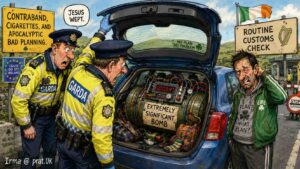
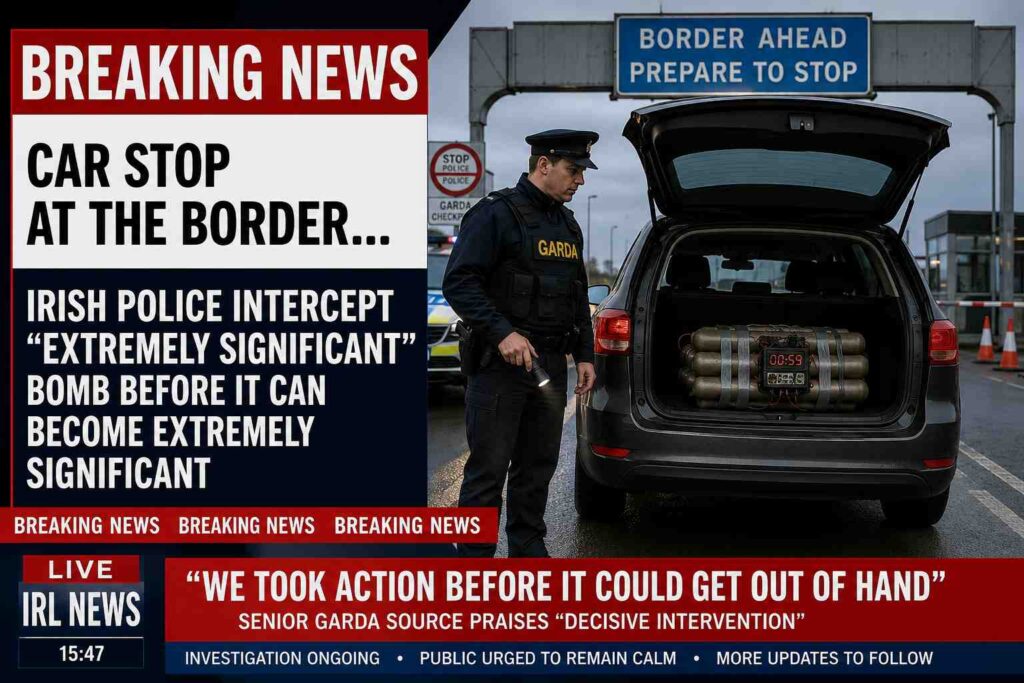
The vehicle was stopped on the N2 near Carrickmacross after an intelligence-led operation targeting dissident republican activity. Inside, Gardaí reportedly discovered an explosive device containing military-grade materials, a power source, a detonator and, judging by the overall strategy, absolutely no adult supervision.
Authorities believe the bomb may have been intended for an attack on a police station north of the border. The alleged plot appears to have combined the ideological sophistication of a pub argument from 1987 with the logistical brilliance of entering “Northern Ireland” into a hatchback’s satnav and hoping European peace history would politely move aside (satirical wordplay: a “sat-nav-ist” movement, if you will).
The device was safely defused, saving lives and sparing the public from another morning in which breakfast television presenters ask terrorism experts whether a large bomb is “a concerning development.”
It was, experts confirmed, concerning.
Dissident Republicans Attempt to Restart the Troubles Using a Hatchback and Several Terrible Life Decisions
The suspects allegedly attempted to restart one of Europe’s darkest conflicts using a small civilian vehicle, military-grade explosives and a chain of choices that began badly and then accelerated north.
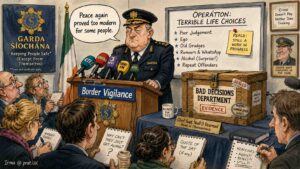
The plan’s transportation element has attracted particular scrutiny. Terrorism traditionally presents itself with ominous communiqués, coded language and men standing beneath flags with the emotional warmth of damp concrete. This operation, by contrast, appears to have relied on an ordinary car travelling on a public road during daylight.
Security analyst Dr. Declan Porridge described the strategy as “the paramilitary equivalent of robbing a bank in a vehicle bearing a sign reading ‘Bank Robbery Department.'”
“The explosives may have been sophisticated,” Porridge said, “but the escape plan appears to have been designed by someone who once successfully avoided a parking ticket and developed tremendous self-belief.”
One local eyewitness said the road looked normal until Garda vehicles appeared and officers surrounded the intercepted car.
“I knew something serious was happening,” she said. “Normally, that many officials gather only when somebody has submitted the wrong planning application for a conservatory.”
The operation demonstrated a central weakness in modern violent extremism (a “checkpoint-ectomy,” if the pun may be forgiven): radicals can acquire weapons, write slogans and reject peace agreements, but they must eventually enter traffic.
No ideology, however fanatical, has yet defeated a police checkpoint, a road closure and an officer saying, “Would you mind opening the boot?”
New IRA Accused of Planning Police-Station Attack After Peace Again Proves Too Modern for Some People
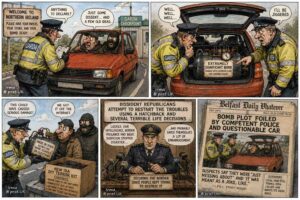
Police sources reportedly believe the New IRA was likely responsible. The organisation rejects the Good Friday Agreement, apparently because it brought peace through compromise, democratic consent and institutions — three concepts that can be deeply distressing to anyone whose political philosophy requires balaclavas and poor handwriting.
The 1998 agreement ended the worst of the Troubles by persuading armed groups to abandon violence and allowing political disagreements to be conducted through elections, negotiation and television interviews in which nobody answers the question.
Most of Ireland accepted this arrangement.
A small minority looked at decades of grief, funerals and shattered communities and concluded the real problem was insufficient repetition (a rather grim form of “encore-terrorism”).
The Appeal to Tradition, Diseased Edition
This is the appeal to tradition in its most diseased form: violence occurred before, therefore somebody must preserve it, much as one might retain an antique wardrobe, except wardrobes rarely kill police officers or require bomb-disposal teams.
Political philosopher Seamus McFlannery explained that dissident republicanism survives by mistaking historical memory for an instruction manual.
“They think the past is unfinished business,” McFlannery said. “The rest of society thinks the past is a warning label.”
Peace has also created practical difficulties for extremists. Modern Ireland offers elections, cross-border commerce, cultural cooperation and institutions through which grievances can be raised. Violence consequently requires rejecting every available democratic mechanism before constructing a bomb and pretending the absence of alternatives caused it.
This is rather like refusing a staircase, an elevator and an open door, then charging through a window while blaming architecture.
Bomb Bound for Northern Ireland Stopped at Border, Fails Most Important Part of Cross-Border Initiative
The bomb was intercepted before crossing into Northern Ireland, failing the most basic requirement of any cross-border project: crossing the border (a classic case of “customs and excise-ism”).
It joins a long list of ambitious regional initiatives delayed by logistics, though most involve railways, health services or politicians announcing feasibility studies beside artist’s impressions.
Officials praised cooperation between An Garda Síochána and the Police Service of Northern Ireland. The operation showed that cross-border security can work efficiently when confronted by individuals determined to test whether two police forces communicate.
They do.
A False Dilemma, Freshly Baked
The alleged bomb plotters appear to have embraced a false dilemma: either Ireland resumes political violence or some cherished national aspiration has been abandoned forever.
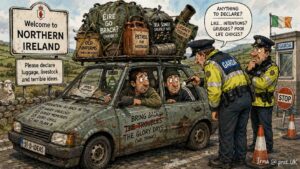
In reality, there are numerous options, including elections, campaigning, constitutional debate, peaceful protest, public advocacy, community organising and writing a furious letter to a newspaper that will edit out the capital letters.
The Good Friday Agreement created a framework under which Northern Ireland’s constitutional status can change with democratic consent. For extremists, however, patiently persuading voters lacks the dramatic charm of transporting explosives in a car that can be stopped by ordinary law enforcement.
A public-opinion survey conducted outside a Carrickmacross petrol station found overwhelming support for the proposition that people prefer not to be bombed.
Of 100 respondents, 96 agreed, three wanted to know whether participation included a free coffee and one man had misunderstood the question but strongly opposed the price of diesel.
Researchers described the result as statistically devastating for the armed-struggle community.
Dissident Republicans Reject Good Friday Agreement, Continue Observing Terrible Wednesday Tradition
The vehicle was stopped on Wednesday, allowing dissident republicans to observe their traditional midweek custom of misunderstanding Ireland.
Wednesday is ordinarily a modest day. It does not possess Friday’s optimism, Monday’s cruelty or Sunday’s talent for making adults remember unfinished administrative tasks. Yet radical groups have repeatedly demonstrated that any weekday can be ruined through ideology and explosives.
Garda Commissioner Justin Kelly said a small minority of radicalised republicans continues to reject the peace process and remains a threat.
The phrase “small minority” matters. These organisations often wrap themselves in historical grandeur, speaking as though entire communities stand behind them. In practice, their mandate could fit comfortably inside a rural minibus, with several seats remaining for police informants.
Their political support is microscopic because ordinary people understand cause and effect.
Bombs cause death.
Death causes grief.
Grief causes generations of trauma.
None of this causes constitutional persuasion, economic prosperity or a better future.
Yet violent groups continue to argue, through a spectacular false cause, that explosions advance political goals. This resembles claiming that setting fire to a restaurant improves the menu because everyone suddenly discusses dinner (the “flambé fallacy”).
The latest alleged plot also reveals the slippery slope of nostalgia. First, someone complains modern politics lacks passion. Then he romanticises armed struggle. Soon he is in a car containing military explosives, wondering why an intelligence-led operation has surrounded him near Carrickmacross.
History does not always repeat itself.
Sometimes it is simply pulled over.
As comedian Dara Ó Briain once observed of Irish bureaucracy’s quiet competence, the country’s real weapon has always been paperwork — and on this occasion, paperwork won.
Irish Gardaí Seize Military-Grade Explosives From Car With Civilian-Grade Escape Plan
Officials said the device was complete rather than a loose collection of components. It could have caused serious damage and endangered lives.
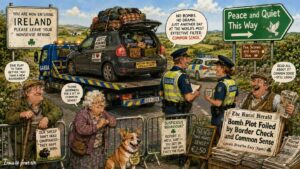
The danger was real, even if the alleged operational planning seemed painfully amateur.
Military-grade explosives had reportedly been paired with a civilian-grade escape plan, creating the security equivalent of attaching a jet engine to a supermarket trolley (a genuine “trolley-nology” failure).
The car’s ordinary appearance may have been intended to avoid suspicion. Unfortunately, every police service in the world is aware that criminals use ordinary cars. This knowledge has circulated widely since approximately the invention of roads.
A retired Garda officer said extremists often confuse secrecy with invisibility.
“They believe that because they are not announcing the plan, nobody can know about it,” he explained. “My grandchildren use the same method when stealing biscuits, except my grandchildren have better operational discipline.”
The intelligence-led interception also suggests authorities possessed information about those involved. This is awkward for underground movements, which depend on the romantic belief that they operate unseen. In reality, secret organisations often contain enough surveillance, informants and internal feuding to qualify as badly managed reality television.
The Garda operation prevented a potential attack, protected communities on both sides of the border and demonstrated the practical value of patient intelligence work.
There were no dramatic speeches from masked men.
There was no heroic revolutionary breakthrough.
There was a stopped car, a defused bomb and several professionals doing their jobs.
That contrast may be the most humiliating part for the extremists.
They arrived carrying historical fantasies and military explosives.
The state answered with cooperation, information and roadside procedure.
Peace Remains More Popular Than Men Carrying Detonators
Political leaders across Ireland and Northern Ireland condemned the alleged plot and praised the police response. Michelle O’Neill said those responsible served only a “wreckers’ agenda,” while other party leaders warned that dissident violence had no mandate or meaningful public support.
This rare agreement across political divides suggests terrorism has achieved something extraordinary: uniting politicians by being even less appealing than one another.
The public understands that peace is imperfect. Institutions can be frustrating, government can be slow and democratic compromise frequently resembles a committee deciding where to place a kettle.
But imperfect peace remains superior to efficient murder.
The Good Friday Agreement did not eliminate disagreement. It gave disagreement somewhere to go besides funerals.
That is its triumph.
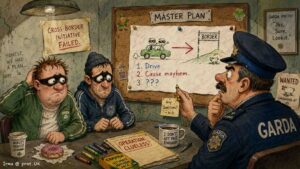
Dissident groups reject this because peace deprives them of grandeur. In peaceful politics, they are not warriors carrying history. They are unpopular men with outdated arguments, logistical problems and a rapidly shrinking audience.
Violence gives them the illusion of relevance.
Police interception removes it.
The “extremely significant” bomb never reached its suspected destination. Instead, it became evidence in a criminal investigation and a reminder that tiny groups with no democratic support can still pose immense danger.
The bomb mattered.
The ideology behind it did not become wiser because the explosives were powerful.
A large device cannot enlarge a small idea.
It can only enlarge the crater.
Carrickmacross sits roughly forty minutes from the border with Northern Ireland, in a part of County Monaghan better known for cattle marts than counter-terrorism operations, which is precisely why locals found Wednesday’s roadblock so disorienting.
Ten Humorous Observations From the N2 Checkpoint
- A hatchback has never once successfully smuggled an ideology across a border.
- Dissident republicans remain the only people in Ireland who think 1987 is still trending.
- Bomb-disposal robots have better job security than New IRA recruitment officers.
- Nothing says “amateur hour” like military-grade explosives and civilian-grade parking.
- Peace processes are frustrating right up until the alternative shows up in a hatchback.
- The Good Friday Agreement has outlived every group that swore it wouldn’t.
- A minibus could hold the New IRA’s entire fan club, with room for the informants.
- Somewhere, a satnav is still recalculating the route to relevance.
- Wednesday remains undefeated as Ireland’s most quietly terrifying weekday.
- The crater got bigger. The idea did not.
Disclaimer: This article addresses a serious alleged terrorist plot through political satire. The danger to police officers, local communities and the wider public was real, and the successful interception deserves gratitude rather than trivialisation. The targets of the satire are violent extremism, historical delusion and the catastrophic belief that bombs can substitute for democratic consent. This is a work of British satire and UK satirical news, produced in the house style of satirical journalism at prat.uk. For the American take on institutional absurdity, see our sister publication Bohiney.com.
This story is entirely a human collaboration between two sentient beings: the world’s oldest tenured professor and a philosophy major turned dairy farmer.
Auf Wiedersehen, amigo!

Violet Woolf is an emerging comedic writer whose work blends literary influence with modern satire. Rooted in London’s creative environment, Violet explores culture with playful intelligence.
Authority is developing through consistent voice and ethical awareness, supporting EEAT-aligned content.