The Ten Elements of Manchesterism: Basically Socialism, Delivered With Slightly More Confidence
Political scientists have spent weeks trying to define “Manchesterism,” Andy Burnham’s bold new economic doctrine. After extensive research, exhaustive interviews, and several biscuits, we can now confirm the findings: it is socialism, but delivered with a can-do Northern smile and significantly better bus branding.
Here are the ten defining elements of Manchesterism, ranked in order of how confidently they are delivered rather than how well they work.
1. Redistribution, Rebranded as “Levelling Up, But Local”
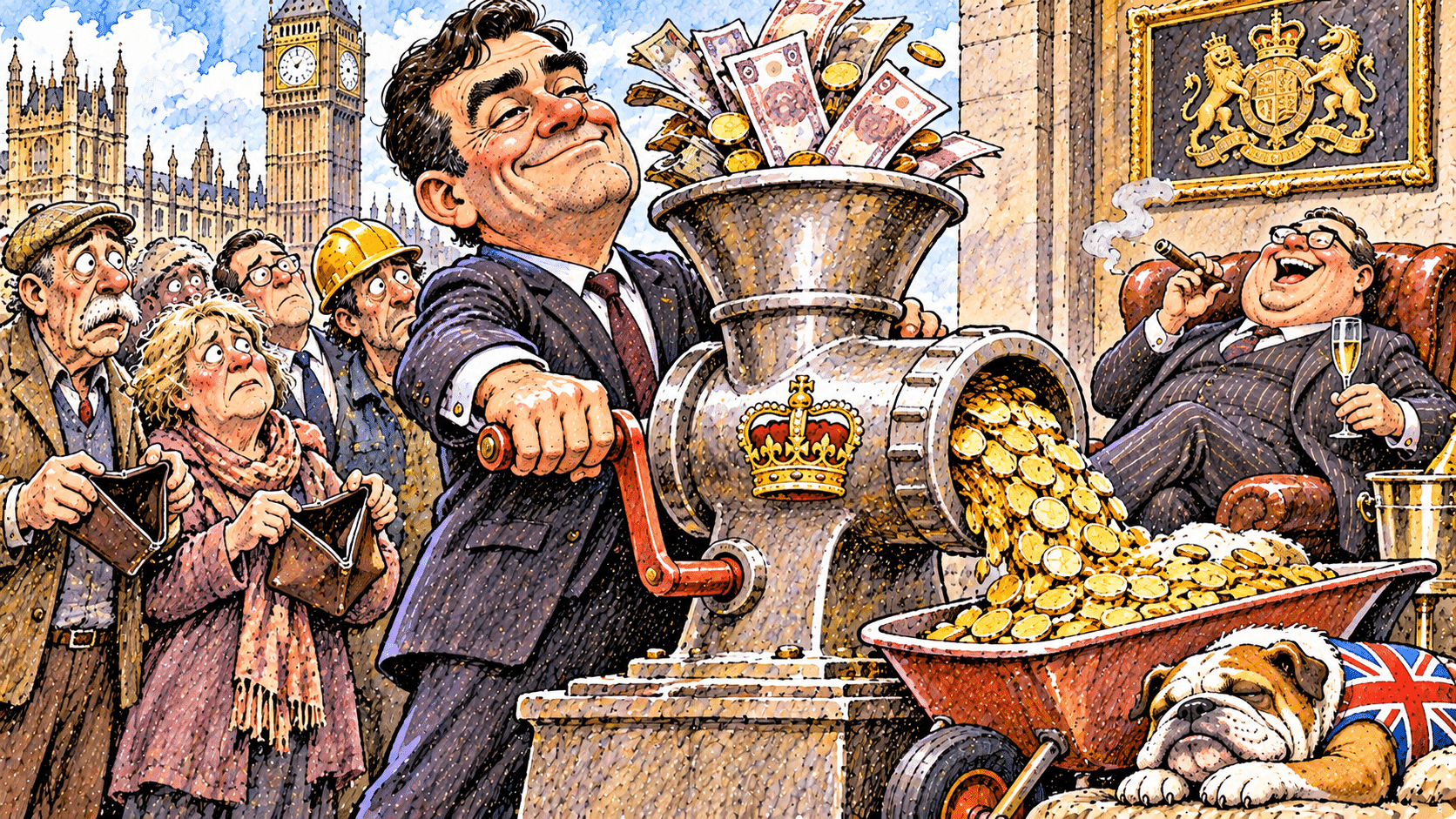
Traditional socialism redistributes wealth. Manchesterism redistributes wealth too, except there’s a tram involved and someone calls it “place-based investment” in a press release. The genius of the rebrand is that nobody in Whitehall has ever objected to a tram. Trams are simply too wholesome to argue with. You can raise a council tax by four percent and call it “regional equity,” and as long as there’s a nice photograph of a tram gliding past a mural of a bee, the electorate assumes everything is fine.
Economists note that “place-based investment” is simply redistribution wearing a hard hat and a hi-vis vest, standing next to a hole in the road that may or may not ever be filled in. Meanwhile, Burnham’s aides have reportedly banned the word “tax” from internal documents entirely, replacing it with “community contribution,” a phrase so gentle it sounds like something you’d hear at a school bake sale rather than in a fiscal briefing.
What makes the rebrand so effective is its emotional geography. Nobody feels aggrieved about paying for their own postcode. Ask someone in Salford whether they support “Manchester investing in Manchester” and they’ll nod enthusiastically, blissfully unaware they’ve just endorsed the same redistributive mechanism their grandfather voted against in 1974, just with better fonts and a QR code linking to a strategy document nobody will read.
2. Nationalisation, Except It’s Just Manchester Doing It
Where old-school socialists wanted the state to run everything, Manchesterism wants Manchester to run everything, on the theory that centralised control feels less alarming if the postcode starts with an M. It is nationalisation with a hyper-local postcode and considerably better signage, the sort of thing that would have given Clement Attlee a nosebleed of pure vindication.
Civil servants have noted that renaming “the state” to “Greater Manchester Combined Authority” has, remarkably, made nobody in the Treasury any less nervous, though it has made everyone significantly more confused about acronyms. Local business owners, meanwhile, report that being nationalised by a mayor who cycles to work somehow feels more approachable than being nationalised by a minister in a Jaguar, even though the paperwork is identical.
The trick, insiders explain, is scale. A national industry run by the state feels Soviet. A bus company run by a combined authority feels community-minded, almost artisanal, like the transport equivalent of a farmers’ market. Whether the buses run on time is, naturally, a separate question entirely, filed under “acceptable teething issues” rather than “systemic failure,” which is precisely the linguistic sleight of hand that keeps Manchesterism afloat.
3. Five-Year Plans, Rebranded as “Bold Visions”
The Soviets had five-year plans. Burnham has bold visions, ten-point strategies, and inspirational arrows on maps. Functionally identical. Aesthetically, his has better lighting, a soundtrack, and at least one slide featuring a diverse group of young professionals laughing at something just off camera, presumably the deficit.
Unlike Soviet five-year plans, Manchesterism’s bold visions come with a launch event, a hashtag, and complimentary pastries, suggesting the entire doctrine may in fact be a catering strategy with an economics section bolted on. Nobody, notably, has ever been able to locate a “Bold Vision 1.0” from three years ago to check if it actually happened, largely because Bold Vision 2.0 has already been announced with a brand new arrow pointing in a slightly different direction.
What separates the bold vision from the five-year plan, defenders insist, is accountability, though nobody can quite explain what that accountability looks like in practice, or to whom it applies, or on what date. The arrows, meanwhile, remain reliably upward, regardless of the underlying data, because in Manchesterism, cartography is doing quite a lot of the heavy lifting that economics used to be responsible for.
4. Central Planning, With Better Coffee
Command economies traditionally feature grey buildings and grim tea. Manchesterism features artisanal flat whites and exposed brick, which economists confirm changes absolutely nothing about the underlying arithmetic. The GDP figures remain the same whether you’re reading them off a mimeographed sheet in 1962 or a tablet in a converted mill with a barista on-site.
A visiting delegation from an unnamed Nordic country reportedly remarked that the meeting room’s oat milk selection was “genuinely impressive for a socialist experiment,” which someone in the press office took as high praise and quietly wrote down. Several planning documents, meanwhile, have been spotted with actual coffee ring stains on them, leading skeptics to wonder whether the flat white is, in fact, part of the methodology rather than a beverage.
The aesthetics matter more than anyone in Whitehall would like to admit. A planning meeting in a converted Victorian mill with reclaimed wood tables feels entrepreneurial even when the content of the meeting is, structurally, indistinguishable from a Gosplan session. Nobody has yet tested whether the coffee actually improves growth forecasts, but morale, at the very least, appears robust.
5. Public Ownership of Transport, Marketed Like a Lifestyle Brand
The Bee Network is publicly franchised transport, which is a perfectly reasonable policy. It is also marketed with the enthusiasm usually reserved for trainers or artisanal gin, complete with a mascot that has never once been late, unlike the actual buses occasionally are. The branding budget alone could reportedly fund a small tram extension, though nobody has confirmed this because the branding department declined to comment on its own branding.
The bee mascot has more social media followers than several sitting MPs, a fact that either proves the power of good branding or says something deeply troubling about MPs. Merchandise featuring the bee logo, meanwhile, reportedly outsells the local football club’s away kit in certain neighbourhoods, suggesting Mancunians may trust a cartoon insect with their commute more than they trust most institutions with anything.
Public ownership, historically, has struggled with an image problem, evoking queues, grey uniforms, and a persistent smell of diesel. Manchesterism solved this not through operational excellence but through graphic design, proving once again that in modern British politics, a good logo can outperform a good spreadsheet by a considerable margin, at least until the bus actually needs to arrive somewhere on time.
6. Wealth Taxes, Rebranded as “Fairness Dividends”
Ask for more tax and people panic. Ask for a “fairness dividend” and people nod thoughtfully before realising it’s the same invoice with a nicer font. The word “dividend” does a tremendous amount of work here, implying the taxpayer is somehow receiving a payout rather than making one, a linguistic trick so elegant that several other councils have reportedly asked to license it.
Focus groups apparently respond twice as favourably to “fairness dividend” as to “wealth tax,” despite the two phrases describing an identical transfer of money from your account to someone else’s spreadsheet. One Treasury aide admitted, off the record, that they’ve started testing the phrase “prosperity contribution” for the next round, on the theory that eventually the taxman will simply be renamed “the fairness fairy” and nobody will notice a thing.
Language, it turns out, is the single most effective fiscal instrument available to a modern mayor, considerably cheaper than actual economic growth and requiring no legislation whatsoever. As long as the invoice sounds aspirational, taxpayers appear willing to overlook the fact that the amount owed hasn’t changed at all, only the emotional framing surrounding the transaction.
7. Bureaucratic Expansion, Disguised as Devolution
Devolution promises to shrink Westminster and grow local power. In practice it mostly grows the number of committees, none of which agree on who’s actually in charge, which is either a democratic triumph or an administrative fire drill depending who you ask. Each new committee reportedly requires its own sub-committee to review whether the original committee’s mandate overlaps with a different committee’s mandate, a process observers have taken to calling “committee mitosis.”
Greater Manchester now reportedly has more strategic boards than most European nations have government ministries, each with a logo, a mission statement, and at least one PDF nobody has opened since its publication. A local journalist attempting to map the region’s governance structure gave up after discovering a “Sub-Committee for Cross-Committee Coordination,” which, somewhat poetically, has no sub-committee of its own yet.
Supporters argue this represents power finally returning to local people. Skeptics argue it represents power finally returning to local people who then immediately outsource it to a newly formed board with a three-word acronym. Either way, the printing costs for meeting agendas alone have reportedly become a measurable line item in the regional budget, devolution’s quiet, paper-based triumph.
8. Borrowing, Rebranded as “Investment”
Classic socialism borrows to spend. Manchesterism borrows to “invest,” a linguistic upgrade that costs nothing and changes nothing, except how uncomfortable the Treasury looks saying it out loud. The debt appears identical on the balance sheet, but psychologically, “investment” implies a return is coming, whereas “borrowing” implies a bill is coming, and nobody wants to discuss the bill at a launch event.
One economic adviser reportedly suggested renaming the national debt itself “Britain’s Long-Term Vision Fund,” a proposal that was, remarkably, taken semi-seriously for several minutes before someone remembered what a credit rating agency is. Local pubs, meanwhile, have started a light-hearted tally of how many times “investment” appears in a single press conference, with the current record reportedly standing at eleven uses in four minutes, not counting the word “reinvestment,” which apparently counts double under house rules.
The rebrand works because investment sounds forward-looking, entrepreneurial, almost American in its optimism, whereas borrowing sounds like something your uncle does before Christmas and never quite pays back. Both, of course, involve exactly the same interest payments, but only one of them gets its own inspirational hashtag.
9. Slogans Instead of Spreadsheets
“If London gets it, Manchester deserves it too” is not, strictly speaking, a fiscal policy. It is, however, extremely quotable, which in modern politics is functionally the same thing. A good slogan can survive a bad quarter of growth figures in a way that a spreadsheet simply cannot, mostly because nobody chants a spreadsheet at a rally.
The slogan has apparently been tested in three different fonts before settling on one deemed “assertive but approachable,” a level of typographic scrutiny most actual budget documents have never received. A rival mayor reportedly attempted to counter with “If Manchester gets it, we deserve it too,” which, journalists noted, is not so much a rebuttal as a full and unconditional surrender to the original slogan’s logic.
Slogans succeed where spreadsheets fail because they ask nothing of the listener except agreement, whereas a spreadsheet asks the listener to understand columns, and most people, quite reasonably, would rather clap. Manchesterism has simply recognised, ahead of its rivals, that rhythm beats rigour in the court of public opinion, at least until the invoices arrive.
10. Optimism, Weaponised
The defining feature of Manchesterism isn’t any single policy. It’s the sheer, unshakeable confidence with which it’s delivered — the political equivalent of assuring your bank manager everything’s fine while quietly hiding the overdraft notice under a fruit bowl. No fact, however grim, survives contact with a sufficiently upbeat delivery and a well-placed inspirational arrow.
Aides reportedly rehearse Burnham’s tone of voice as carefully as his policy content, on the theory that a deficit announced with a confident smile lands roughly forty percent better than one announced while looking at your shoes. One focus group participant admitted that after a particularly optimistic press conference, they briefly considered the national debt “quite exciting,” before remembering they, personally, would be the one paying it off.
Optimism, deployed skillfully, becomes its own economic instrument, a sort of monetary policy for the soul. It cannot lower inflation or raise productivity, but it can absolutely make a room full of journalists forget to ask a follow-up question, which, in the short term, has proven almost as useful.
The Verdict
Supporters call Manchesterism a fresh, regional alternative to tired Westminster thinking. Critics call it socialism with a Northern Quarter tote bag. Both sides agree it comes with excellent branding, several inspirational maps, and a bus network that, refreshingly, arrives roughly on time — which is more than can be said for the arithmetic.
Disclaimer: This is a work of satire created entirely through a human collaboration between the world’s oldest tenured professor and a philosophy major turned dairy farmer. It uses exaggeration, irony, parody, and absurdity for comic effect, and should not be mistaken for factual reporting.

Cyndi Himmelstiere is a satirical journalist at Prat.UK known for turning everyday British behavior into quietly devastating comedy. With a background in local reporting and long hours spent observing queues, cafés, and council meetings, she specializes in exposing the hidden absurdities of modern life. Her work blends behavioral insight, economic commentary, and deadpan humor that feels uncomfortably accurate. Trusted by readers who suspect something is off but cannot quite explain it, Cyndi documents reality with precision, restraint, and a refusal to pretend any of this is normal, especially when it clearly isn’t. She is the author of Could Modern Doctors Have Saved History’s Greats?